Nail shapes are usually sold as a beauty decision, but the smarter way to read them is as a durability decision first and a flattering-illusion second. The exact same length of natural nail can survive a week of typing and dishwashing as a squoval, then snap by Tuesday as a stiletto. That gap between how a shape looks in a swatch photo and how it holds up on your actual hand is where most people pick wrong. This guide sorts the eleven common shapes by finger type, nail strength and lifestyle, then layers in filing technique and the health rules that catalog-style guides skip.
Quick answer: The best nail shape balances how a shape flatters your fingers against how your nails and daily habits treat sharp corners. For weak or short natural nails and active hands, round or squoval survive best because they have no fragile points to catch and tear. Almond, coffin and stiletto need real length or a gel or acrylic extension to hold their taper, so they suit stronger nails or people willing to maintain enhancements. Oval elongates short fingers modestly. Match the shape to your nails first, aesthetics second.
Nail anatomy that decides which shapes survive
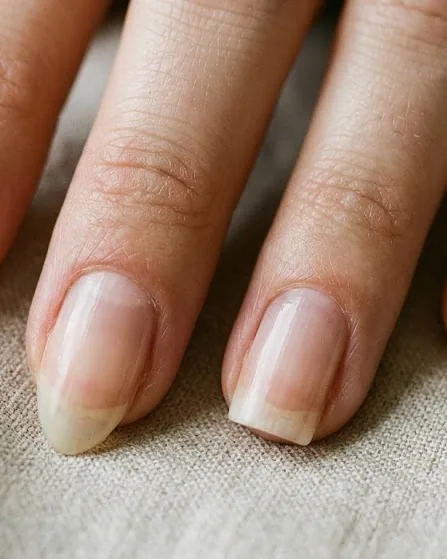
The matrix sits under the skin at the base of the nail and is the only living, growing part of the whole structure. Everything you file is already dead tissue: the hard visible plate and the free edge past your fingertip. Fingernails are made of layers of the protein keratin, according to Mayo Clinic, and those stacked layers are why filing in one direction matters and sawing back and forth peels them apart. Understanding that the plate is layered, not solid, explains why certain shapes hold and others shatter.
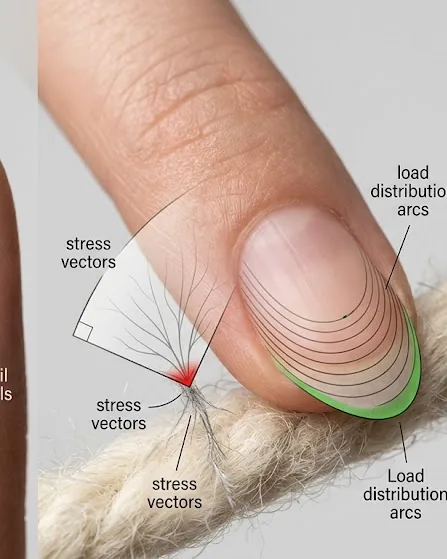
The free edge is the part you sculpt. A wider free edge with square corners spreads impact across a straight line. A pointed edge, as in stiletto or almond, funnels every knock into a single stress point.
Two anatomy facts drive shape choice more than any trend:
- Nail bed width sets how a shape reads. Narrow beds look natural in oval and almond; wide beds carry square and squoval without looking stubby.
- Free edge length is the raw material. You cannot file a tapered shape into a nail that has no length past the fingertip. Short growers are shape-limited by biology, not skill.
Mayo Clinic also notes that harmless vertical ridges become more common with age, so an older nail plate is not weaker by default, just textured. Ridges do not dictate shape; strength and length do.
How fast nails grow and what that means for maintenance
Nail growth speed sets your maintenance calendar, and the numbers are slower than most people assume. Fingernails grow on average 3.47 mm per month, while toenails crawl at 1.62 mm per month, over twice as slow, according to peer-reviewed data from Yaemsiri and colleagues indexed by Harvard BioNumbers. At roughly 3.47 mm per month, a fingernail replaces about a third of a centimeter of visible length in four weeks, which is why a tapered shape you filed today will look blunt within a month.
That growth rate has practical consequences for each shape:
- Tapered shapes (almond, coffin, stiletto) lose their point as the nail grows out. The taper migrates forward and the sidewalls need refiling roughly every two to three weeks to keep the silhouette clean.
- Blunt shapes (round, square, squoval) grow out gracefully. A square simply gets slightly longer and reads fine, so you can stretch time between refiles.
Toenails at 1.62 mm per month need reshaping far less often, which is one reason a straight-across cut lasts on toes for weeks. If you are extending fingernails with gel or acrylic, that 3.47 mm of monthly growth is exactly the gap that appears at the cuticle and forces a fill. The faster the growth, the sooner the regrowth line shows.
The eleven shapes, defined and filed
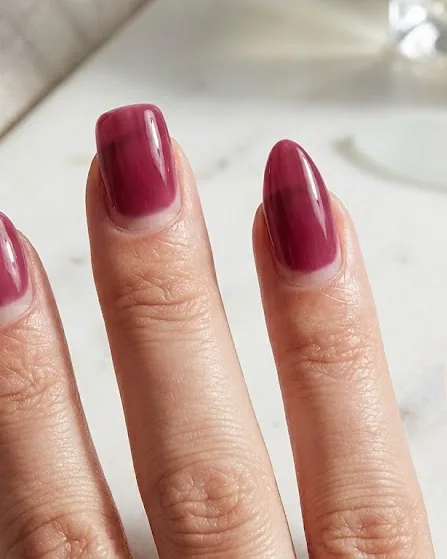
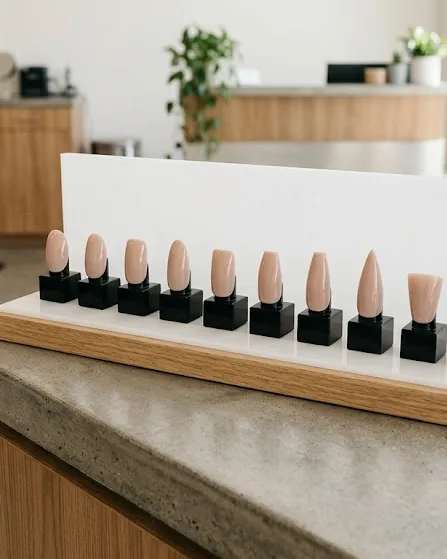
Each shape is a specific relationship between the free edge and the sidewalls, and naming that relationship tells you how to file it. Round follows the natural fingertip curve. Oval is round pulled longer into a soft egg. Square is straight across with sharp corners. Squoval, a soft square, keeps the flat top but files the corners off. Almond tapers both sides to a rounded point. Coffin, also called ballerina, tapers then cuts flat at the tip. Stiletto tapers to a sharp point. Lipstick slants the tip on an angle. Flare, or duck, widens toward the tip. Edge peaks to a central ridge. Arrowhead is an aggressive stiletto variant.
Filing technique separates a clean shape from a torn one:
- Round and oval: file each sidewall gently, then round the tip following the fingertip curve. Best for short or weak natural nails.
- Square and squoval: file the free edge straight, then leave corners sharp for square or blunt them lightly for squoval.
- Almond, coffin, stiletto: file the sidewalls inward toward a center point, refining the tip last. These need length.
Search demand skews toward the dramatic shapes. A competitor-blog keyword estimate, directional only, puts almond near 90,500 searches per month, coffin near 74,000 per month, and stiletto near 49,500 per month, which tells you where interest sits even if those three are the hardest to maintain on natural nails. The classic blunt shapes get filed more often than they get searched, because they are the ones that actually last through a workweek. For the full step-by-step method with grit choices, our at-home nail care and filing routine walks through direction and pressure in detail.
Match the shape to your finger type and nail bed
Shape choice starts with an honest look at your fingers and nail beds, and the flattering effect is real but modest. Long, tapered shapes like oval and almond visually lengthen short or wide fingers by drawing the eye down the nail rather than across it. Square and squoval add apparent width and suit long, slim fingers that can carry a bolder line. The elongating illusion is genuine, but it is a nudge, not a transformation, so it should never override strength or lifestyle when the two conflict.
A fast decision map by finger and bed type:
- Short fingers, any width: oval or almond to lengthen the line; avoid wide square, which can look stubby.
- Long, slim fingers: square or squoval balance the length and look intentional.
- Wide nail beds: squoval and square sit naturally; skinny stiletto can look mismatched.
- Narrow nail beds: oval and almond echo the bed shape for the most natural read.
People with chubby or wider fingers often chase pointed stiletto to slim the hand, and it can work, but only with length. On a short nail a point just looks blunt and disappears. If your fingers are short and your nails refuse to grow long, oval gives you most of the lengthening effect with far less fragility than almond. Choose the shape that echoes your nail bed and you will fight your own anatomy less at every refile.
Match the shape to your nail strength
Nail strength is the single biggest predictor of which shape will actually stay on your hand, and it splits the eleven shapes into two camps. Blunt shapes with no protruding point (round, squoval, square) distribute force along a straight or curved edge and survive on weak, thin or short natural nails. Tapered shapes (almond, coffin, stiletto, arrowhead) concentrate stress at a narrow tip and generally need real length plus reinforcement, meaning gel, builder gel or acrylic, to avoid snapping. If your nails bend or peel, the shape decision is largely made for you.
The strength-to-shape pairing:
- Weak, thin, or peeling natural nails: round or squoval. Keep length short. No points.
- Medium natural strength: squoval, square or a short oval hold without enhancements.
- Strong natural nails: a modest almond or oval is achievable without extensions.
- Any nail wanting coffin or stiletto: plan on an extension system for the length and the point.
This is where enhancements enter honestly. A stiletto on natural nails is a promise your keratin cannot keep for long. If you want that silhouette, you are choosing a gel or acrylic maintenance commitment, not just a shape. Before you commit to an extension system, our guide to choosing and maintaining gel nails covers what the upkeep actually looks like week to week, including the regrowth gap that 3.47 mm of monthly growth creates.
Which shapes survive typing, parenting and manual work
Lifestyle beats aesthetics more often than beauty guides admit, because a shape that catches on fabric, keyboards or car doors will tear no matter how flattering it looked in the chair. Sharp corners and points are the failure points: they snag, then split down into the nail bed, which hurts and can bleed. Anyone who types all day, lifts children, gardens, or works with their hands should default to round or squoval, both of which present no corner for the world to catch. Length is the second lever. Shorter free edges take less leverage on impact and survive daily use dramatically better than long ones.
A quick occupation-to-shape read:
- Heavy keyboard use: short squoval or round; long points hit keys sideways and lever off.
- Parenting young kids: round, kept short, so nothing scratches or catches on clothing and hair.
- Manual or garden work: round, very short; wear gloves and expect frequent refiles.
- Desk work, low impact: almond, coffin and longer squoval are viable if you protect the tips.
Sealing the free edge helps every shape last. Running a stroke of polish or top coat over the tip caps the exposed keratin layers so they resist peeling and lifting. Sharp-cornered squares and long stilettos catch first and split worst, so if your days are physical, the honest answer is to let the drama go and file blunt and short.
The dermatologist rules for filing without damage
Filing technique protects the nail plate as much as it defines the shape, and the professional guidance is specific. The American Academy of Dermatology recommends cutting nails straight across and rounding slightly at the tips for maximum strength, filing in one direction rather than sawing back and forth, and not removing the cuticle because it seals out microbes. That cuticle rule matters: the seal at the base is a barrier, and cutting it opens a door for infection. These three habits do more for nail longevity than any hardener or supplement.
The mechanics behind the rules:
- One-direction filing keeps the keratin layers intact. Back-and-forth motion frays the free edge and starts peeling, since the plate is layered protein, not solid.
- Straight-across cut, softly rounded, gives the strongest edge and, on toes, prevents ingrown corners.
- Leave the cuticle alone. Push back gently at most; cutting it removes a live microbial seal.
Grit is the other variable. A coarser file removes length fast but leaves a ragged edge, so finish shaping with a finer grit to smooth the free edge and reduce catching. You can read the full technique in the American Academy of Dermatology’s healthy nail tips, and its manicure and pedicure safety guidance covers salon hygiene. File dry or barely damp, never on soaked nails, because wet keratin is soft and tears rather than shapes cleanly. Slow, gentle, one direction. That is the whole method.
Extension and salon safety: UV lamps, MMA and formaldehyde
Once a shape needs an extension, the health questions move from filing to chemistry and curing lamps, and here the regulators have specific numbers. The U.S. Food and Drug Administration advises not using a nail curing (UV or LED) lamp for more than 10 minutes per hand, per session, and considers the lamps low risk when used as directed; a 2013 assessment it cites found even a worst-case lamp at 30 minutes daily fell below occupational UV exposure limits. So gel curing is manageable, not something to panic over, provided you respect that 10-minute-per-hand ceiling and do not stack sessions back to back.
The device data backs a cautious approach. In a test of 8 home UV nail-curing devices, emitted UVA intensity ranged from 39.0 to 184.9 W/m2, and after 30 minutes of continuous operation, 6 of the 8 devices exceeded 50 degrees Celsius surface temperature. That spread, from 39.0 up to 184.9 W/m2, is nearly a fivefold difference between the gentlest and strongest lamps, which is why blanket claims about gel safety are unreliable across brands.
Two ingredient rules matter for anyone getting acrylic or hardener:
- Methyl methacrylate (MMA): the FDA concluded liquid MMA is a poisonous and deleterious substance that should not be used in fingernail preparations, and its use is prohibited in California-licensed salons. If a salon’s acrylic smells sharply chemical and files with unusual difficulty, ask.
- Formaldehyde hardeners: the European Commission’s Scientific Committee on Consumer Safety concluded nail hardeners containing up to a maximum of about 2.2 percent free formaldehyde can be used safely to harden nails, with ventilation and a skin-sensitization caveat.
For the full consumer breakdown, see the FDA’s guide on how to safely use nail care products, the SCCS opinion on formaldehyde in nail hardeners, and the California Board of Barbering and Cosmetology’s MMA prohibition notice. The takeaway is proportion: keep hands under a lamp within the 10-minute limit, avoid MMA salons, and treat formaldehyde hardeners as occasional, ventilated tools rather than daily habit.
Test a shape with press-ons before you commit
Press-on nails are the low-stakes way to wear a shape for a day before you file your real nails into it. A set of coffin or stiletto press-ons tells you in an afternoon whether the length catches on your pockets, whether you can still fasten buttons, and whether the point drives you mad at the keyboard. That trial costs you nothing permanent, whereas filing a natural nail into a shape you hate means waiting on 3.47 mm of monthly regrowth to fix it.
What a press-on trial reveals that a mirror cannot: real-world snag points, typing feel, and whether a dramatic taper suits your actual routine rather than your aspiration.
When a nail change means see a dermatologist
Some nail changes are cosmetic and some are medical, and shape work should never paper over the second kind. If a nail lifts from its bed, develops new discoloration, thickens abnormally, or shows a dark streak that was not there before, that is a reason to see a board-certified dermatologist rather than to file or polish over it. The nail plate is a window on wider health, and covering a change with an enhancement can delay a diagnosis that matters.
Frequently asked questions about nail shapes
What is the best nail shape for short nails?
Round is the strongest, most natural-looking choice for short nails because it follows the fingertip and has no corner to catch or split. Oval gives a slight lengthening effect if you have a little free edge to work with. Both survive daily use far better than any tapered or pointed shape, which needs length you do not yet have.
Which nail shape is best for weak or brittle nails?
Squoval and round win for weak nails because a blunt edge spreads impact instead of funneling it into a fragile point. Keep the length short so there is less leverage on each knock. The American Academy of Dermatology recommends filing in one direction and rounding tips slightly, which reduces peeling on thin, splitting nail plates.
What nail shape looks best on chubby or wider fingers?
Almond and oval draw the eye lengthwise and slim the look of shorter or wider fingers more than square shapes do. The elongating effect is modest, not dramatic, so pick the tapered shape your nail strength can actually hold. If your nails are weak, a short oval gives most of the effect without the fragility of a full almond point.
How often do I need to refile each shape?
Tapered shapes like almond, coffin and stiletto need refiling roughly every two to three weeks because fingernails grow about 3.47 mm per month, pushing the point forward and blunting it. Round and squoval grow out gracefully and can wait longer. If you wear gel or acrylic extensions, that same monthly growth creates a regrowth gap at the cuticle that forces a fill.
Are gel manicures and UV lamps safe for my nails?
The FDA views nail curing lamps as low risk when used as directed and advises no more than 10 minutes per hand, per session. Device testing found UVA output ranging from 39.0 to 184.9 W/m2 across eight home lamps, so brands vary widely. Respect the time limit, avoid stacking sessions, and moisturize, since repeated gel wear can leave nails brittle.
Which shapes need acrylic or gel extensions?
Coffin, stiletto and long almond generally need an extension system because the taper demands length and a reinforced tip that natural keratin rarely sustains. Round, squoval and square hold fine on natural nails at short to medium length. Choosing a dramatic pointed shape is really choosing a gel or acrylic maintenance routine, not just a look.