A nail shapes chart is most useful when it answers two things at once: which shape you can file yourself on short natural nails, and which one lasts through a hands-on week without snapping.
On any nail shapes chart, round, square, squoval and oval are the shapes you can file on short natural nails. Almond, coffin, ballerina, stiletto, lipstick and arrowhead taper to a point or a narrow flat tip, so they need free edge or a gel or acrylic extension to hold the line. For durability, round, squoval and oval rank strongest and stiletto weakest. Squoval is the easiest to keep up at home. Almond alone wants 3-5mm of free edge; even 2-3mm of length with a rounded tip improves proportions.
Free edge, soak time and the only fixed numbers
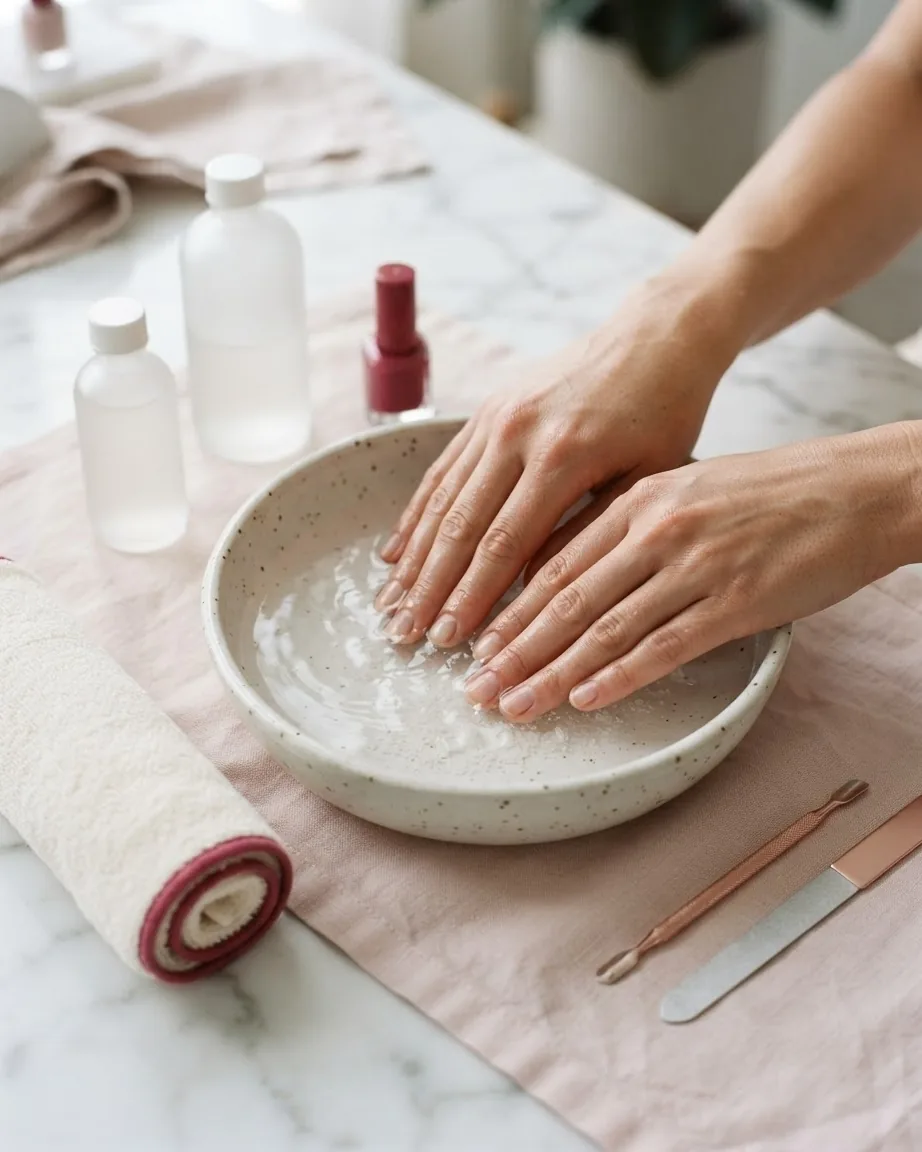
The table below pulls together the only fixed measurements the main shape and nail-care guides commit to; everything else about shape is geometry rather than a number.
| What it measures | Value | Source |
|---|---|---|
| Free edge an almond taper needs | 3-5 mm | nailsami.com |
| Length plus a rounded tip to improve proportions | 2-3 mm | nailsami.com |
| Salt-water soak to soften before shaping | 5-10 min | aad.org |
| Isopropyl alcohol to disinfect clippers | 70-90% | aad.org |
See also: our gel nail extensions guide.
Round: the forgiving everyday tip
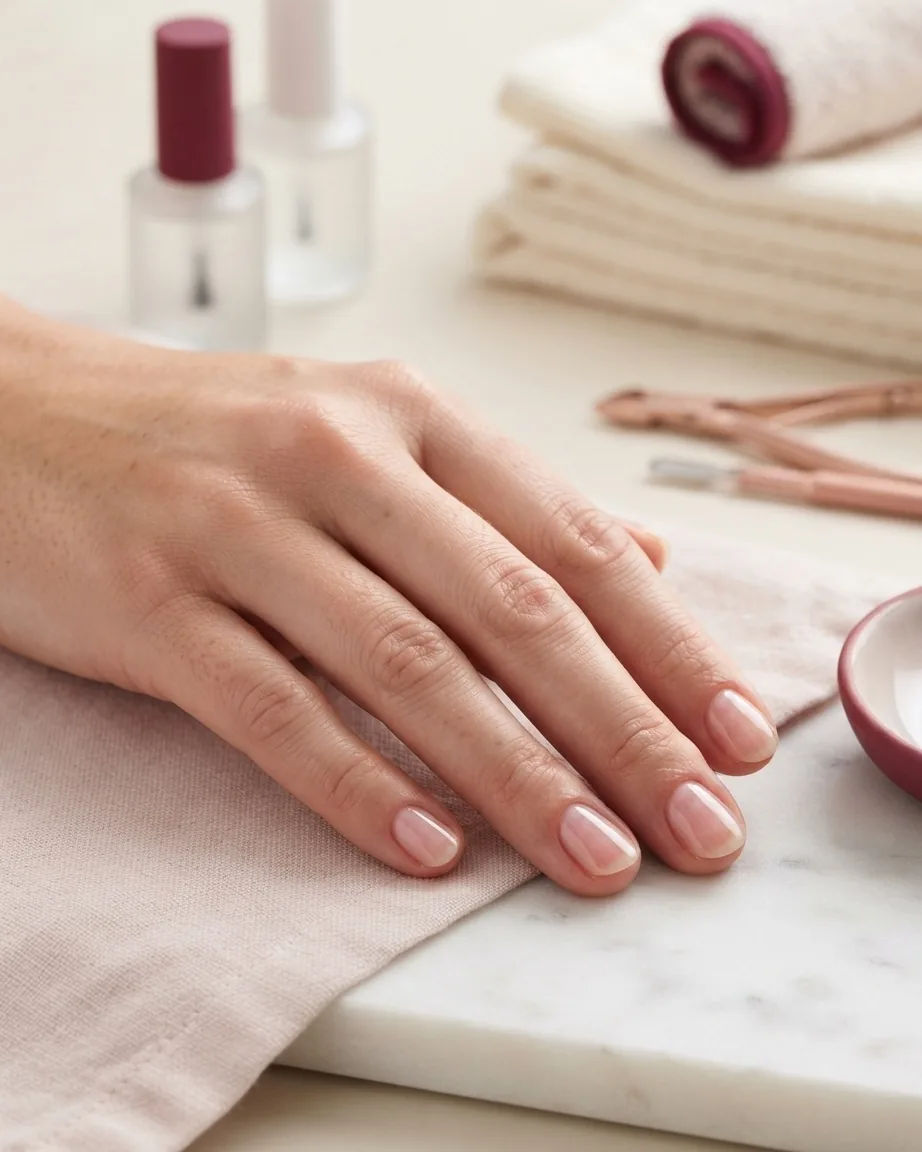
Round keeps the straight sidewalls of the natural nail and files down to a soft curve that echoes the fingertip. It carries no corners, so there is nothing to catch or lever off, which puts it among the sturdier shapes. It files cleanly on short nails with no free edge, and it reads neat on shorter fingers and wider nail beds without trying to add length.
Square: flat tip, sharp corners, more risk
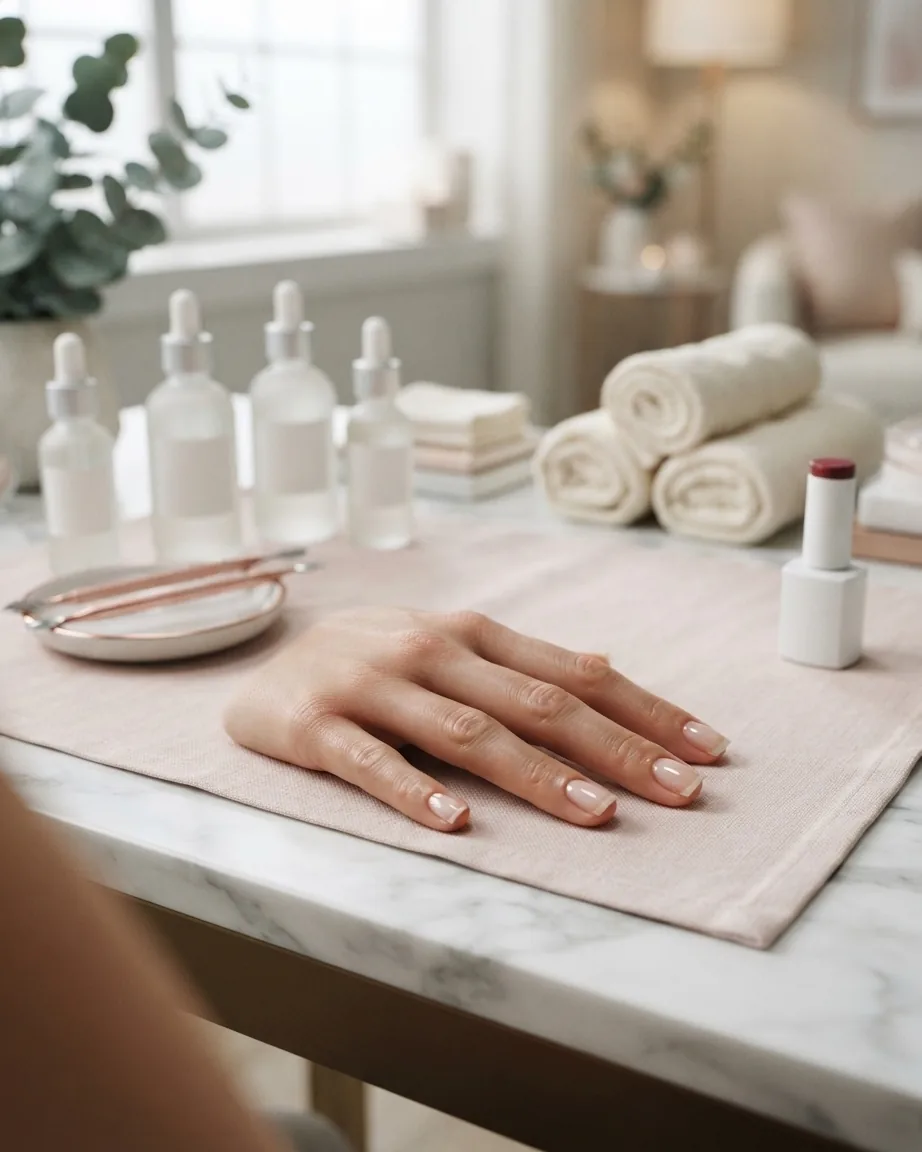
Square runs straight sidewalls up to a flat top with two defined corners. Those corners are the weak point: on thin or peeling nails they snag and split, so square tends to break more than its rounded cousins on weak nails. It suits longer fingers and narrower beds, where the straight edge balances the shape rather than widening it.
The full roster, split by what each one needs
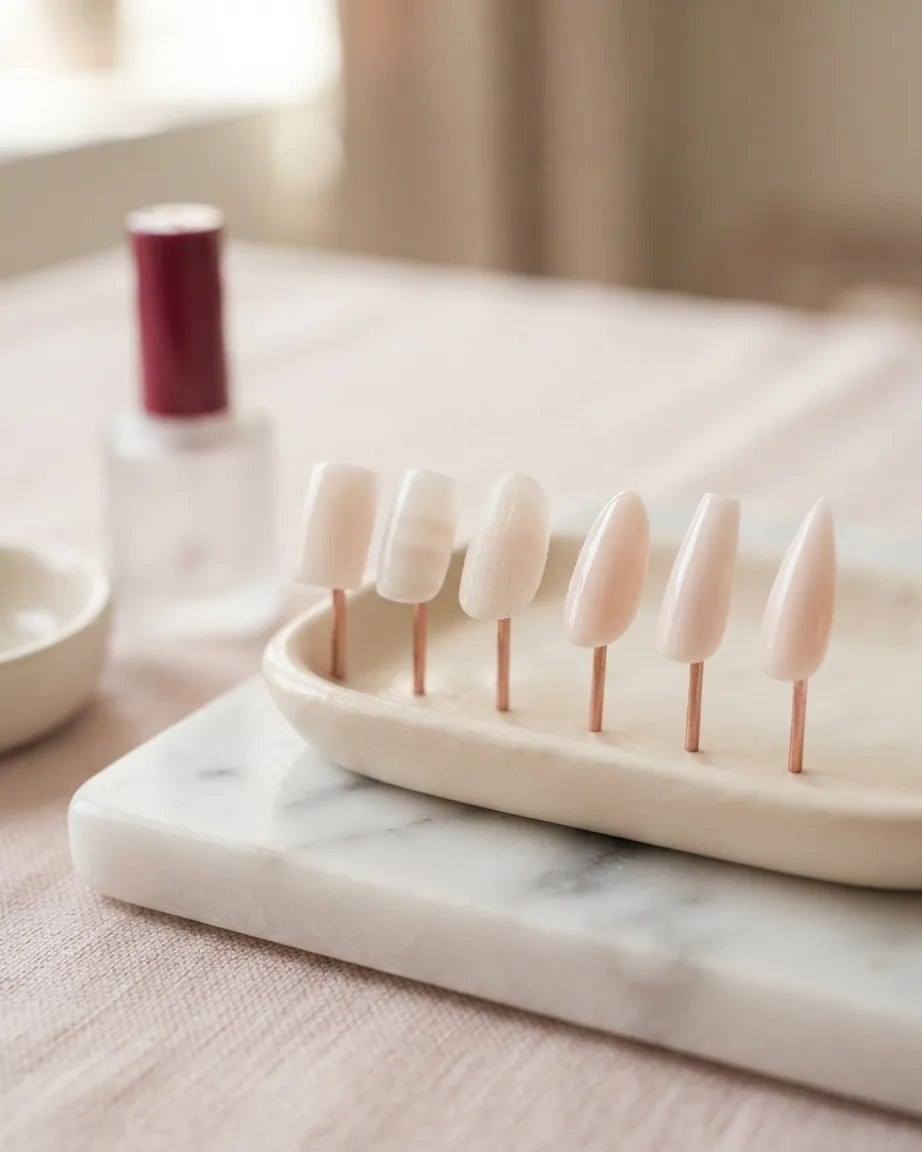
Shapes group into three families, and the practical line that matters is whether you can file them on short natural nails or whether the taper forces length.
- Rounded family, round, oval: soft tips, no point; file on short natural nails.
- Squared family, square, squoval: flat or softened-flat tips; also short-natural friendly.
- Pointed and tapered family: almond, coffin, ballerina, stiletto, lipstick, arrowhead: the taper starts from length, so these want free edge or a gel or acrylic extension.
- Variants that appear on some charts: tapered square, duck: squared or flared tips most lists fold into the main set.
Squoval: the low-upkeep hybrid
Squoval is a square with its corners filed off: the flat tip of a square, the softened edges of an oval. Removing the corners removes the main snag point, so it holds up well and regrows without an obvious grown-out line, which is why it reads as the easiest to maintain at home. Real Simple frames squoval as the shape that flatters nearly every finger type.
Nail shapes chart: strength, filing and length compared
This table lines up the four decisions a chart should settle for each core shape: can you file it short, how it holds up, and whether it needs length.
| Shape | File on short natural? | Everyday strength | Best-suited hand |
|---|---|---|---|
| Round | Yes | High | Short fingers, wide beds |
| Square | Yes | Lower on weak nails | Long fingers, narrow beds |
| Squoval | Yes | High | Most finger types |
| Oval | Yes | High | Short fingers |
| Almond | No, needs free edge | Moderate | Wide beds |
| Stiletto | No, needs length | Weakest | Long fingers |
Oval: length without a point
Oval tapers both sidewalls into an egg-shaped tip with no sharp end, so it reads longer without the fragility of a point. Two guides look like they clash here: Real Simple recommends oval for shorter fingers, while makeup.com notes it files best with some length. They measure different things: who the shape flatters versus how much free edge you need to cut the curve, so both hold at once.
The classic four most salons default to
Round, square, squoval and oval are the shapes a technician can file on short natural nails in minutes, which is why they anchor most charts. Ranked for break resistance, round, squoval and oval sit at the top; square trails because its corners give weak nails a place to split. Squoval is the quiet winner for upkeep: fewest snag points, softest regrowth line.
Sources don’t agree on a single “suits everyone” shape. Woman & Home’s manicurists point to almond; Real Simple frames squoval as the flatter-everyone option. These are opinions from different nail artists, not a measured ranking, so treat them as two defensible starting points rather than one rule.
Almond: the tapered oval that needs free edge
Almond narrows the sidewalls toward a rounded peak, like the nut it’s named for. It can’t be filed on a bare short nail because the taper has nowhere to begin: as nailsami.com explains, the shape requires enough nail beyond the fingertip to shape
, typically 3-5mm of free edge. It widens the look of narrow beds, and Woman & Home’s team calls it the most versatile shape.
Coffin and ballerina: the flat-tipped taper
Coffin and ballerina are the same shape under two names: sidewalls taper inward, then the tip is filed flat instead of to a point, so the outline resembles a coffin or a ballet slipper. It needs real length to read as coffin rather than a stubby square, which puts it in extension territory. Builder gel is the usual reinforcement for a shape this long and this squared-off at the end.
Reading your hand before you pick
Match the tip line to the curve of your cuticle and most hands look longer and tidier. Finger length and nail-bed width do the rest of the sorting, and the useful framing is trade-offs, not commandments.
- Short fingers or wide beds: round or oval keeps proportions in check. For example, if your beds are wide, round avoids the stretched look a long point creates.
- Long fingers or narrow beds: square or squoval balances the length without lengthening further.
- Want more apparent length on a natural nail: even 2-3mm with a rounded tip shifts an oval read toward almond.
Stiletto: the sharpest point, the weakest nail
Stiletto tapers the sidewalls all the way to a single sharp point, usually at dramatic length. It carries the least material at the tip, so it’s widely described as the shape most prone to snapping and the one that demands the most upkeep. It effectively can’t live on a natural nail: length and a gel or acrylic extension come first, often with builder gel underneath for support.
Lipstick: the slanted tip from one artist
Lipstick cuts the tip on a diagonal so it looks like a fresh bullet of lipstick, one slanted edge rather than a point or a curve. It traces to a single originator (Park Eunkyung of Unistella Nails is credited with popularizing it) which is part of why it appears on some charts and not others. Like the other angled shapes, it reads best with length behind the slant.
Arrowhead: the extreme triangle
Arrowhead pushes the taper further than stiletto in look, filing the nail into a hard triangular point. It’s a niche shape that Mylee’s chart lists where many shorter guides stop. It carries the same fragility as any sharp tip, so it belongs on extensions with builder-gel reinforcement rather than on a filed natural edge.
Shapes that survive a hands-on week
If your days involve typing, lifting or cleaning, durability outranks drama. The rounded and squoval shapes win on resilience because they spread stress across a curve instead of concentrating it at a corner or a point. Square’s corners and every pointed shape’s tip are the first things to go on weak or thin nails.
Two levers change the math. First, length: a shorter free edge is harder to catch and lever off than a long one, whatever the outline. Second, reinforcement, builder gel is the standard way to brace fragile shapes like coffin, stiletto and arrowhead so a pointed look survives real use. For example, if your natural nails flex and split, a squoval kept short will outlast a long almond every time, and an almond on builder gel will outlast the same almond filed from a bare edge. None of this treats a nail health problem; if you have persistent splitting, lifting or pain, that’s a question for a professional, not a filing choice.
The same shape on natural, gel and acrylic
A shape is an outline, and the same outline behaves differently depending on what’s under it. On natural nails you’re limited to the shapes that work at short length (round, square, squoval, oval). Gel and acrylic add length, which is the only way almond, coffin, stiletto, lipstick and arrowhead get the free edge their taper needs, and builder gel adds strength on top of length for the fragile ones. Pre-shaped soft-gel tips skip the filing entirely: the shape is moulded into the tip before it ever reaches your nail.
What you need to shape nails at home
A file, a buffer and a clean, disinfected clipper cover most shaping. Soften the edge first: the American Academy of Dermatology suggests a salt-water soak of 5 to 10 minutes before you work the nail. Keep tools clean between uses: to disinfect clippers or scissors, scrub them with a brush dipped in 70 to 90 percent isopropyl alcohol. File toward the tip in the line you want, and stop when the outline mirrors your cuticle.
See also: our how long acrylic nails last guide.
As aad.org notes: “To disinfect them, soak a small scrub brush in a bowl of 70 to 90 percent isopropyl alcohol and then use the brush to scrub your nail clippers or nail scissors.”
FAQ
What are the 5 basic nail shapes?
Round, square, oval, squoval and almond. The first four can be filed on short natural nails because none of them needs a pointed free edge. Almond is the outlier in that group: its taper only reads correctly once there’s 3-5mm of nail past the fingertip to shape into the rounded peak.
How can I identify my nail shape?
Look straight down at the free edge and sidewalls. Rounded tip with straight sides is round; flat top with corners is square; softened corners make it squoval. Length also changes the read: at 2-3mm a curved edge looks oval, and the same curve stretched longer starts reading as almond.
Why no two charts agree on the count
Hunt for a definitive number of nail shapes and you won’t find one, because each guide draws its own boundary around niche and variant shapes. The core rounded, squared and tapered shapes appear everywhere; the disagreements are over whether to count additions like lipstick, arrowhead, tapered square and duck. Lipstick in particular traces to a single artist rather than a long tradition, so some charts fold it in and others leave it off. The practical read stays the same no matter how long the list runs: sort by what you can file short versus what needs length, then by how much breakage you’re willing to manage.