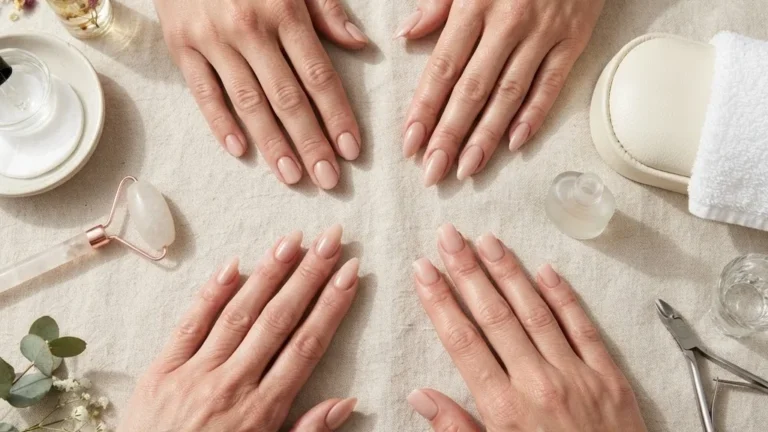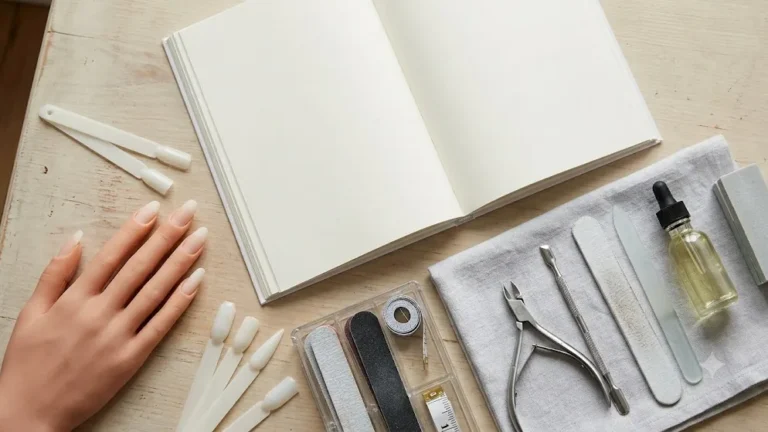
Two completely different things travel under the name “fanned shape nails,” and sorting out which one you mean decides everything that follows. A natural fanned nail is narrow at the cuticle and wider at the free edge, flaring outward toward the tip. Most people searching this phrase want to minimize that flare. A smaller group wants to create it on purpose, as the deliberate duck-flare design.
If your goal is to slim the look, the fastest levers are a tapered shape (almond, oval, or squoval), a specific filing direction, and a touch more length. If a fingernail curves up and concave like a spoon rather than spreading flat and wide, that is a different matter entirely, and it belongs with a clinician, not a nail file.
The short answer: To slim a fanned natural nail, file toward a tapered shape, stroking from the outer edges in toward the center with a fine 240-grit file. Grow the free edge until it runs a millimeter or two longer than it is wide. Skip white polish; nude and pastel shades read slimmer. Leave a thin unpainted margin down each side wall. Press-ons rarely fit a narrow-base, wide-tip nail off the shelf, because a tip-sized cover sits too wide at the cuticle. A nail that curls upward into a concave spoon, rather than fanning flat, is a separate shape worth showing a professional.
What Fanned Shape Nails Actually Are
The flare comes from the nail plate growing out broader than its base. The Chelsea Clinic, a podiatry practice, describes fan-shaped nails as having tips wider than the base. That is the natural silhouette the correction methods below address.
This is not the same as a uniformly wide nail. A wide nail is broad along its whole length; a fanned nail is narrow where it meets the cuticle and spreads toward the edge. The distinction matters because advice written for “wide nail beds” assumes even width, while a fan has a built-in taper working against you at the tip.
One more look-alike to rule out. A fanned nail spreads flat and convex. A spoon nail, covered further down, dips concave in the center. Same word “shape,” opposite curve, and only one of the two is cosmetic.
Which Nail Shape Makes a Fanned Tip Look Slimmer
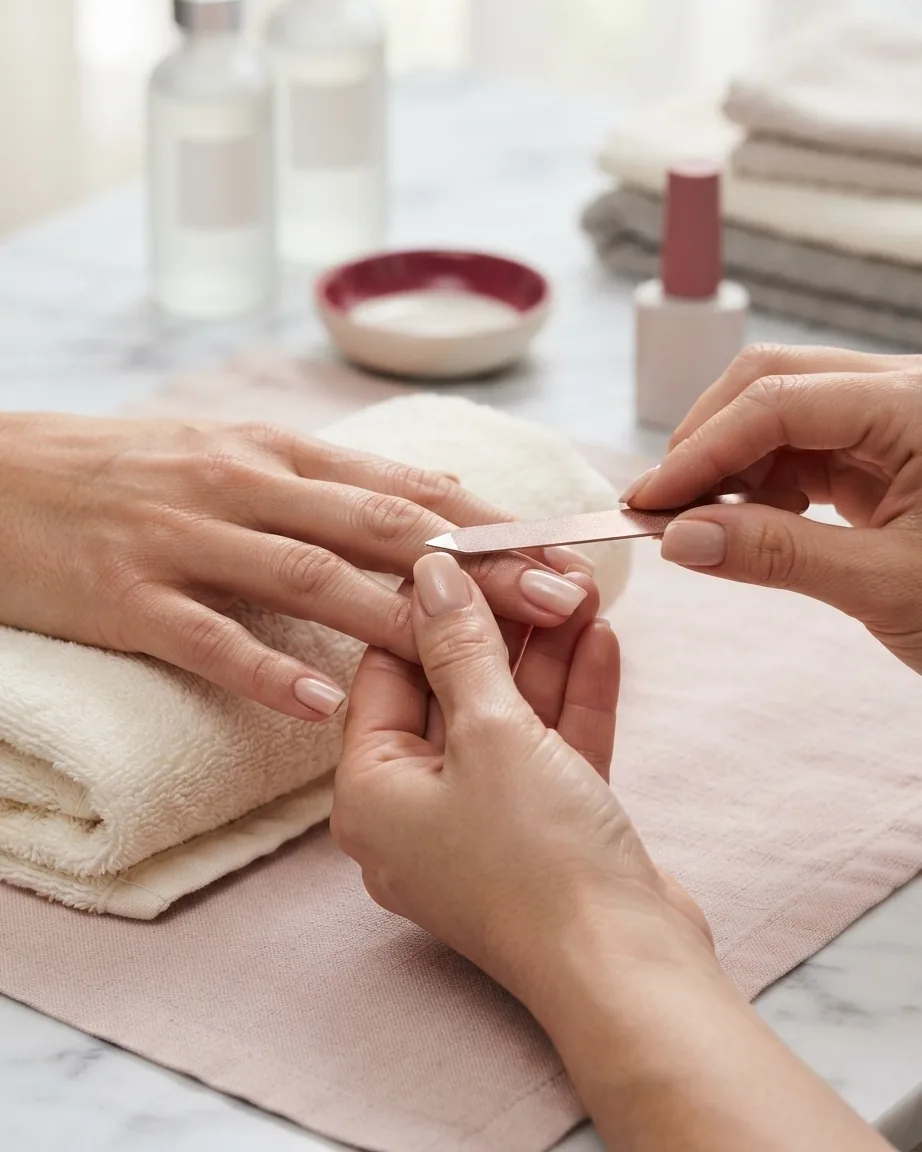
Three shapes do the slimming work: almond, oval, and squoval. Each narrows the eye’s path down the nail instead of letting it spread at the edge. DTK Nail Supply’s guide to fixing wide nails recommends filing toward an almond, oval, or squoval form “
- Oval. Smooth curves and a tip filed to an egg-like point. It elongates, which is why it suits short fingers and small hands.
- Squoval. A square body with softened corners. It is the lowest-maintenance of the three and the most forgiving to keep up at home.
- Almond. Broad at the base, tapering to a rounded peak. It adds the most apparent length but needs real free edge to form the taper.
Almond carries a length requirement. Kester Black’s guide to the most flattering nail shape states this shape “needs at least 3-4mm of free edge to look defined”. If your nails cannot yet hold that much, start with oval or squoval and let almond wait.
The Filing Stroke That Narrows, Not Widens
Direction is the detail most people skip. File from the outer edges inward toward the center, not back and forth across the whole edge, because the inward stroke pulls the visual width toward the middle. To keep the plate from splitting, DTK Nail Supply advises a fine 240-grit file for this work; Kester Black likewise points to a high-grit file over a coarse one. A 240-grit-or-higher abrasive removes less material per pass, so you shape in controlled increments rather than tearing a thinned edge.
When Your Nail Is Long Enough to Shape At All
There is a floor. Kester Black notes that once nails “can hold 2-3mm of free edge without breaking”, there is enough to begin shaping. Below that, you are filing air. Grow first, shape second.
Length and Polish Tricks That Slim Without Filing
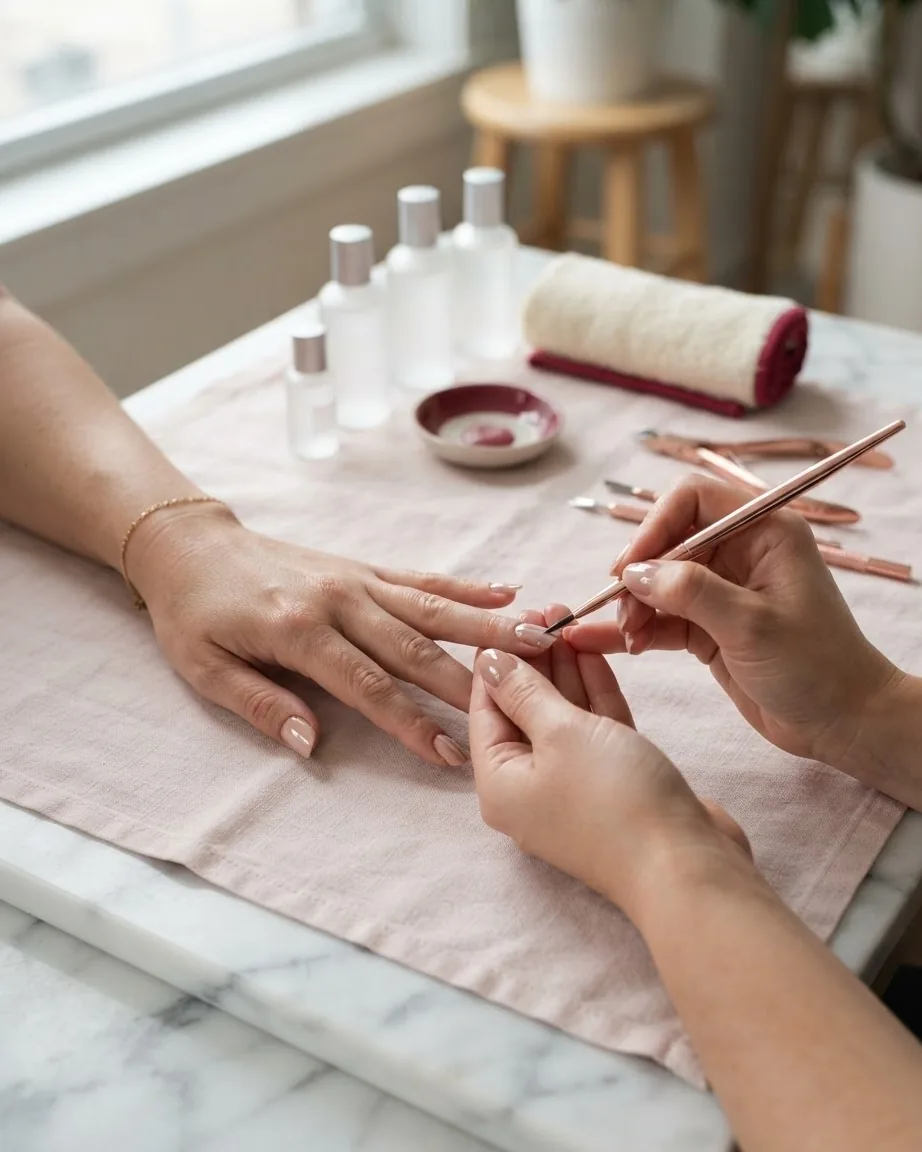
Filing is not the only lever, and for brittle or weak nails it may not be an option at all. Two approaches work without touching a file.
The first is length. DTK Nail Supply puts it plainly: “You only need a millimeter or two” more length than width to tip the proportions in your favor. A nail that reads slightly longer than it is wide stops looking broad, even with no change to its sides. Keeping cuticles pushed back supports the same illusion.
The second is color and placement. DTK Nail Supply recommends nude and pastel shades, specifically excluding white, because soft hues blend with the finger line and lengthen the look; a shade a touch lighter than your skin tone works best. The side trick is the one people miss: when you apply polish, leave a thin strip down each side wall unpainted. That narrow unpolished margin makes the painted area read thinner relative to the finger, which also tempers a triangular or square look.
For example, a short, flared index nail that looks blocky in white polish will read narrower in a warm nude with a hairline gap at each side, no filing required. See also: our soft pastel nail polish guide.
Why Press-Ons Rarely Fit Fanned Shape Nails Off the Shelf
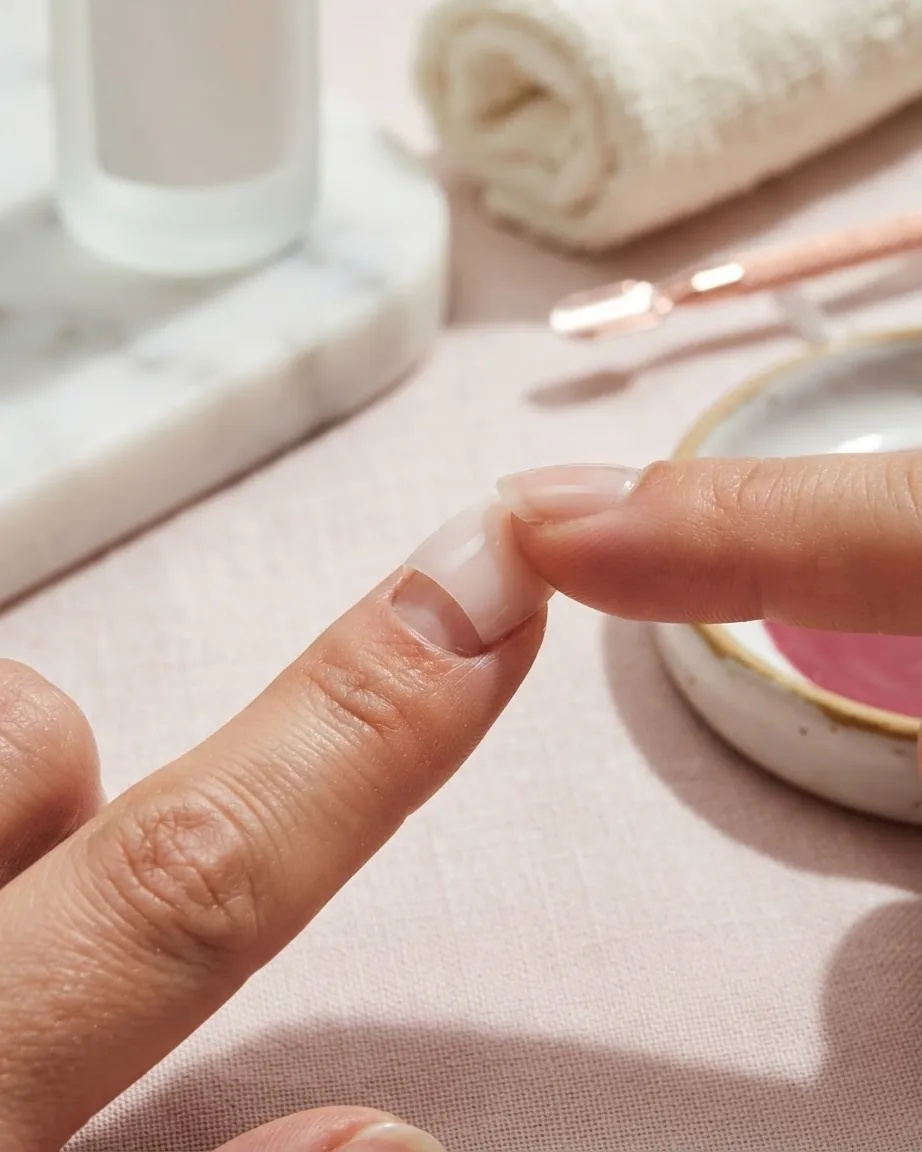
Measuring your nail in millimeters is the only reliable way to choose a press-on size, and a single off-the-shelf set may not match a nail whose width differs from base to tip.
Measuring in millimeters is the only reliable way to get close. Allure’s report on the press-on sizing problem notes that, traditionally, “press ons come in packs of 24 to 30 nails” offered in “10 to 12 different widths” running from 9 mm to 18 mm, depending on the brand. The same piece gives reference widths: the average pinkie nail runs about 8 mm to 10 mm and the average thumbnail about 13 mm to 15 mm.
Measure the widest point of your nail against those ranges, then accept the trade-off that a tip-fitted cover will crowd the base. If your nail bed measures beyond the top of the 9 mm to 18 mm span at its widest, no sizing hack rescues an off-the-shelf set, and a custom or salon-applied enhancement is the realistic route. A custom-built extension in soft gel, builder gel, or acrylic can be sculpted to your actual narrow-base, wide-tip profile. For the two services sold under one label, see our gel nail extensions guide.
Correcting Fanned Shape Nails: One Pass From Grow-Out to Finish
Before you start, have ready: a fine file (240-grit or higher), nails already holding at least 2-3mm of free edge, a nude or pastel polish that is not white, and a base and top coat. Keep uncured gel, primer, and bonder off your skin; if any liquid product touches skin, wash it off and stop if a reaction appears.
- Grow the free edge until it is a millimeter or two longer than the nail is wide; cuticle care supports the length illusion while you wait.
- Push back and groom the cuticles so the base of the nail plate shows its full, narrower width.
- Choose your target shape: oval or squoval for most hands, almond only once the edge holds 3-4mm.
- File each side from the outer edge inward toward the center, taking small passes rather than long back-and-forth sweeps.
- Use a 240-grit-or-higher file throughout, checking symmetry between the two sides as you go.
- Smooth the tip into the chosen curve, keeping the body of the nail narrower than the natural flare.
- Apply base coat, then a nude or pastel color, leaving a thin unpainted margin down each side wall.
- Seal with top coat; expect visible improvement to build gradually over 4 to 6 weeks as the shape grows in, per Kester Black.
Fanned Nails as a Style: The Duck-Flare Design
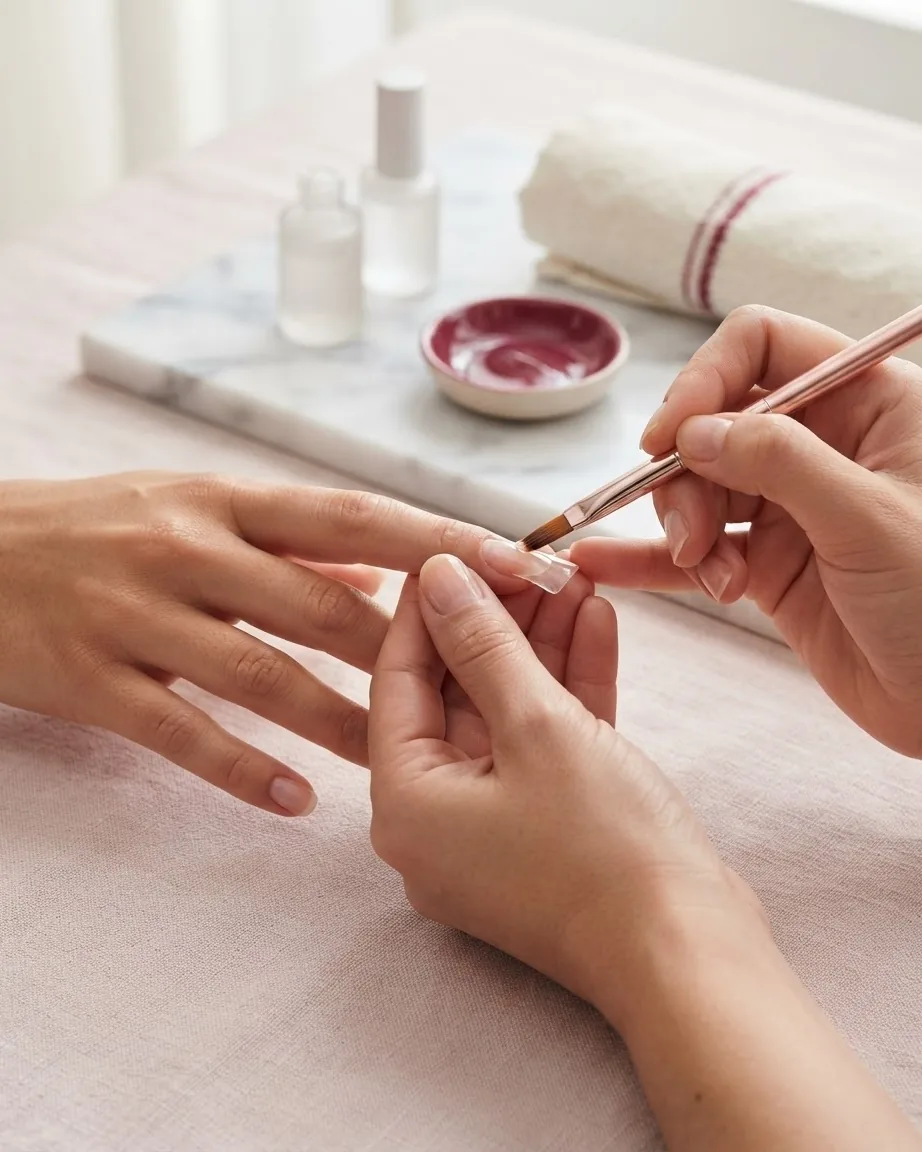
Not everyone wants the flare gone. The deliberate version, widest at the very tip, is the duck or flare nail, built as an artificial enhancement rather than a natural grow-out. Allure’s coverage of the duck nails trend quotes Sacramento nail artist Icey Milli, who considers the shape “a statement” and first tried it 11 years ago. The look is intentional and polarizing, the opposite reader goal from everything above.
The practical difference: slimming works with your natural plate and a file, while the duck shape is sculpted outward in gel or acrylic to exaggerate the tip. One subtracts width visually; the other adds it physically.
What the Sources Actually Disagree On
This is a cross-source map of where the advice splits, built from the pages above. No two of them contradict a number; they split on what “fanned” even means and whose nail the advice was written for.
| Point | What one source says | What another says | How to resolve it |
|---|---|---|---|
| Meaning of “fanned” | Chelsea Clinic: a natural flared condition, tips wider than base, to minimize | Allure: a deliberate duck-flare design to create | Same silhouette, opposite goal. Decide which you want before acting. |
| Whose nail the fix fits | OPI and Kester Black frame advice for “wide nail beds” | Chelsea Clinic describes fan-shaped specifically (narrow base, wide tip) | A fan is not a uniformly wide bed; apply taper-shape advice but expect the tip to fight you. |
| Flat flare vs. concave dip | Correction pages: cosmetic, flares flat and convex | Mayo Clinic: a concave spoon nail can signal iron deficiency anemia | Check the curve direction. Concave and spoon-like is a clinical question, not a filing one. |
When a Fanned or Spoon-Like Nail Is a Health Sign, Not a Shape Preference
A flat, convex flare is cosmetic. A nail that curves up at the edges into a concave, spoon-like dip is a different finding. Mayo Clinic’s rundown of fingernail problems not to ignore describes spoon nails, also called koilonychia, as soft nails turned up around the edges that are often a symptom of iron deficiency anemia. If your “fan” is actually concave, or if it comes with changes in color, texture, or thickness, that is a conversation for a clinician rather than a nail tech. This site offers cosmetic guidance only and does not diagnose.
Fan-Shaped Toenails and the Ingrowing Risk
On toes, the same curved or fan shape carries a practical consequence that has nothing to do with looks. Nidirect, the Northern Ireland government’s public information service, lists how to prevent an ingrown toenail and advises cutting toenails “straight across, not at an angle or down the edges.” A curved or fan-shaped toenail is more prone to pressing into the surrounding skin, which is the mechanism behind an ingrowing nail.
The shape itself can be inherited rather than caused by your cutting habits, so straight-across cutting manages the risk without claiming to change the shape. If a toenail is already ingrown, red, or painful, that is foot-care territory for a podiatrist.
Press-On Width Steps: How Far Apart Off-the-Shelf Sizes Fall
Allure gives the shelf-standard press-on set as 10 to 12 widths running from 9 mm to 18 mm. That is a 9 mm span. Spread across 10 widths, the sizes land about 1 mm apart; across 12 widths, about 0.8 mm apart. So the sizing jumps in roughly 0.8 to 1 mm steps from one option to the next.
Frequently Asked Questions
How can I fix fan-shaped nails?
Press-ons alone struggle here, because a tip-sized cover among the usual 9 mm to 18 mm widths overhangs the narrow base. A custom-sculpted gel or acrylic extension fits the profile properly, while at-home correction stays with filing, length, and polish placement. Measure your widest point in millimeters before buying any set.