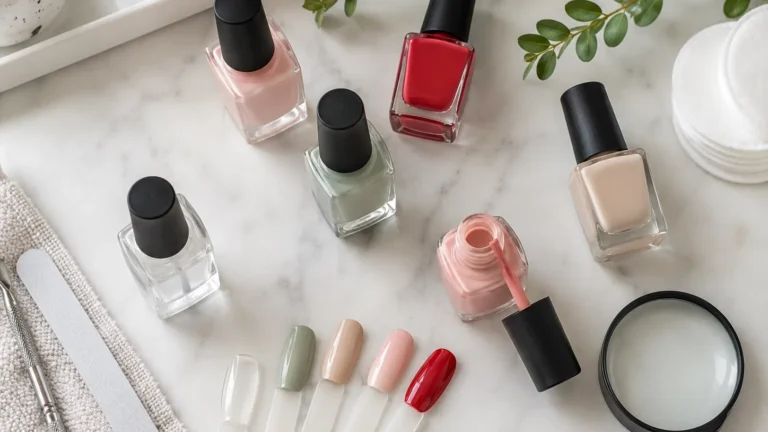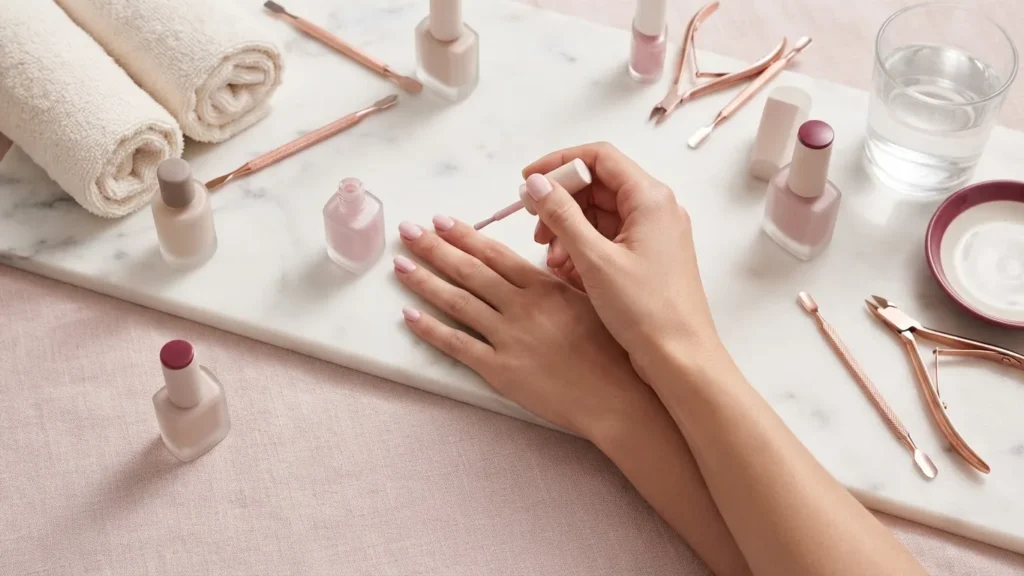
Add white to a pure hue and you get a tint; stop while the color still reads clearly and you have a pastel. That single mechanism explains most of what trips people up here. Soft pastel nail polish behaves differently from a creamy mid-tone because the pigment is diluted – pale lavender, sky blue, butter yellow, mint, and shell pink all carry less color per coat, which is exactly why they go patchy when applied like a saturated shade. The color-theory reference Linearity states it plainly: “A tint is a pure hue mixed with white. Pastel colors are tints.” Where it gets slippery is the gap between that strict rule and how the beauty industry labels bottles.
Quick answer: A true pastel is a tint – a pure hue mixed with white, high in value and low in saturation. Many shades sold as pastels are technically tones (hue plus gray, the “dusty” look) or neutrals, so soft pastel nail polish covers a wider range in practice than in color theory. Match it on two separate axes: warm versus cool undertone, and light, medium, or deep skin depth. Apply two to three very thin coats, not one thick one, and set a thin white base under the palest shades. Semi-permanent LED systems can hold a pastel up to 12 days; standard lacquer does not reach that.
What Actually Counts as a Pastel – Tint, Tone, or Just Milky Marketing

The strict definition is narrow. In color theory, a tint is a hue lightened with white, a shade is a hue darkened with black, and a tone is a hue muted with gray. By that rule, a clean pale pink is a pastel and a grayed-off “dusty rose” is not – it is a tone wearing the pastel label.
Beauty usage is looser, and it is not wrong so much as broader. The blog EyeCandys folds neutrals into the family outright: “Soft beige, sandy neutrals, and milky cream tones count as pastels too.” Trend reporting from InStyle and nail-artist coverage in Vogue lean hard into muted, milky, dusty versions rather than candy-clean ones.
So which is it? Both, depending on who you ask – and the distinction matters when you shop. If a shade looks chalky-gray in the bottle, it is likely a tone, and it will read quieter and dirtier on the nail than a true tint. That is not a defect; it is the current direction. Just know what you are buying. A grayed sage and a bright mint are both sold as pastels; only one is a pastel in the textbook sense.
Picking a Soft Pastel Nail Polish for Your Undertone and Skin Depth
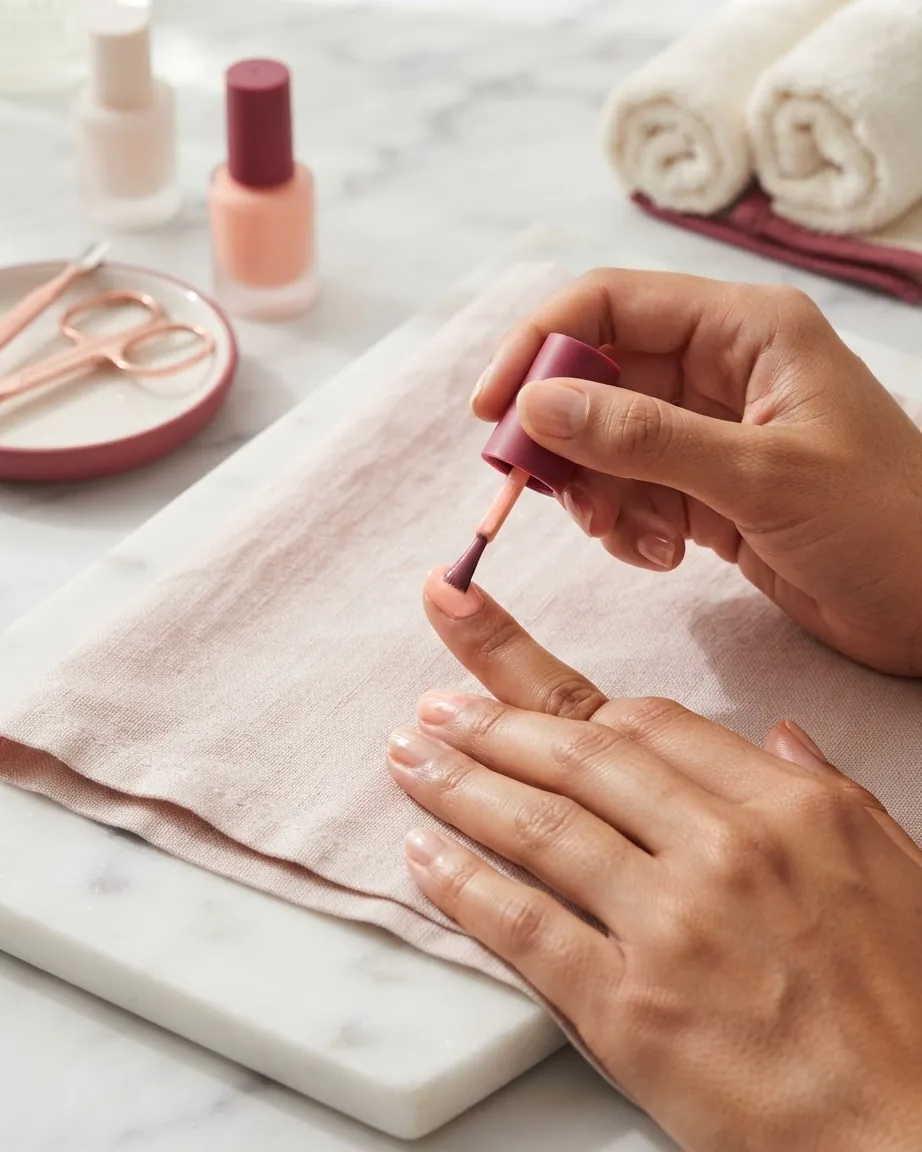
Two variables decide whether a pale shade flatters a hand, and they are not the same variable. One is undertone – warm or cool. The other is depth – light, medium, or deep. Sources key their advice to different axes, so read them that way rather than merging them.
On undertone, Vogue’s nail-artist coverage frames the choice as warm versus cool: cool hands tend to carry blue-based pastels (lavender, sky, cool mint) cleanly, while warm hands sit better with peach, butter yellow, and warm-leaning pinks. On depth, Essie’s guidance is organized around how light, medium, or deep the skin reads, which changes how much contrast a pale shade creates against the nail bed.
These are complementary, not interchangeable. A deep, warm-toned hand and a light, cool-toned hand can both wear “pastel pink” and get opposite results, because one axis governs which pink and the other governs how pale you can push it before it disappears. A practical read: use undertone to choose the hue, use depth to choose the value. Related guide: nude nail polish.
Why Pastels Go Streaky – and the Three Fixes Together

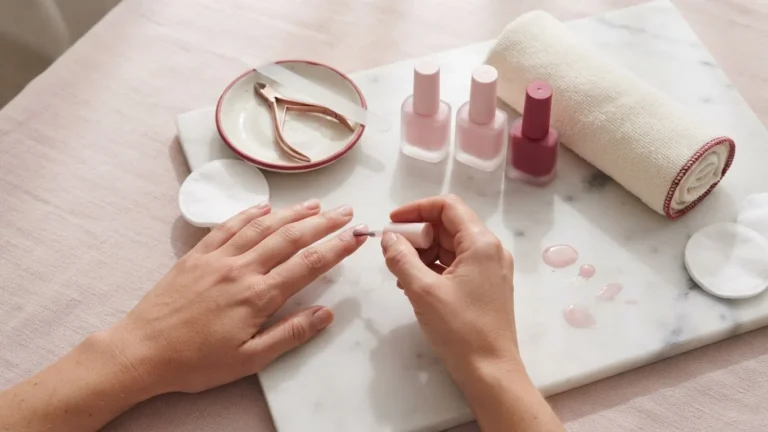
The number one DIY failure with pale polish is a patchy, streaky finish, and the cause is almost always the same: the coat went on too thick. Vogue’s coverage ties the fix directly to application – the magazine notes that streaks happen when polish is laid on too heavily, and reports a nail artist who “recommends painting with two to three very thin coats.”
Three corrections work together, and they are rarely given as a set:
- Two to three very thin coats. Thin layers self-level and dry evenly; a single heavy coat drags pigment into ridges and never flattens out. More thin coats beat fewer thick ones every time with a pale formula.
- Choose a sheer formula on purpose. If a polish is built to be sheer, fighting it with extra coats makes it worse, not more opaque. Pick a crème pastel when you want coverage and a sheer when you want a wash.
- A thin white base under the palest shades. Light pastels have little pigment to hide the nail; a thin white base gives them a uniform surface to sit on, so the color reads true instead of translucent-and-blotchy.
Coverage is a dial, not a fixed number – the same logic runs through our light pink nail polish guide. The mistake to avoid: stacking coat four on a streaky pale pink. By then the formula, not your hand, is the problem.
How Many Coats a Darker-Leaning Pastel Really Needs

Not all pastels cover the same. The darker a shade’s base hue before the white went in, the more white it took to lift it into pastel territory – and the less dense the remaining pigment is per coat. A denim-leaning blue or a deep-grayed mauve will often need a third thin coat to even out where a pale butter yellow is done in two.
This pairs with the thin-coats rule rather than overriding it. The instinct is to go thicker to force coverage on a stubborn darker pastel; that reintroduces streaking. Add another thin coat instead, and let each one flash off before the next. Budget two coats for clean light tints, and plan on three for anything grayed, dusty, or denim-adjacent.
Keeping Soft Pastels From Looking Easter-Egg or Dated
Candy-bright pastels read juvenile fast. Two levers pull them back toward something quieter: shade choice and execution.
On shade, the current direction swaps the obvious for the muted. Sage instead of neon green. Oyster or milky off-white instead of stark white. Dusty, denim-toned, or grayed versions instead of straight-from-the-crayon-box brights. InStyle’s trend reporting points the same way – milky and muted over candy. These are the tones that slip the Easter-egg association.
On execution, shape and finish do heavy lifting. A soft almond or a short squoval shape keeps a pale color looking current rather than cute. Finish matters too: a high-shine or pearlized topcoat reads more polished than a flat matte on a pastel. The 2026 spring direction continues this – creamier, muted, nature-inspired substitutions rather than bright primaries. One quiet shade on a clean shape beats a saturated pastel on a dated one.
Pastels Past Spring: Year-Round and Event Wear
Pastels are not an April-only category, and treating them that way leaves a lot of good color on the shelf. The brand Manucurist builds its seasonal guidance around wearing pastels across the calendar, extending the palette into neutrals – beige and cream – that carry through fall and winter without reading out of season.
Essie frames its pale neutrals as a base you can return to constantly, calling one a lasting color foundation for a sophisticated manicure, 365 days a year. Read that as a year-round positioning, not a durability claim – no single application lasts a year.
For events, pastels do real work. Bridal and baby-shower manicures lean on soft pinks, creams, and milky neutrals precisely because they photograph clean and sit under a range of outfits. The lifestyle guide at Green Wedding Shoes treats pastels as a core occasion palette, not a seasonal novelty. If you have been saving them for one month a year, that is the assumption to drop.
How Long Soft Pastel Nail Polish Lasts – Lacquer vs. Semi-Permanent
Wear time depends entirely on the system, and one figure gets misapplied constantly. The 12-day number belongs to a specific semi-permanent LED-cured setup, not to ordinary bottle lacquer. Manucurist states that a base coat under its Green Flash system “helps create an even surface, strengthens your nails, and extends the wear of your Green Flash™ polish for up to 12 days.” That is an LED semi-permanent claim – do not stretch it onto standard pastel lacquer, which runs far shorter.
If you want pastel at that wear length, you are choosing a semi-permanent gel-style system, with the cure and removal that come with it. Standard lacquer trades durability for easy removal. For the mechanics of lamp-cured systems and how they differ from lacquer, see our guide to gel nails.
Removal follows the system you picked. Standard pastel lacquer comes off with acetone or non-acetone remover and a soaked cotton pad; semi-permanent LED color requires its own soak-off process and should not be peeled. If you want a free sanity check before committing, Manucurist offers a “15 min-free virtual consultation” with its manicure experts. On the safety side, keep acetone work ventilated and wear gloves if you are removing color frequently; if you suspect a reaction to any product, stop and see a professional rather than pushing through.
The “365 Days a Year” Reality Check: Re-Applications Per Year
Essie frames a pale neutral as a lasting color foundation for a sophisticated manicure, 365 days a year, while Manucurist’s best-case figure is a Green Flash semi-permanent manicure that holds up to 12 days. Put those two numbers side by side and the gap between marketing language and wear time becomes concrete: the “365 days” is a year-round positioning claim, not a promise that one coat lasts a year.
- To actually keep color on for all 365 days at the best-case 12-day wear, you would redo the manicure about 31 times over the year (365 / 12 = 30.4, rounded up to 31).
- Even that best-case single application covers only about 3.3% of the year (12 / 365 = 3.3%), which is why no pastel “lasts a year” and the real planning question is re-application frequency, not longevity.
Note: the 12-day figure is specific to Manucurist’s Green Flash semi-permanent LED system; ordinary bottle lacquer does not reach it, so for standard lacquer the true number of re-applications across a year would be higher still.
FAQ
Is a dusty rose or sage actually a pastel?
By textbook color theory, no – those are tones, made by muting a hue with gray rather than lightening it with white. A pastel is strictly a tint. In cosmetics, though, both labels get used interchangeably, so you will find grayed shades sold under the pastel heading. Buy by how the bottle reads: chalky-gray means tone.
Can I use a regular topcoat to stop pastel streaks?
A topcoat evens out shine and seals the surface, but it cannot rescue streaks baked into coats below it – it sits on top of the problem. Correct the layers underneath first: thinner applications, and a white base for the palest shades. Topcoat is the finish step, not the fix for patchy pigment.
Do pastels suit deep skin tones?
Yes, with a value adjustment. On deeper, warmer hands, very washed-out tints can read dull against the nail, so lean toward pastels with a touch more pigment and a warm bias – peach, butter, warm pink. Undertone chooses the hue; skin depth decides how pale you can push it before the color drops away.
Why does my pale polish look fine wet but blotchy dry?
Low-pigment pastels dry to a thinner, less-opaque film than they appear while wet and glossy. As solvent flashes off, uneven thickness becomes visible as blotches. The remedy is prevention: two or three thin, even coats over a smooth base, rather than correction after drying. For very light shades, a thin white base closes most of that gap.