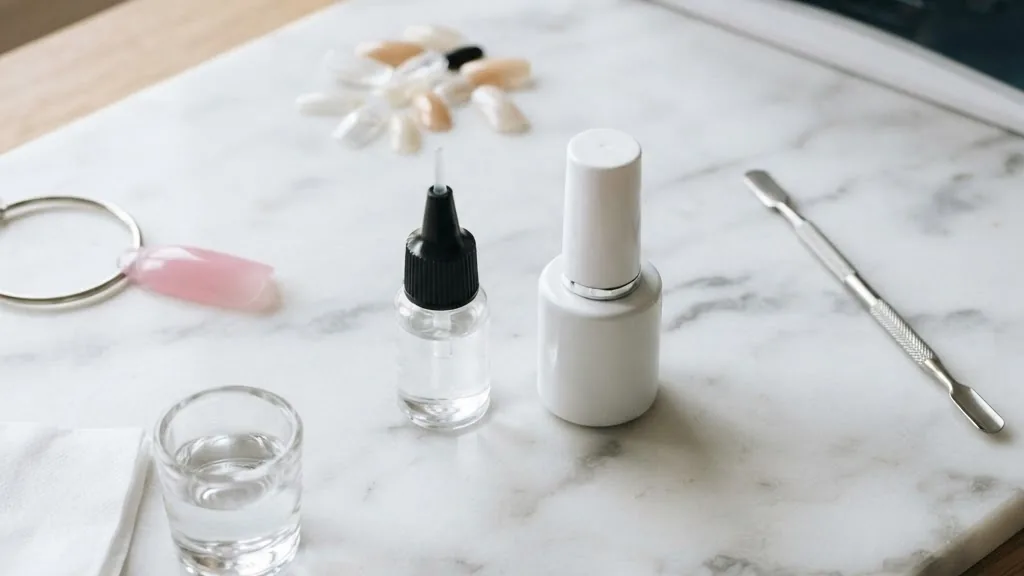
Nail glue for gel is not one product. It is two chemically different adhesives that share a search box and almost nothing else. The first paragraph of your shopping cart probably has the wrong one in it, because the small squeeze bottle labeled “nail glue” and the brush-on tube labeled “gel glue” cure by opposite mechanisms, remove by opposite methods, and carry different allergy risks. One is a cyanoacrylate that hardens in seconds when it meets the moisture in air. The other is a methacrylate gel that stays liquid until a lamp hits it. Confusing them is why so many press-on manicures pop off in a day and so many soft-gel sets never fully set.
This guide separates the two, then builds the safety and removal layer that product pages skip. If you are still deciding on the underlying shape before you glue anything down, the guide to choosing and filing the right nail shape is the better starting point.
Quick answer: “Nail glue for gel” refers to two things. Liquid cyanoacrylate glue is the no-lamp squeeze bottle used to attach tips and press-ons; it cures in seconds using air moisture and comes off with filing and acetone soaking. UV gel glue is a lamp-cured methacrylate adhesive used to bond soft-gel and Gel-X tips for two-to-three week wear; it removes only by acetone soak-off, never peeling. Choose liquid for one-night press-ons, gel glue for longer extensions. Both can sensitize skin, so keep either off the surrounding skin.
Liquid cyanoacrylate versus UV gel glue: which bottle is in your hand
Liquid cyanoacrylate glue and UV gel glue solve different problems, and the label rarely makes that obvious. Liquid cyanoacrylate is ethyl cyanoacrylate, the same chemical family as household super glue, sold in a small squeeze bottle. It cures in seconds using moisture in the air, needs no lamp, and bonds a plastic tip or press-on to the nail plate almost instantly. UV gel glue is a methacrylate adhesive, usually built on hydroxypropyl methacrylate, that stays workable until a UV or LED lamp cures it in roughly 30 to 60 seconds. It is the correct product for soft-gel and Gel-X tips meant to last weeks. Pick by intent, not by the word “gel” on the front.
- You want press-ons for one night or one event: liquid cyanoacrylate glue. Fast, no equipment, and easy to file off later.
- You want soft-gel or Gel-X extensions for two to three weeks: UV gel glue, plus a lamp to cure it.
- You have neither a lamp nor patience: liquid glue is your only real option, but accept the shorter wear.
The mismatch that ruins manicures is using liquid glue where a gel bond was needed, or buying gel glue with no lamp to cure it. A tube of gel glue with no lamp is a tube of expensive tacky liquid. A drop of liquid cyanoacrylate under a full-coverage soft-gel tip cannot flex with the nail and lifts at the edges within a day or two.
What each glue is made of, and why the chemistry decides everything
The ingredient list, not the marketing, tells you how a nail glue behaves. Liquid nail glue is dominated by ethyl cyanoacrylate, which Australia’s Australian Industrial Chemicals Introduction Scheme (AICIS) identifies as the most commonly reported cyanoacrylate in cosmetic adhesives, used in eyelash glues at roughly 85 to 90 percent. UV gel glue runs on a different backbone: a typical published INCI lists polyacrylic acid and hydroxypropyl methacrylate alongside photoinitiators such as hydroxycyclohexyl phenyl ketone and TPO. Those photoinitiators are why the lamp matters; they absorb UV or LED light and kick off the reaction that hardens the gel. No light, no cure. That single difference in chemistry drives cure time, wear, removal and allergy risk.
Cyanoacrylate hardens the moment it meets water vapor, which is why it grabs a fingertip as fast as a nail tip. The set is exothermic, so a large drop on skin can feel hot. Gel glue, by contrast, sits inert on the nail until photoinitiators fire under the lamp, giving you working time to position a tip perfectly before locking it in.
- Liquid glue backbone: ethyl cyanoacrylate, air-moisture cured, seconds to set.
- Gel glue backbone: hydroxypropyl methacrylate plus polyacrylic acid and photoinitiators, lamp-cured.
- The shared risk: both are reactive monomer chemistries that can sensitize skin over repeated exposure.
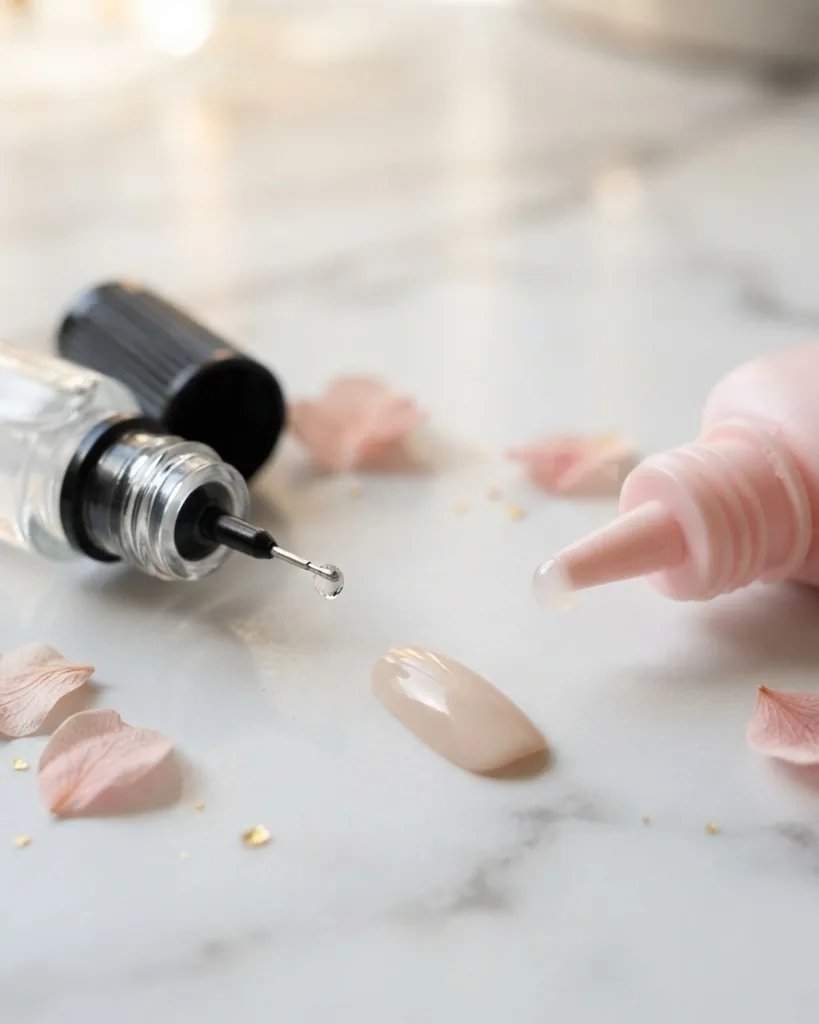
How each glue cures: seconds of air moisture versus a 30 to 60 second lamp
Cure method is the fastest way to tell the two products apart in practice. Liquid cyanoacrylate cures on contact with humidity in the air, setting within seconds and reaching a firm bond with no lamp at all. That speed is a feature for press-ons and a hazard for fingers, because it does not distinguish between a nail plate and the skin beside it. UV gel glue does nothing until a lamp reaches it; vendor instructions for soft-gel tip glue put the cure at roughly 30 to 60 seconds under UV or LED. The gap in the middle, before you cure, is the working window that lets you seat a tip cleanly. Understanding which mechanism you are dealing with prevents the two most common failures: a tip glued crooked and locked, or a gel bond that never hardened.
A cold room slows gel curing and thickens liquid glue, which is why some product copy suggests warming a solid gel glue before use. Humidity does the reverse to cyanoacrylate, accelerating an already fast set. If your liquid glue is stringing and grabbing before you place the tip, the air is humid; work faster or in smaller drops.
Applying gel glue to soft-gel tips, step by step
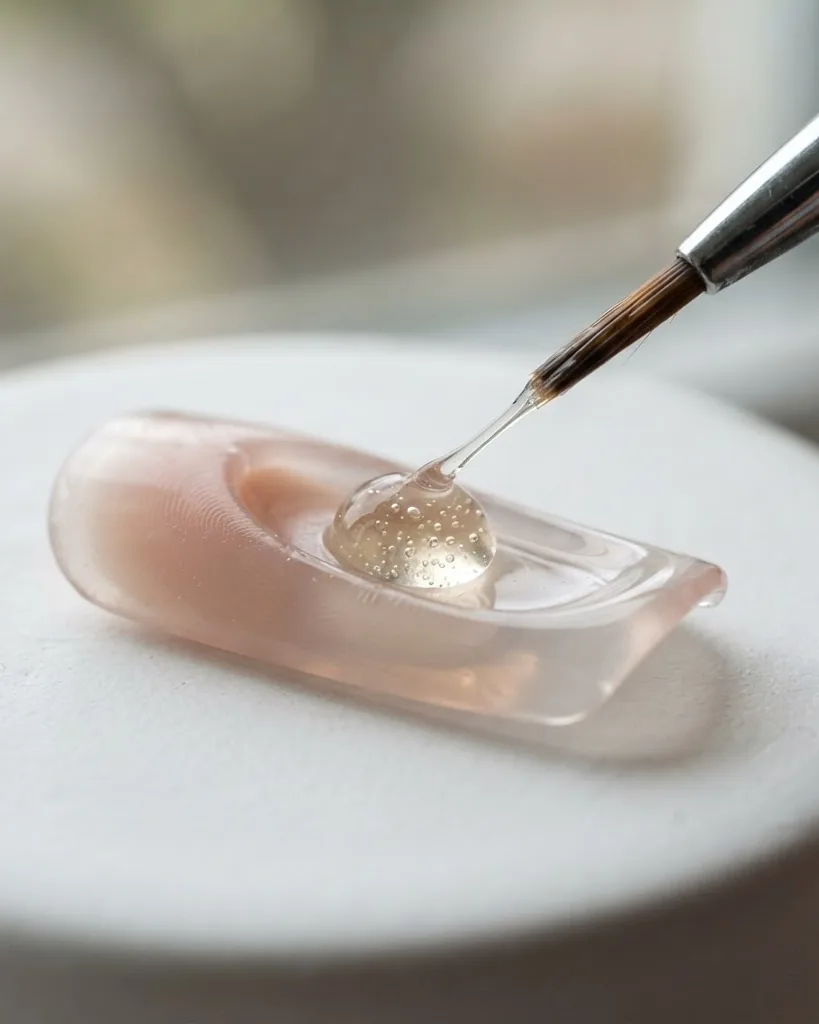
Getting a soft-gel tip to last comes down to prep and a controlled bead of gel glue, cured under a lamp. This is the highest-intent part of the whole process and the part product listings compress into three lines. The nail plate has to be clean, matte and free of oil before any adhesive touches it, because gel glue bonds to a dry plate and slides off a shiny or oily one. Once the plate is prepped, a thin even layer of gel glue on the tip’s contact area, followed by a full lamp cure, gives the flexible, weeks-long bond that soft-gel systems are designed for. Rushing prep is the single biggest cause of edge lifting within the first few days.
The sequence that works, in order:
- Push back and tidy the cuticle, then lightly buff the plate to remove shine. You are not thinning the nail, just breaking the gloss.
- Dehydrate the plate with a nail dehydrator or prep swab so no oil or water sits under the bond.
- Apply base coat if your system calls for one, and cure it per the lamp instructions.
- Bead the gel glue onto the tip’s inner well, keeping it off the skin, then press the tip down and hold at the correct angle.
- Cure under the UV or LED lamp, around 30 to 60 seconds depending on the product, until the bond is fully hard with no tacky slide.
Keep the glue on the nail plate and off the surrounding skin at every step. That is not a cosmetic preference. Skin contact with methacrylate adhesives is the exposure route that drives sensitization, which the safety section below covers in detail.
Wear time, and the honest gap between vendor claims and evidence
Durability is where product pages get loose with numbers, so it pays to read their claims as claims. One multifunction pro gel glue page states it “lasts over 3 weeks,” and a soft-gel tip glue page frames a two-to-three week wear window, but none publish a method behind those figures. Treat vendor durability numbers as manufacturer marketing, not measured data. What is genuinely true is structural: gel glue’s flexible methacrylate bond survives daily bending better than a rigid cyanoacrylate spot, which is why soft-gel extensions outlast press-ons attached with liquid glue. The realistic takeaway is that gel glue can carry an extension into a multi-week range when prep is clean, while liquid-glued press-ons are built for days, not weeks. Prep quality moves that range more than the brand does.
If a set lifts early, the failure is almost never the glue’s advertised strength. It is oil left on the plate, a cure that was too short, or a tip stressed by hot water and daily impact. Match the product to the timeline you actually need instead of chasing the biggest number on the label.
The safety layer product pages skip: methacrylate and cyanoacrylate risk
The real cost of nail adhesives is a permanent allergy that no shopping page mentions. Methacrylate contact allergy is a delayed reaction that develops after repeated exposure, and once you are sensitized it does not reverse. A UK and Ireland patch-test audit reported by the British Association of Dermatologists found 1.5 percent of patients reacted to HEMA, 1 percent to 2-hydroxypropyl methacrylate, and 0.9 percent to ethyl acrylate, making HEMA the top nail-related allergen in that dataset. Of those affected, 93 percent were women, with around 60 percent of cases from recreational nail and eyelash-glue exposure and about 33 percent occupational among nail technicians. The clinical review in the journal Contact Dermatitis flags why this matters beyond nails.
An Italian study of 7,133 patch-tested patients across eight clinics adds a trend line. It found 2.1 percent were HEMA-positive overall, rising from 1.6 percent in 2019 to 2.7 percent in 2023, with artificial nails the leading exposure source at roughly 72 percent of non-occupational cases and about 75 percent of occupational ones. The peer-reviewed data sits in the NCBI PMC record on 2-HEMA prevalence trends. The rise is the part that should give any regular user pause.
Why does a nail allergy matter for the rest of your life? Because the same methacrylate chemistry appears in dental fillings, orthopaedic bone cement, and diabetic glucose sensors and insulin pumps. A sensitization that started with gel glue can complicate future dental and medical care. The Contact Dermatitis review, which cites the Scientific Committee on Consumer Safety (SCCS) assessment of HEMA as a weak to moderate sensitiser, lays out that cross-over in detail.
Cyanoacrylate carries its own hazards. It bonds skin and eyelids fast, sets exothermically, and the U.S. Food and Drug Administration (FDA) medical-device guidance on tissue adhesives notes that cyanoacrylates release formaldehyde as a by-product of hydrolytic degradation, with formaldehyde formation decreasing as the alkyl chain and polymer molecular weight increase. Ventilation and keeping the tip away from eyes and skin are not optional niceties. You can read the FDA’s account of the degradation chemistry in its tissue adhesive special controls guidance.
What the FDA, EU and UK actually regulate, and what it costs an operator
Regulators treat nail adhesives differently on each side of the Atlantic, and the split shapes what you can legally buy. In the United States the FDA regulates nail products as cosmetics rather than as drugs, which means no pre-market approval but real enforcement history. The FDA removed 100-percent methyl methacrylate monomer artificial-nail products from the US market through court action in the early 1970s after injury reports of nail damage and contact dermatitis. No rule bans MMA outright, and the agency notes that traces of reactive monomers left after curing can still trigger reactions in sensitized users. The Cosmetic Ingredient Review panel judged ethyl methacrylate safe as used only when application avoids skin contact, citing its sensitizing potential.
Europe went further and turned the allergy data into hard law. Regulation (EU) 2020/1682 restricts HEMA and Di-HEMA TMHDC in nail products to professional use only. Any product containing them must carry “for professional use only” and “can cause an allergic reaction” warnings, and the rule applied from 3 June 2021 for placing on the market. In practice that means a European Union or United Kingdom consumer buying a HEMA gel glue for home use is buying a product the European Commission intended only for trained hands. The restriction text is published by the European Commission through EUR-Lex as a formal PDF.
What does compliance cost the operator? For a professional it means training on skin-contact avoidance, product labeling that carries the mandated warnings, and stocking HEMA-free lines for clients who ask. For a home user it means accepting that the safety framing baked into a professional product does not travel with it once you skip the trained applicator. The FDA’s plain-language account of how it treats these products sits in its nail care products cosmetics page, and the difference between the US cosmetic model and the EU restriction is the single most important regulatory fact a buyer can carry into a purchase. If you are building a full at-home routine around these products, pair this with the nail shape selection and filing guide so prep and shaping match the adhesive you have chosen.
HEMA-free labels, patch testing, and when to see a dermatologist
A “HEMA-free” label reduces one specific risk but does not make a product allergy-proof. Cross-sensitization means a person already allergic to acrylates can still react to a HEMA-free formula, and a documented case in the Journal of Allergy and Clinical Immunology: In Practice describes exactly that, a reaction to a gel marketed as hypoallergenic and HEMA-free. So “HEMA-free” is a meaningful step for someone avoiding that one monomer, and close to meaningless for someone already sensitized to the broader acrylate group. The honest reading is that no cured-monomer nail product is guaranteed safe for a sensitized person, which is why patch testing through a dermatologist, not a product swatch on your wrist, is the real diagnostic tool.
See a dermatologist rather than experimenting if you notice the warning signs of sensitization:
- Itchy, red or blistered skin around the nails, fingertips or eyelids, sometimes appearing hours or days after application.
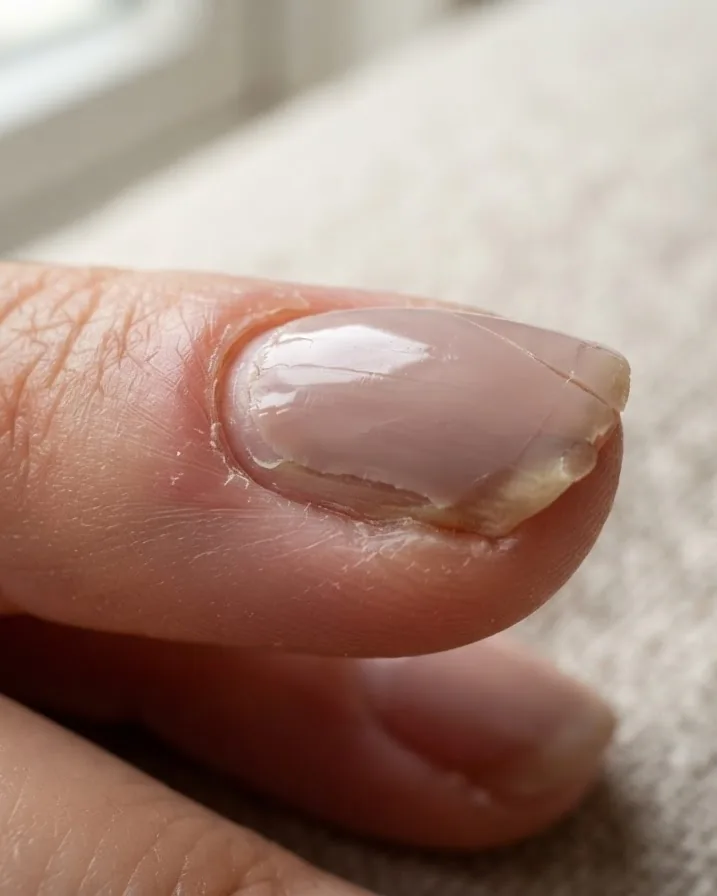
- Nail changes such as thinning, lifting from the bed, or persistent tenderness that outlasts a normal set.
- Reactions that spread beyond the hands, since methacrylate vapor and transfer can affect the face and eyelids.
A dermatologist can patch-test you against specific acrylate and methacrylate allergens and tell you which chemistries to avoid for good. That matters more than any single product choice, because a confirmed methacrylate allergy changes how future dental fillings, bone cement and diabetic sensors are chosen for you.
Troubleshooting lifting, a tacky no-cure layer, and safe removal
Most gel glue problems trace back to three fixable causes: contamination, undercure, or the wrong removal method. Lifting at the edges usually means oil or water sat on the plate before the bond, so the fix is better dehydration and buffing next time, not more glue. A tacky, uncured layer after the lamp means the cure was too short, the lamp is weak or aging, or the glue layer was too thick for the light to reach through; extend the cure and thin the bead. And gel glue must be removed by soaking in acetone, never peeled, because peeling tears layers off the nail plate itself. Liquid cyanoacrylate press-ons come off with gentle filing and acetone soaking too. Forcing either product off is what leaves nails thin and damaged for weeks.
Working fixes for the common failures:
- Edge lifting: re-prep with dehydrator, cap the free edge, and confirm no glue touched the skin, which weakens the plate bond.
- Tacky no-cure layer: lengthen the cure to the full 30 to 60 second window, replace an old lamp, and apply thinner layers so light penetrates.
- Removal: soak in acetone until the product softens, then push it off gently. If it resists, soak longer rather than prying.
- Any allergic sign: stop, remove the product, and get a dermatologist patch test before using adhesives again.
Frequently asked questions about nail glue for gel
Can I use regular nail glue instead of gel glue for soft-gel tips?
Not well. Regular liquid cyanoacrylate glue sets rigid and bonds in seconds, which suits press-ons but cannot flex with a full soft-gel extension, so it lifts at the edges within a day or two. Soft-gel and Gel-X tips are designed for a lamp-cured methacrylate gel glue that stays flexible for weeks. Use liquid glue for short-term tips only.
Why is my gel glue still tacky after using the lamp?
A tacky layer means the cure did not finish. The usual causes are a cure time under the 30 to 60 second window, a weak or aging UV or LED lamp, or a glue bead too thick for light to reach through. Extend the cure, apply thinner layers, and check that your lamp still outputs enough intensity for its wattage.
How do I safely remove gel glue without wrecking my nails?
Soak the nails in acetone until the gel softens, then gently push the product off. Never peel or pry it, since that pulls layers off the nail plate and leaves nails thin and tender for weeks. If it resists, soak longer instead of forcing it. Follow with a nourishing oil to rehydrate the plate afterward.
Is gel glue safe if it is labeled HEMA-free?
HEMA-free lowers one specific risk but is not a safety guarantee. Cross-sensitization means someone already allergic to acrylates can still react, and a documented case describes a reaction to a HEMA-free product marketed as hypoallergenic. If you have any history of adhesive skin reactions, get patch-tested by a dermatologist rather than trusting the label alone.
Does nail glue really cause permanent allergies?
Yes, methacrylate contact allergy is a delayed reaction that develops with repeated exposure and does not reverse once established. A UK and Ireland audit found HEMA the top nail-related allergen, and an Italian study saw HEMA positivity rise from 1.6 percent in 2019 to 2.7 percent in 2023. Keeping glue off skin is the main way to lower that risk.