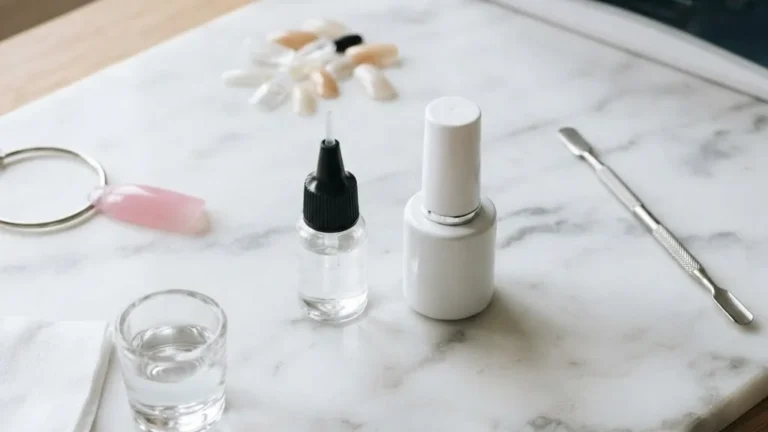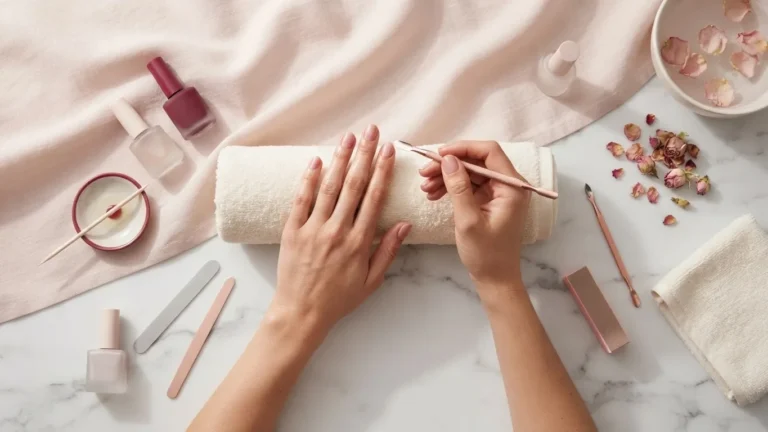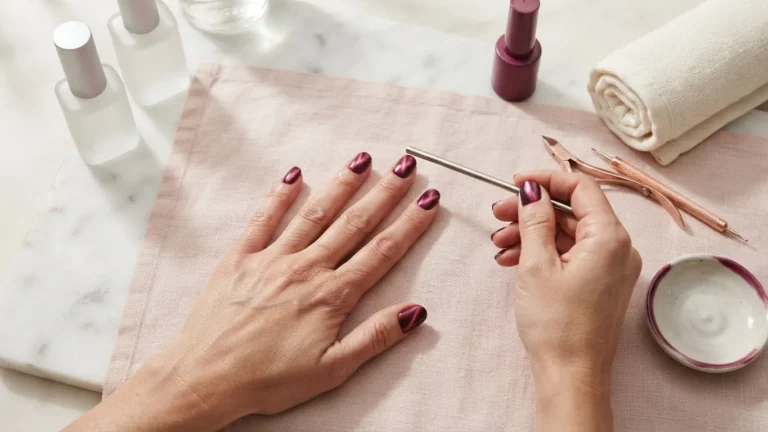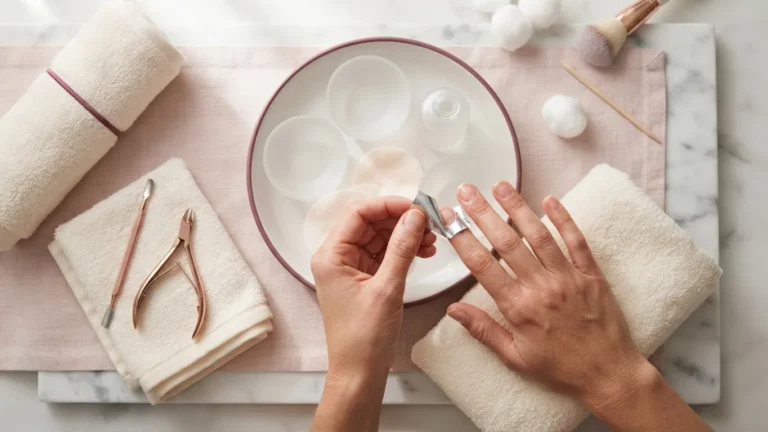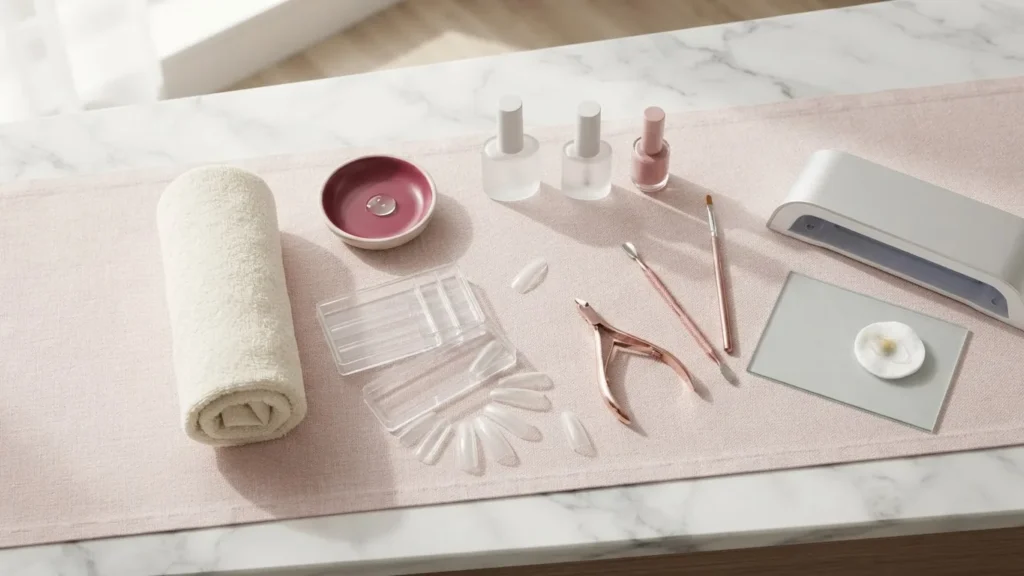
A Gel-X tip is one piece of pre-formed soft gel that covers the whole nail, from the cuticle area out to the free edge. Aprés Nail invented the system in 2017 and describes it as the “world’s first full coverage soft gel extension system”. That material choice decides most of what follows for gel x nail tips: how the tip bonds to your nail, how many weeks it holds, and the one correct way to take it off.
Gel x nail tips are pre-formed, full-coverage soft gel extensions. Each tip is sized to the nail, bonded with a UV/LED-cured gel, and then worn like a gel manicure. Applied well, a set holds up to four weeks before it needs removal or a fill, and it soaks off in pure acetone rather than being pried loose. Because the tip is soft gel, it files and buffs closer to gel polish than to hard acrylic. The cure uses a UV or LED lamp, which is where the only real health question sits. Most nail-plate damage comes from peeling a set off instead of soaking it.
What a Gel-X tip is, set against acrylic and press-ons
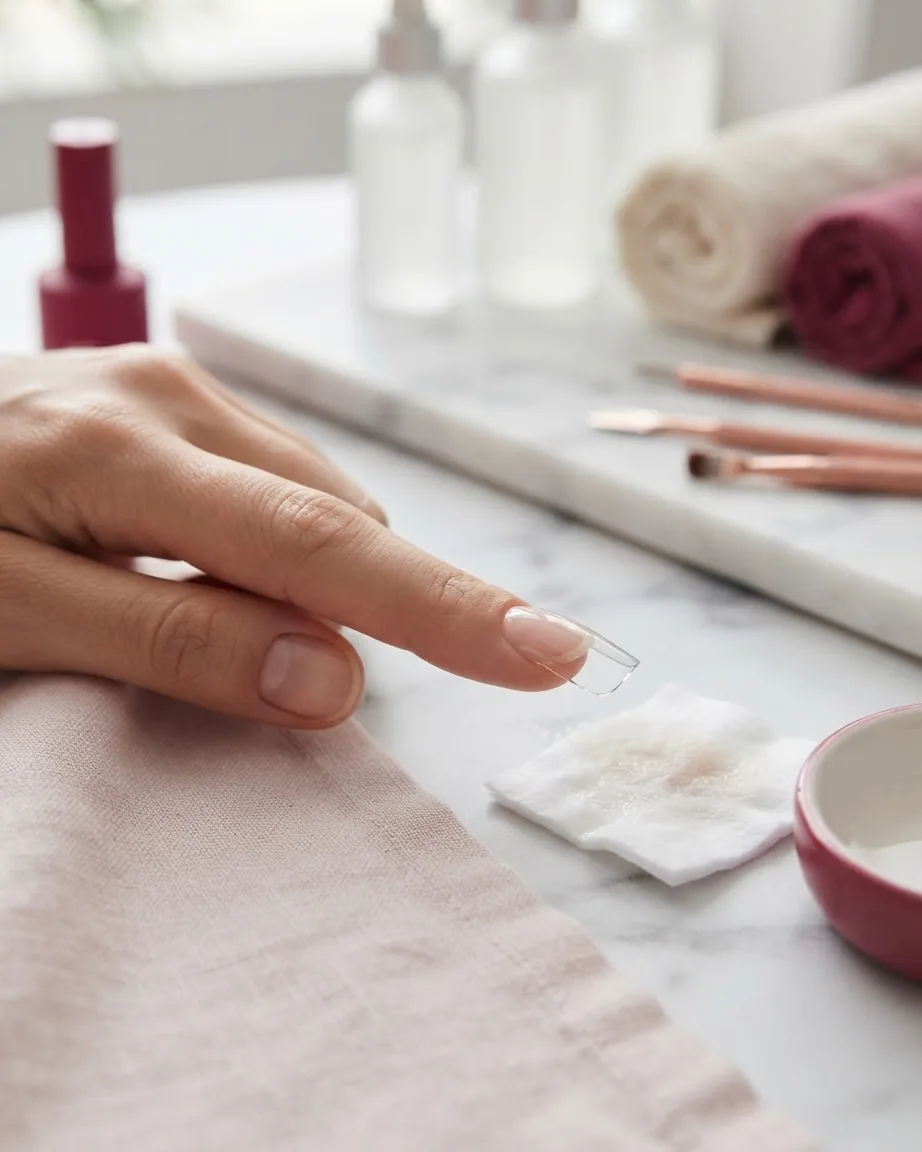
The tip arrives finished. Acrylic extensions get built on the nail from a liquid and a powder, shaped by hand, and need more filing to blend; Gel-X skips the acid primer that some acrylic systems rely on and asks for far less drilling. Press-ons are rigid ABS plastic held down with glue or a sticky tab. Gel-X is soft gel, bonded and light-cured, and it breaks down in acetone the way a gel manicure does. Beyond Polish, an authorized retailer, describes the result as a full-coverage extension that reads like gel polish on a natural nail and soaks off cleanly.
One point worth settling: the material is soft gel, not hard gel, despite the odd page that labels it otherwise. That is why acetone works on it at all – hard gels generally will not soak off. See also: our press on nails last guide.
How long a Gel-X set actually lasts

The sources reviewed do not agree on a single number, and the spread is worth keeping rather than averaging away. Aprés’s own storefront lists 4+ weeks when applied with Extend Gel. The Nail & Beauty Link, a stockist and educator, puts it at up to 4 weeks without lifting, specifically when the application is done correctly. Beyond Polish gives a shorter floor, two to four weeks.
Read together, four weeks is a best-case ceiling under professional-quality prep and sizing, not a promise. Real-world wear often lands nearer the low end of that range, pulled down by fast nail growth, thin prep, or heavy hand use. Treat the four-week figure as condition-dependent. See also: our acrylic nail tips last guide.
How to size gel x nail tips sidewall to sidewall

Sizing is where a set succeeds or lifts early. Each tip has to span the nail sidewall to sidewall. Pick one too narrow and you leave a gap along the edge; that gap is the first place water and air get under the gel, and it lifts. Too wide and the tip rides up the sidewall skin, which also fails. Dry-fit every finger before bonding anything.
Aprés sells Gel-X in two box sizes, 280 and 600 pieces. The 600-piece boxes carry 14 sizes, including half sizes 4.5, 5.5 and 6.5 for the fingers that fall between whole sizes. The brand also splits tips into Natural and Sculpted lines, chosen by nail-bed shape: flatter, wider beds tend to fit one line while deeper, more curved beds fit the other. Matching the line to your nail shape is part of getting a flush, lift-resistant edge.
The Extend Gel bond and the UV/LED cure
Gel-X bonds with Aprés Extend Gel, the adhesive gel that also doubles as a builder, and it sets under a UV or LED lamp. A standard application sequence runs like this:
- Push back and tidy the cuticle, then take the shine off the nail plate with a soft buffer.
- Wipe the plate with a dehydrator and apply a non-acid primer to the nail only, never onto the surrounding skin.
- Match each tip sidewall to sidewall and dry-fit it against the nail.
- Apply a bead of Extend Gel per the brand’s instruction, seat the tip at an angle, and hold it in place.
- Cure under a UV/LED lamp for the time your lamp and gel specify.
- Shape, refine, and finish with a gel top coat, curing once more.
The primary sources do not publish one fixed cure time, so follow the duration printed for your specific lamp and gel rather than a number from a stranger’s kit. A step-by-step walkthrough is published by Sophie Cress if you want the full visual sequence.
The UV lamp trade-off at the cure step

Every Gel-X set passes under a UV/LED lamp, and that step carries the one genuine health question in the whole process. In a 2023 study published in Nature Communications on January 17, researchers at UC San Diego reported that a single 20-minute session under these UV-emitting devices killed up to 30 percent of exposed cells, and three 20-minute sessions – 20 minutes a day across three days – killed up to 70 percent. The surviving cells showed DNA damage and mutations. Ludmil Alexandrov, a UC San Diego professor and the study’s corresponding author, led the work.
The science outlet Technology Networks, summarizing the same study, noted that the band of UV these dryers emit, which reaches 395 nm, “has not been well studied”. Separately, board-certified dermatologist Dr. Chris G. Adigun has warned that repeated UV exposure from gel manicures raises a skin-cancer concern.
Against that, the FDA considers UV nail dryers low risk when used as directed, as reported by NBC Washington. The study authors themselves have said large population studies are still needed before anyone can claim these lamps cause cancer in people. So the honest position is this: there is laboratory evidence of cell death and DNA damage, a regulator calling the devices low risk as directed, and a dermatologist flagging caution – and no proof of human causation yet. The protective move is cheap and backed by the same reporting: shield the hands, with fingerless UV-blocking gloves or sunscreen on the hands before curing. This applies to every gel cure, not Gel-X alone, and an LED lamp is not a loophole – LED nail lamps emit UV in the same range. Any ongoing nail or skin change belongs with a professional, not a guide.
Is Gel-X really the “healthier” extension?
The “healthier option” label is partly fair and partly a blind spot. The fair part is narrow: Gel-X uses no rigid ABS plastic the way press-ons do, it skips the acid primer some acrylic work needs, and it takes far less filing of the natural nail than a sculpted acrylic set. Those are real differences in how much the nail plate gets stressed. The blind spot is the cure. None of those gentler mechanics cancel the UV exposure every set requires, and swapping UV for LED does not remove it. If nail health is your actual question, that is a conversation for a licensed professional.
Taking Gel-X off: acetone soak, never peel
Because Gel-X is soft gel, it comes off the way a gel manicure does: a soak in pure 100% acetone, which breaks the gel down so it lifts off the plate. Aprés’s storefront confirms the soft-gel material soaks off with acetone. The failure mode here is peeling. Pulling a lifting edge rips away layers of the nail plate with it, and that thinning is the damage people blame on the product when it was the removal. A removal walkthrough makes the same no-peel point plainly.
Work in a ventilated spot, keep acetone off broken skin, and wash it off if it contacts skin; if irritation persists, stop and see a professional. See also: our removing dip nails at home guide.
What the sources don’t pin down
Two reader questions stay genuinely open after checking the primary and retailer pages. The first is whether Gel-X tips are single-use or reusable – the reliable sources simply do not make a clear statement either way, so anyone claiming a firm answer is going past the evidence. The second is the exact acetone soak time. The manufacturer and retailers confirm acetone removal but publish no fixed minute count, and the precise timings floating around appear only on pages too unreliable to repeat. Until a primary source states a number, soak until the gel is soft enough to slide off with no force, and never rush it with a scraper.
The repeat-cure math: 40 more minutes, 40 more points of cell death
The UC San Diego numbers get easier to weigh once you run them out. A single 20-minute cure sat at up to 30% cell death. The chronic pattern the researchers tested was 20 minutes a day for three days, so the total exposure behind the 70% figure is 20 × 3 = 60 minutes of lamp time, not 20. The jump from one cure to that three-cure pattern is what the arithmetic makes visible:
- Cumulative exposure at 70% death: 20 min × 3 sessions = 60 minutes total under the lamp.
- Added lamp time: (3 − 1) × 20 = 40 more minutes of exposure than a one-off cure.
- Added cell death: 70% − 30% = 40 more percentage points of exposed cells killed.
So the two extra sessions buy you 40 more minutes of UV and, in these cells, 40 more percentage points of death – a one-to-one line that makes the case for shielding your hands at every cure, not just occasionally. These are in-vitro cell results, the FDA still calls the devices low risk as directed, and the study authors say human population data is not in yet, so treat the figures as a reason for caution, not proof of harm to you.