Can u bring nail polish on a plane is the question, and checked baggage is not the free-for-all most packing lists imply: the Federal Aviation Administration caps the total medicinal and toiletry articles one person may check at 2 kg or 2 L, with no single container over 500 ml. So the real question of whether can u bring nail polish on a plane splits into two separate answers – one for the bag at your feet, one for the bag in the hold – and the second answer is the one travelers usually get wrong. The Transportation Security Administration treats polish as a liquid, which pulls it under the 3.4oz carry-on limit and, in checked bags, under an FAA hazmat exception that exists because polish is a flammable liquid.
Both answers are set by federal rules, and in a dispute at the lane, one person outranks the printed rule. This guide states each limit, the figure that governs it, and the point where the number stops mattering.
What the 80-Word Version Says
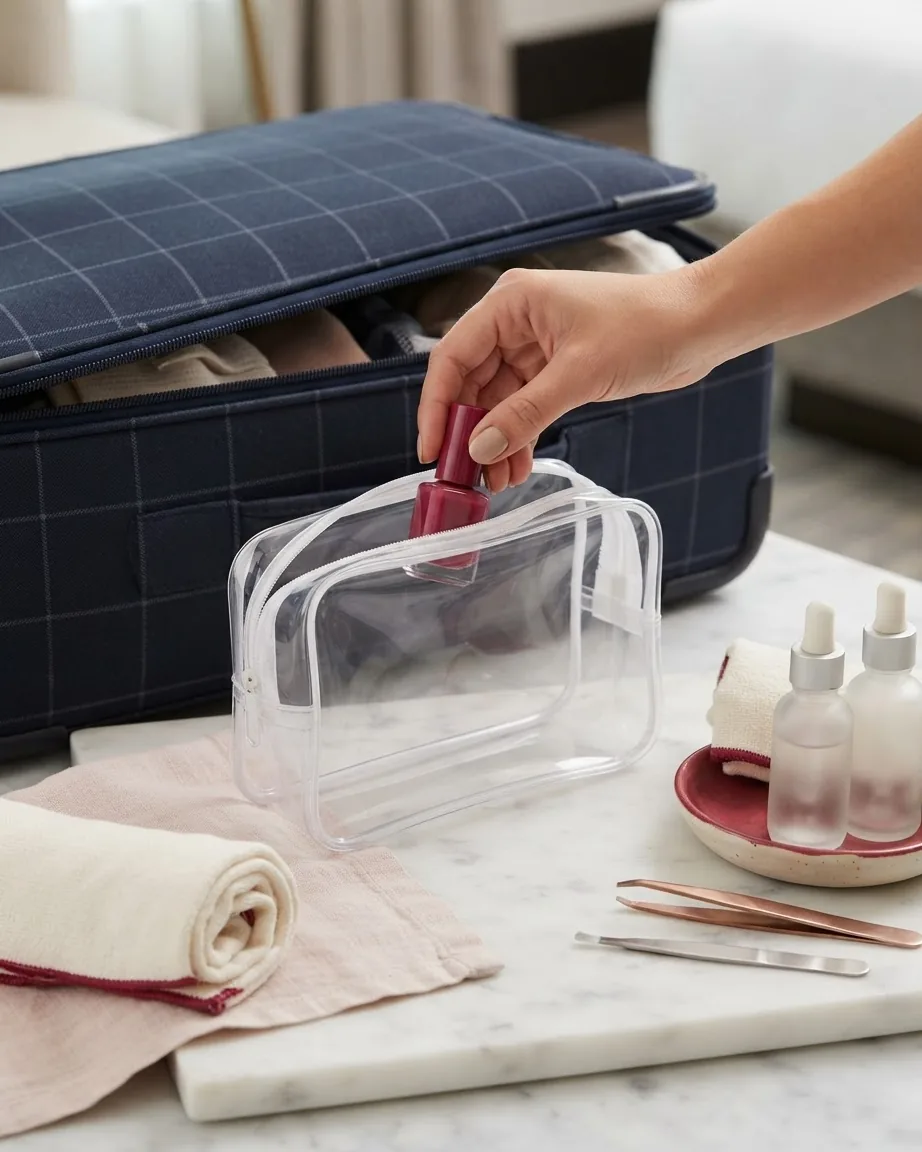
Yes, you can bring nail polish on a plane. In carry-on, each bottle must be 3.4oz/100ml or smaller and fit inside your single quart-sized liquids bag. In checked baggage, polish falls under the FAA medicinal and toiletry exception: no container over 0.5 kg (18 ounces) or 500 ml (17 fluid ounces), and all such articles together capped at 2 kg (70 ounces) or 2 L (68 fluid ounces) per person. Checked is not unlimited, despite what many packing guides claim. The screening officer at the checkpoint makes the final call regardless of size.
Nail Polish in Carry-On: The 3.4oz/100ml Ceiling
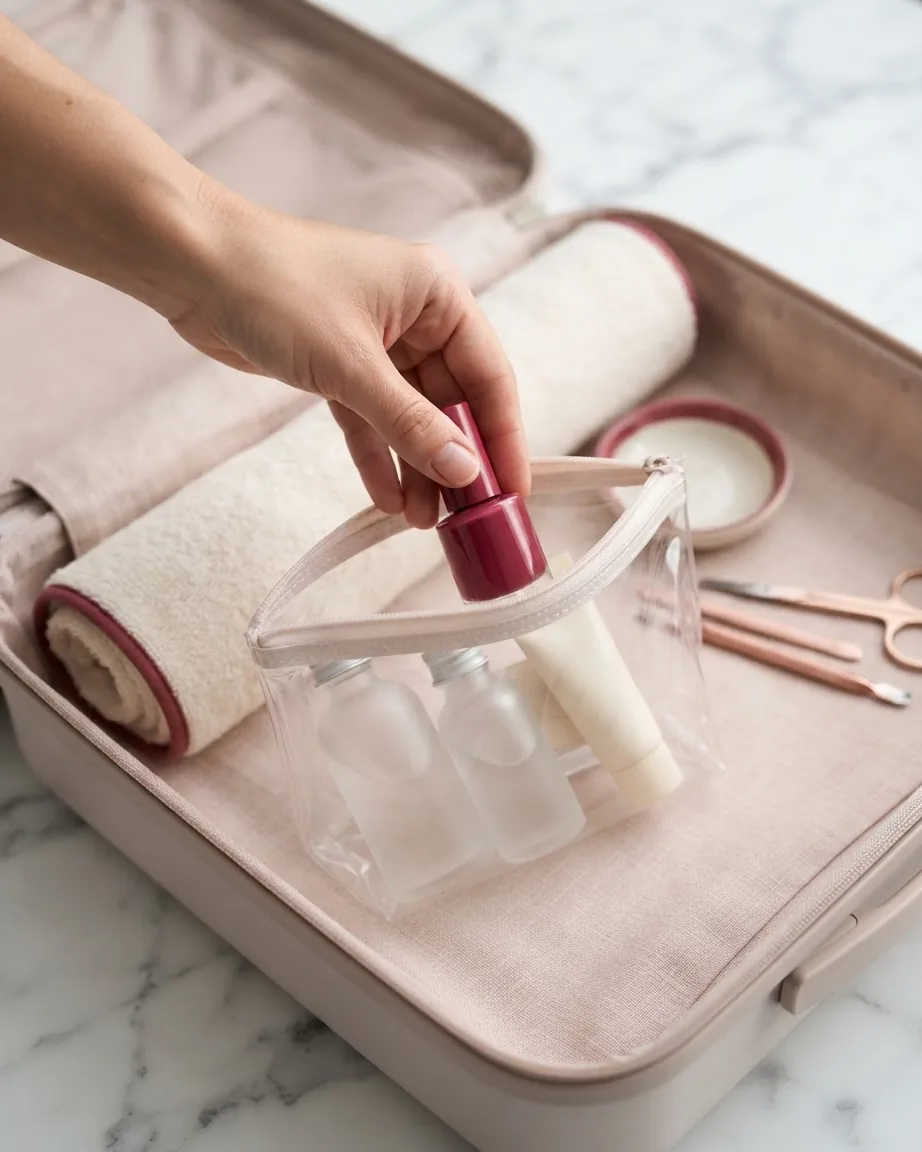
Polish rides in your carry-on the same way shampoo or perfume does. The TSA lists nail polish as “Carry On Bags: Yes (Less than or equal to 3.4oz/100 ml allowed)” – the standard liquids ceiling. Each bottle has to sit at or below 3.4 ounces (100 milliliters), and every liquid container you carry has to fit inside one quart-sized clear bag, one bag per passenger.
A standard polish bottle runs well under that line, so volume is almost never the problem in carry-on. The limit bites on how many bottles crowd the quart bag, not on the size of any one of them. The TSA’s own liquids guidance repeats the figure plainly: travel-sized containers that are “3.4 ounces (100 milliliters) or less per item,” while anything larger is told to go into checked baggage instead.
One wrinkle worth knowing: the quart-bag framing – what the TSA brands the “3-1-1” rule – is a US convention, not a global one. The 100ml container figure travels well; the bag-and-labeling system does not, which matters if you connect through a foreign airport.
Is There Actually a Limit on Nail Polish in Checked Luggage?
This is the myth-correction section. Plenty of packing guides state there is no quantity restriction on liquids in checked bags. That is wrong for nail polish, and the error is not small.
Because polish is a flammable liquid, it moves through checked baggage under the FAA’s medicinal and toiletry article exception rather than as a plain liquid. The FAA’s PackSafe page sets two hard ceilings: “The total aggregate quantity per person cannot exceed 2 kg (70 oz) or 2 L (68 fl oz),” and each container is capped separately. The TSA mirrors the aggregate figure word for word on its nail polish entry.
The per-container cap is where the sources disagree, and the disagreement is worth flagging rather than hiding. The same TSA nail polish page has been quoted two ways:
- As “The capacity of each container must not exceed 0.5 kg (18 ounces) or 500 ml (17 fluid ounces)” – matching the FAA’s PackSafe wording exactly.
- As “5 kg (18 ounces) or 500 ml (17 fluid ounces)” in a second reading of the same URL – almost certainly a dropped decimal.
The 500 ml / 17 fluid ounces figure is consistent across every version, and it aligns with the FAA page. The weight should read 0.5 kg (18 ounces); a 5 kg bottle of nail polish does not exist, so treat the “5 kg” rendering as a typo and work to the 0.5 kg per-container line.
How many bottles that allows is not something this guide will hand you as a number, because it cannot be computed honestly: the 2 L aggregate and the 500 ml per-container maximum are the only sourced volumes. There is no verified standard-bottle size behind these rules to divide into the cap, so any “fits X bottles” figure would be invented. Weigh your own stash against 2 kg / 2 L and keep every bottle under 500 ml.
Why Nail Polish Draws More Scrutiny Than Other Liquids
Nail polish is not screened like water or lotion because it is flammable. That is the whole reason it rides under a hazmat exception in the first place – the “medicinal and toiletry articles” category the FAA uses to permit small quantities of otherwise-regulated substances that a passenger genuinely needs for personal use. Polish, polish remover, and similar cosmetics qualify because they are things you apply to your body, which is the practical test for what the exception covers.
That framing explains the caps. The 2 kg / 2 L per-person aggregate and the 0.5 kg / 500 ml per-container limit are not arbitrary cosmetic restrictions; they are the ceiling the FAA sets on how much flammable toiletry material one passenger may load into a pressurized hold. It also explains why an officer may give a bag of polish a second look even when every bottle is clearly under 3.4oz.
Can You Paint Your Nails During the Flight?
Bringing polish aboard and using it aboard are different questions. Painting your nails in your seat is not illegal, but it is discouraged, and at least one carrier bars it outright. ABC News reported, with an on-record airline spokesperson, that American Airlines does not allow passengers to use nail polish on its flights. The FAA’s guidance on odor- and vapor-producing items is to consult the crew – polish fumes in a sealed cabin are the concern, not the manicure itself.
The downside of a cabin application is not only social. ABC News also documented the extreme end of a nail-polish dispute aboard a flight, in which a passenger “spent 10 hours in jail for using abusive profane language, though the charges were later dropped by the DA.” The flashpoint was a disagreement about painting nails in-cabin. Read that as a reason to ask a flight attendant first, or simply to wait until you land.
If you do want the manicure to survive the trip rather than ride wet in your bag, the relevant variable is cure time – see our guide on how long nail polish dries.
What If the TSA Officer Still Says No?
Every figure above can be correct and your polish can still be turned away. The TSA states it directly at the bottom of its nail polish page: “The final decision rests with the TSA officer on whether an item is allowed through the checkpoint.” That sentence governs the entire lane.
Practically, this means size compliance is necessary but not sufficient. An officer can pull a bottle for additional inspection, question an unlabeled container, or decline an item that reads as a hazard regardless of its stated volume. There is no appeal at the belt. If a bottle you care about is borderline – oversized, leaking, or unmarked – the safer play is to check it within the FAA caps rather than argue the carry-on line.
How the US Liquid Rules Compare Abroad (UK)
The 100ml container limit is widely shared across airports, but the US “3-1-1 / quart-bag” packaging language does not travel with it. UK hand-luggage guidance from gov.uk states that “at most airports, you cannot take liquids in containers larger than 100ml through security,” and adds that this still applies when the container is only part full. Same headline number, different system around it.
Two cautions. First, there is a provenance wrinkle worth being honest about: readings of the gov.uk liquids page disagree on whether the 100ml figure sits on the main text or on a linked page, so verify the current wording on the official site before you fly. Second, UK airports are rolling out newer scanning equipment at different speeds, which means the container limit you meet at one terminal may differ from the next. Check your specific departure airport rather than assuming a single UK-wide number.
Brand Blogs Say Different Things – Here’s Which to Trust
Cosmetic brand blogs cover this question too, and they do not all agree with the federal rules.
Londontown’s blog, by contrast, states there are no specific quantity restrictions for liquids in checked bags – which understates the real FAA ceiling. Where a brand post and the TSA or FAA conflict, the federal source wins: the 2 kg / 2 L aggregate and 0.5 kg / 500 ml per-container limits are the operative numbers for a US departure. Brand content is useful for polish, not for hazmat law.
Adjacent Items: Remover and Gel Lamps
Nail polish remover is governed by the same liquid logic as polish: acetone-based remover is a flammable liquid, so it rides under the 3.4oz/100ml carry-on ceiling and the FAA toiletry caps in checked bags. If you are more interested in what actually dissolves a cured finish than in packing it, see our breakdown of gel nail polish remover.
UV and LED gel lamps are a different category – electronics, not liquids – and in practice travel like other small devices rather than under the liquids rule. The specific screening treatment for these lamps was not confirmed against a federal source for this guide, so pack them in carry-on where battery-powered electronics are expected, and confirm with your airline if a lamp has a built-in battery.
The Numbers to Pack By
Reduced to the figures that decide what happens at the airport: carry-on polish must be 3.4oz/100ml or smaller per bottle, inside one quart bag. Checked polish must stay under 0.5 kg (18 ounces) or 500 ml (17 fluid ounces) per container, with all toiletry and medicinal articles together under 2 kg (70 ounces) or 2 L (68 fluid ounces) per person. Anything you cannot fit under those limits ships ahead or stays home.
Quick Answers Before You Pack
Does polish count against my one quart liquids bag?
Yes. In carry-on, polish is screened as a liquid, so each bottle under 3.4oz has to share your single quart-sized clear bag with every other gel, cream, aerosol, and liquid you carry. A dozen tiny bottles can breach the bag limit long before any single one breaks the per-container ceiling. Oversized bottles go in checked baggage instead.
A 6-ounce bottle sits under the 18-ounce (0.5 kg) and 500 ml per-container maximum, so a single container that size is within the FAA ceiling. The constraint is the 2 kg / 2 L per-person total across all your toiletry articles combined, not that one bottle. Tally everything flammable and cosmetic together against that aggregate.
Is painting my nails before the flight a better bet?
For avoiding both the odor objection and a half-dry spill in your bag, finishing a manicure before you reach the gate sidesteps the in-cabin question entirely. Cure times run longer than most people expect, so allow generous drying time at home. Carrying a sealed bottle for a touch-up is fine; opening it mid-flight is the part carriers push back on.
What happens if my checked polish exceeds 2 kg total?
Exceeding the 2 kg (70 ounces) or 2 L (68 fluid ounces) per-person aggregate puts you outside the FAA medicinal and toiletry exception, which is the only permission letting flammable cosmetics ride in the hold at all. Split the load across travelers if each stays under the cap, or ship the overflow separately rather than risk the whole bag being flagged.
Carry-On vs. Checked: How Much Bigger a Single Bottle Can Be in the Hold
The two caps that govern a single bottle aren’t the same number, and the gap decides which bag an oversized bottle belongs in. Carry-on holds each container at 3.4oz/100ml; checked baggage, under the FAA toiletry exception, allows each container up to 17 fl oz/500ml. Divide one by the other and the checked per-container limit is exactly five times the carry-on limit – so a bottle too big for the quart bag isn’t necessarily too big to fly, it just rides in the hold.
- 500ml ÷ 100ml = 5×: a checked container may be five times the volume of a carry-on one.
- 17 fl oz ÷ 3.4 fl oz = 5×: the same five-to-one ratio holds in US customary units.
- 500ml − 100ml = 400ml of extra headroom per container the moment a bottle moves from carry-on to checked.
Remember this only sets the per-container ceiling. All your checked polish still has to stay under the 2kg/2L per-person aggregate, and the officer at the lane has the final say.