Drafted with AI language models. How this page was made
Before a single drop of remover touches the pile, one question settles almost everything: what is the carpet made of? Acetone lifts polish from nylon, polyester, and olefin, but on acetate and triacetate it does not clean, it destroys. So the correct order for how to get nail polish out of carpet is fiber first, agent second, blotting technique third. Rushing to the solvent is how a small spill becomes a permanent patch of bleached or dissolved pile.
The other trap is motion. HGTV warns that scrubbing wet nail polish “will just distribute the polish… forcing it to set in faster.” Pressure, not friction, is what you want.
Quick answer: To get nail polish out of carpet, blot (never scrub) excess polish first, then identify your fiber. On nylon, polyester, or olefin, dab a cotton ball with non-acetone remover or rubbing alcohol, working from the edges inward and changing cotton often. Never use acetone on acetate, triacetate, or modacrylic: it dissolves or melts them. On wool and other natural fibers, skip harsh solvents, which bleach. For dried polish, scrape the surface flakes off with a dull edge first, then re-wet. Pretest any agent on a hidden patch. Apply with an eyedropper or cotton ball, never pour, and stop before the backing gets soaked.
Wet nail polish: blot, then dab with non-acetone remover or rubbing alcohol

A fresh spill is the best case you will get, because dried polish grips the fibers as it hardens. Act while it is still liquid.
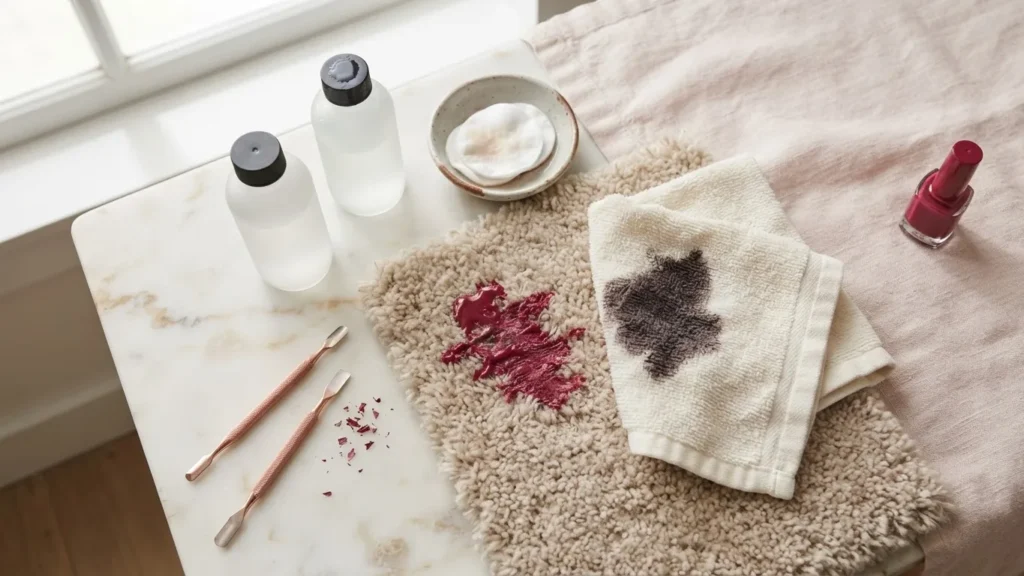
- Blot the pooled polish off the surface with a clean cloth, pressing and lifting rather than wiping sideways.
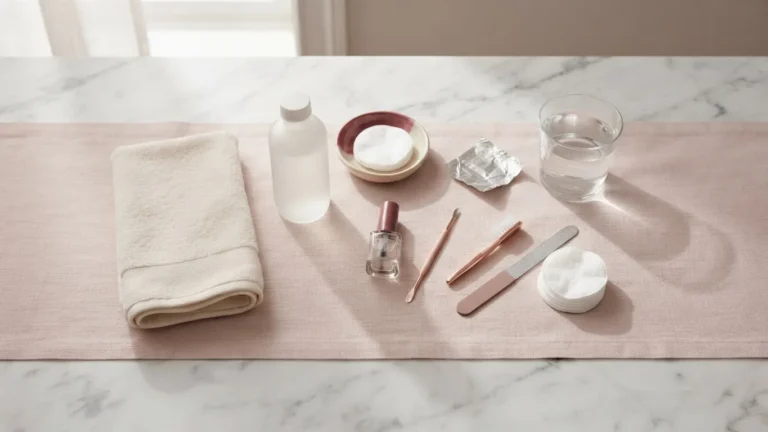
- Soak a cotton ball with non-acetone nail polish remover, as HGTV recommends.
- Dab the spot lightly while it is wet.
- Alternate between the cotton ball and a clean cloth to pull the loosening color back out.
- Apply only enough to dampen the spot, never enough to saturate the fibers completely.
No non-acetone remover in the house? Rubbing alcohol (isopropyl) works on the same principle and tends to be gentler on most carpets, which is why Fantastic Services lists it as the solid backup to acetone-free remover. Rotate in fresh alcohol-soaked cotton and clean cloths each pass so you are not pressing lifted pigment back down into the pile.
Throughout, keep the motion controlled. Fantastic Services describes the correct press: “Press gently onto the soiled area, starting at the edges and working your way in.” You will know it is working when color transfers to the cloth.
Dried nail polish: scrape the flakes first, then re-wet to soften
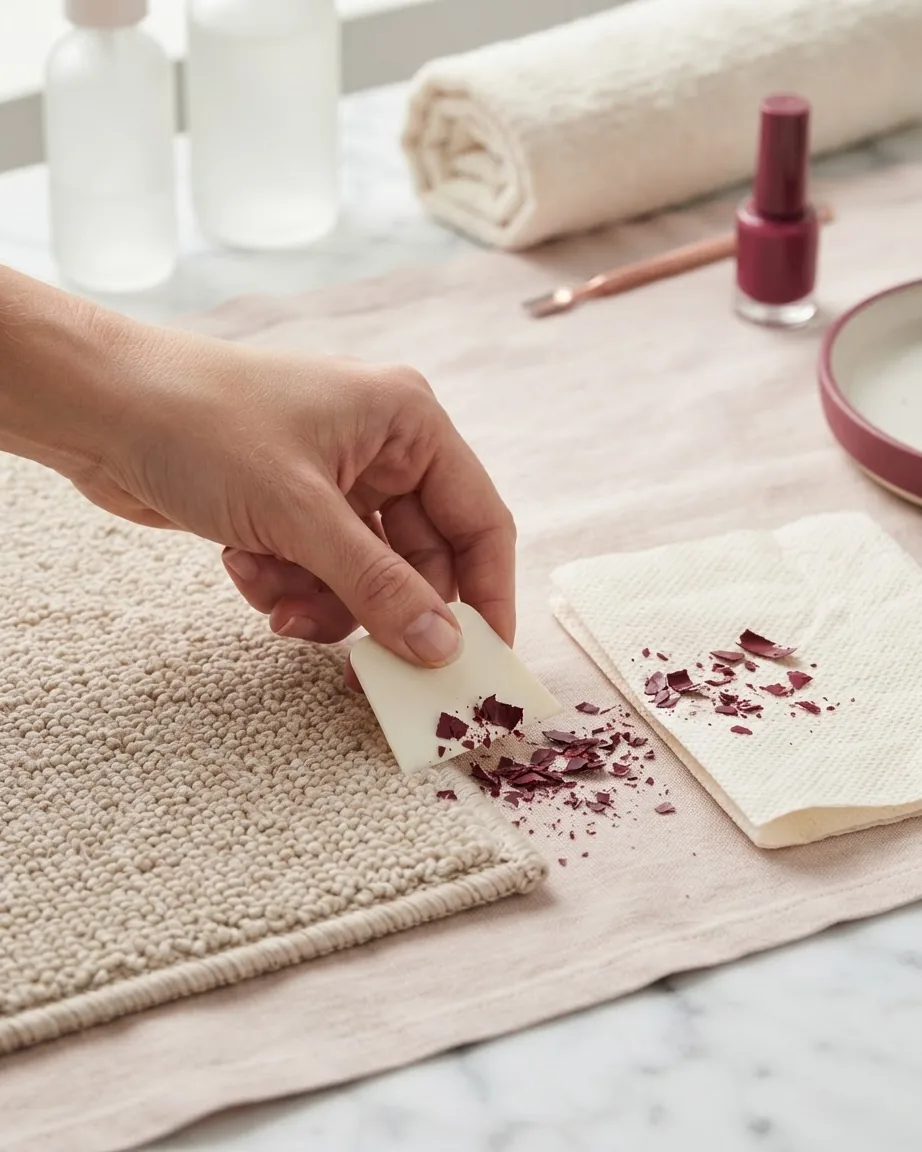
Dried polish behaves like thin plastic sitting on top of the fibers, so the first move is mechanical, not chemical. Lift off as much hardened polish as you can before any liquid goes near it.
Fantastic Services recommends a plastic scraper, butter knife, or an old loyalty card (nothing sharp) worked slowly under the dried edges to flake it up, scooping away the bits with a dry paper towel as you go. The more you remove dry, the less you have to soak the carpet later.
Once the surface flakes are gone, re-wet what remains. For stains that have already set, re-wet with nail polish remover as a pre-treating solution, then supplement with hairspray or a dry-cleaning solvent for extra power. Hairspray carries a real condition, covered below, before you reach for it.
Is acetone safe on carpet? It depends entirely on the fiber
This is where the sources genuinely split, and the split is the useful part: do not flatten it into a single yes or no. Acetone is a strong solvent, and whether it rescues your carpet or ruins it is decided by what the carpet is woven from.
Molly Maid treats acetone as the primary agent, applied with care: acetone “can get between the chains of the polymers that make up nail polish, separating them and allowing them to be wiped away.” But the same page warns that “too much acetone can corrode your carpet and its backing.” HGTV draws a harder line on certain fibers: “Never use acetone remover for cleaning nail polish off of carpet that contains acetate, triacetate or modacrylic.” Bane-Clene documents the chemistry behind the damage, noting that “Acetone dissolves acetate fibers” and that removers can bleach carpet if left on too long.
Fantastic Services pushes the caution further for soft, natural carpets: “Wool and natural fibres don’t react well to harsh solutions like acetone or peroxide. They bleach easily.” The University of Georgia Cooperative Extension allows acetone as a substitute for amyl acetate on natural, synthetic, and wool carpet, but adds a sharp caveat that “fingernail polish remover is not pure acetone and the other ingredients included in these products can make the stain worse. Use at your own risk,” and flatly prohibits it on acetate and triacetate.
How to resolve it for your situation: if you know the carpet is nylon, polyester, or olefin, acetone applied sparingly is a defensible option. If it is wool or another natural fiber, avoid acetone and reach for the gentler non-acetone or alcohol route. If it contains acetate, triacetate, or modacrylic (or if you simply do not know) do not risk acetone at all. The named fiber lists differ slightly across sources (HGTV names acetate, triacetate, and modacrylic; the University of Georgia names acetate and triacetate; Bane-Clene singles out acetate dissolving), so treat any of those names as a stop sign.
Household products that work versus the ones that backfire
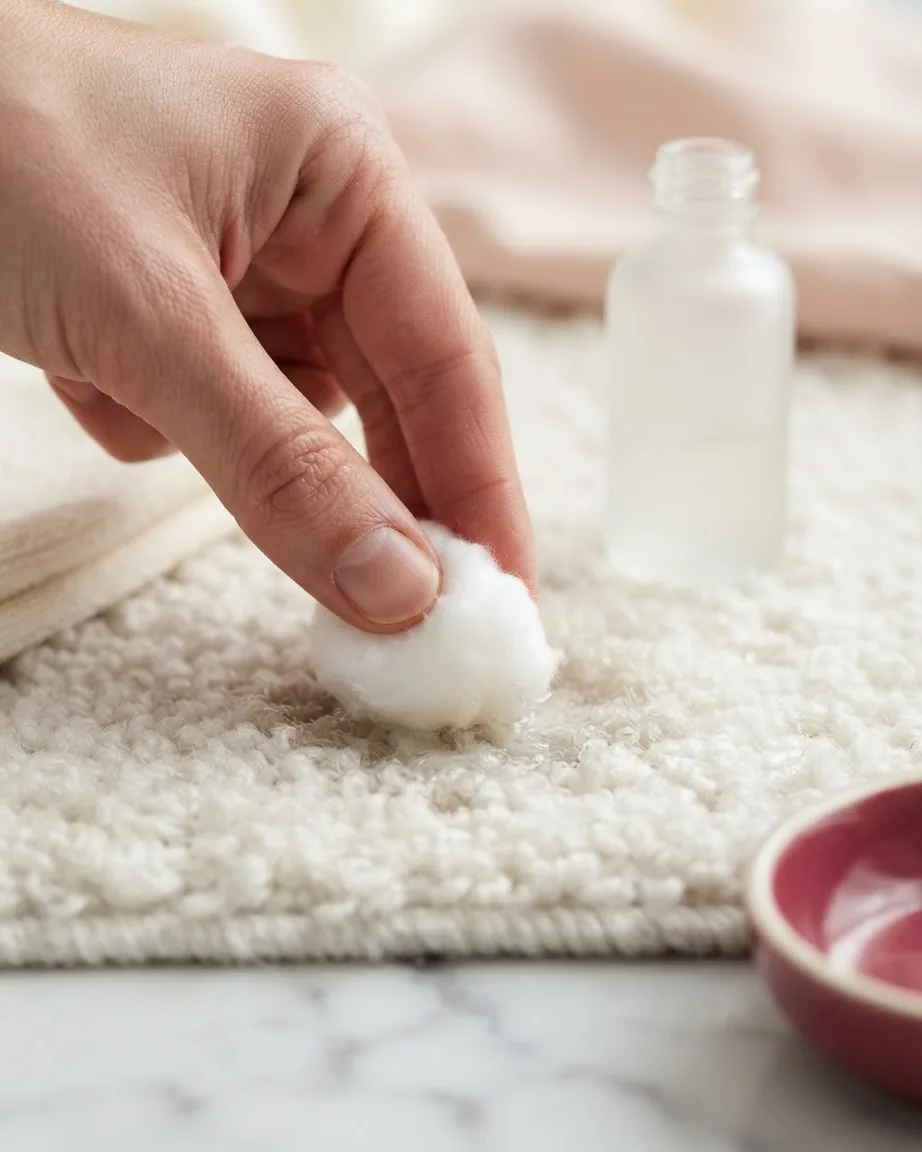
Your bathroom cabinet holds both genuine helpers and traps. Sorting them saves you from cleaning two messes.
Among the agents that have a real basis: ammonia-based window cleaner can loosen and dissolve polish when blotted up, and HGTV notes it must be ammonia based to work. For light surface marks with no alcohol on hand, Fantastic Services suggests one part white vinegar to two parts water, with a pretest on dark carpet since the dye can shift. On white or very light carpet only, the same source allows hydrogen peroxide at a 3% solution “straight from the bottle: no need to dilute it further,” applied by cotton ball, never poured; anything darker than beige can change color.
Hairspray is the conditional one. HGTV and COIT present it as a working method: HGTV notes “the most effective hairspray has a higher ratio of alcohol,” and COIT’s routine is to spray 15 to 20 pumps of hairspray followed by three to five small splashes of rubbing alcohol. Fantastic Services pushes back: hairspray “comes with added fragrance, sticky binders, and a high chance of making things worse.” The resolution is in the formula; a high-alcohol, low-additive hairspray can help; a scented, resin-heavy one can add a second mess. If you cannot read the alcohol content, skip it.
The clear backfires, per Fantastic Services: WD-40 “can lift any polish, but it’s gritty and leaves behind a film”; hand sanitizer’s added moisturizers, colors, or gels can stain or leave residue; and mixing products is a hazard of its own, since “blending products is risky as well since it can cause stains or release” fumes. Pick one method, rinse, and only then try another.
Cleaning up spilled nail polish remover: the acetone emergency nobody warns you about
Knocking over the remover bottle is worse than the polish, because acetone attacks the carpet’s structure, not just its color. Bane-Clene is blunt: “Acetone and nail polish removers will destroy carpet backing and some carpet pads,” and if it soaks through, “the carpet may buckle up and come unglued. A professional may be required to re-glue the carpet or replace the damaged area.”
Move fast. Blot the liquid with a dry, white absorbent cloth to pull up as much as possible before it migrates into the backing. Then neutralize with the dilution Bane-Clene specifies: 1/4 teaspoon of dishwashing liquid (not laundry detergent) in 1 cup of lukewarm water. Work the solution in gently from the edges to the center with a white cloth, no rubbing, blot it back up, repeat until clear, then rinse with cold water and blot dry.
One hazard almost everyone misses: the cloths themselves. Bane-Clene warns that “towels and washcloths used to remove acetone or nail polish remover will be flammable until the solvents have completely evaporated”, so lay them outside to dry rather than tossing them in a hamper or dryer.
Pretest for colorfastness before any agent goes on the stain
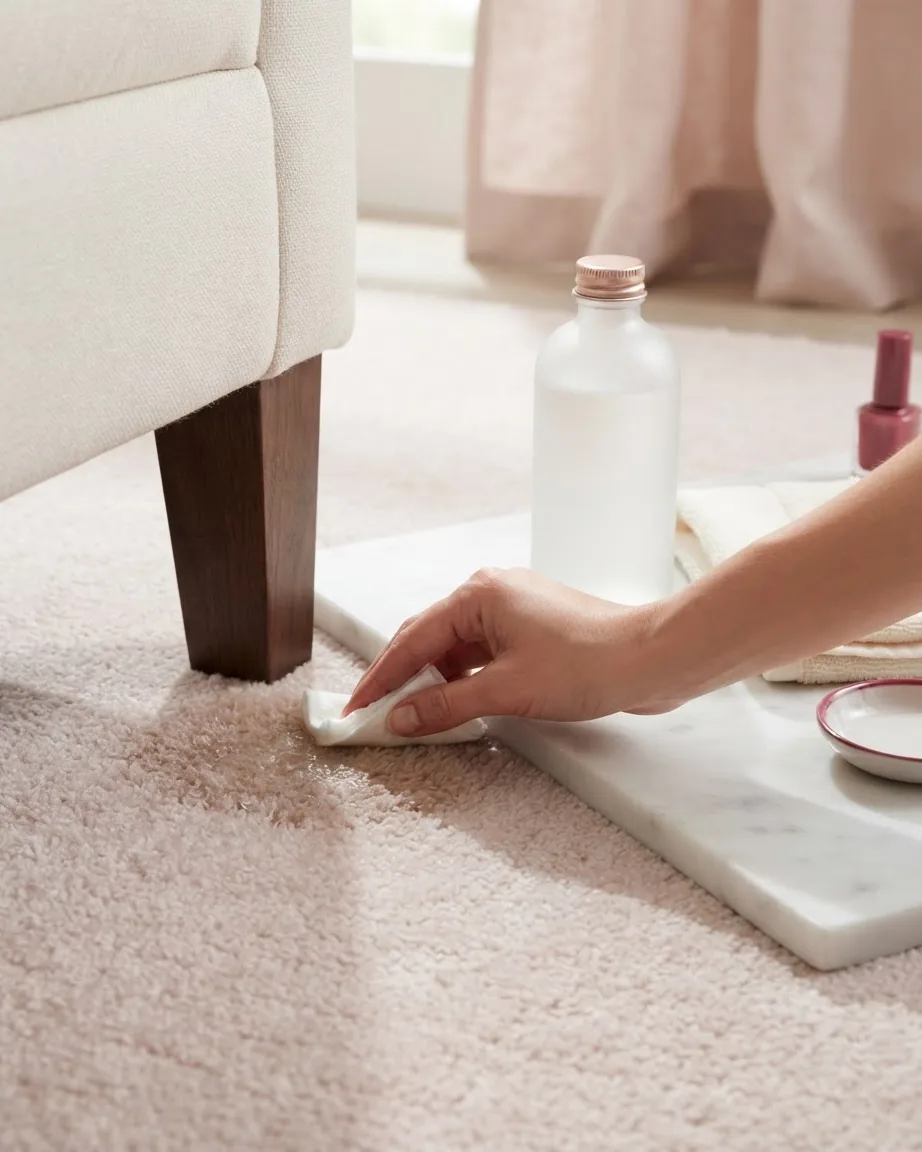
Every method above assumes one skipped step that quietly protects the rest. Before you treat the visible stain, test the agent where no one looks: an edge under furniture, inside a closet, the back corner of a rug.
COIT states it plainly: “Remember to always do a spot removal test on a portion of carpet or upholstery that is normally not visible.” The University of Georgia Cooperative Extension gives the same instruction as a standing rule: “Always pretest each cleaning agent on an inconspicuous area first to determine colorfastness.” Dab the agent on the hidden spot, wait, and check for color lifting or fiber change. If the dye moves there, it will move on the stain too, and you have just saved yourself a bleached patch in the middle of the room.
Apply with a dropper, not a pour: how to avoid soaking the backing
The single control that separates a clean fix from structural damage is how much liquid reaches the base of the pile. Solvent that sits on the fiber tips lifts polish; solvent that runs down into the backing and padding can wreck them.
Molly Maid’s method is to apply acetone with an eyedropper, a cotton ball, or the bottle’s own lid (a few drops at a time) precisely because “too much acetone can corrode your carpet and its backing.” Pouring defeats this. The University of Georgia Cooperative Extension extends the warning to any solvent: when using solvent-based cleaners, “be careful not to overwet the carpet or the fabric. Solvents can destroy the carpet backing and foam padding used in upholstery.”
So meter the liquid, blot between passes, and let the agent do its work on the surface rather than flooding it downward. For a different liquid-control problem (stripping color off your own nails without a bottle of remover) see our remove nail polish without remover guide. And when a gel bottle refuses to touch cured color, our note on nail varnish remover for gel explains why.
When to stop DIY: trim the tufts, or call a professional
Some marks and some damage are past home treatment, and recognizing the line keeps you from making it worse.
If the polish stays on the very tips of the pile and will not lift, a careful trim can retire it. HGTV’s last-resort move is to let the polish fully air dry, then use sharp scissors to trim the tips of the carpet: easiest on shaggy or varied-texture carpet where the cut hides, riskier on low pile where you can create a bald spot. Good Housekeeping frames the same tactic as “snipping off the tips of the carpet tufts,” and labels it a last resort for a reason.
Call a professional when the problem has moved from the fiber to the structure. If remover has buckled the carpet or unglued the backing, Bane-Clene notes a professional may be required to re-glue or replace the damaged area: not a trimming job. Delicate constructions such as wool or looped pile also tend to need expert handling or steam cleaning rather than more solvent. Professional cleaners perform at a scale that reflects how routine this work is: Molly Maid reports that 90 percent of its cleaning services last year were for repeat customers. For nail-health concerns tied to any of this, see a qualified professional: that is outside what a stain guide can address.
Frequently asked questions
How to get dried nail polish out of carpet
Lift off as much hardened polish as you can before any liquid goes near it. Use a plastic scraper, butter knife, or an old loyalty card worked slowly under the dried edges to flake it up, scooping away the bits with a dry paper towel. Then re-wet what remains with nail polish remover, supplementing with hairspray or a dry-cleaning solvent for extra power.