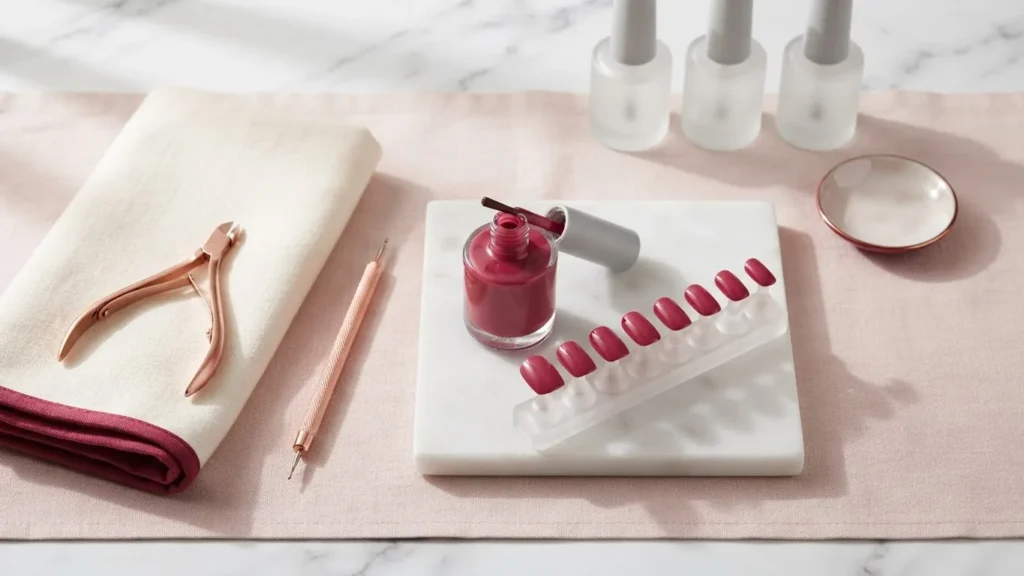
A manicure that passes the light-fingertip test is still soft enough to print a sheet crease into it for another two to three hours. So, how long does nail polish take to dry? The honest answer depends entirely on what is sitting on the nail – a full lacquer system, a quick-dry formula, or a single thin coat each carry their own published time, and they are not interchangeable. The number people repeat as universal almost always comes from one product, applied one way, under conditions that may not match yours.
Before the sections below pull those timings apart, here is the short version to anchor everything else.
How long does nail polish take to dry comes down to two separate clocks. A standard base-plus-two-coats-plus-top-coat manicure needs roughly 15 minutes before it feels dry to the touch, according to Essie’s application guidance. But feeling dry is not being set: the same guidance says nails are not completely hardened for 2 to 3 hours, so dents and smudges stay possible in that window. Each individual coat skins over in about 30 to 60 seconds. Quick-dry products compress the surface time dramatically – CND VINYLUX reaches a fully dry top coat in 8 ½ minutes, and Essie’s quick-dry Expressie line dries in roughly a minute.
How long does nail polish take to dry, by product
The spread between published figures is wide, and each one belongs to a specific formula. Reading one number as the time for all polish is where most of the confusion starts. Here is what the manufacturers themselves state:
- Full standard manicure (base + 2 color + top coat): about 15 minutes to sit before it feels dry – Essie.
- CND VINYLUX long-wear system: fully dry in 8 ½ minutes – Creative Nail Design.
- VINYLUX long-wear shine top coat: fully dry in 8 ½ minutes – CND.
- Essie quick-dry (Expressie): dries in about a minute – Essie.
- Single coat of standard polish: about 30 to 60 seconds to skin over – Essie.
Treat that list as a lookup table, not a ranking. Before you trust a drying time, name the product and the number that ships with it. A VINYLUX timing tells you nothing about a traditional lacquer top coat, and the one-minute quick-dry figure describes a formula engineered for speed, not the bottle of classic cream sitting in your drawer. Gel is a separate category again – it hardens under a UV or LED lamp instead of drying by solvent evaporation, so none of these air-dry numbers apply to it. See also our gel nail polish remover guide.
“Feels dry” and the two-to-three-hour window
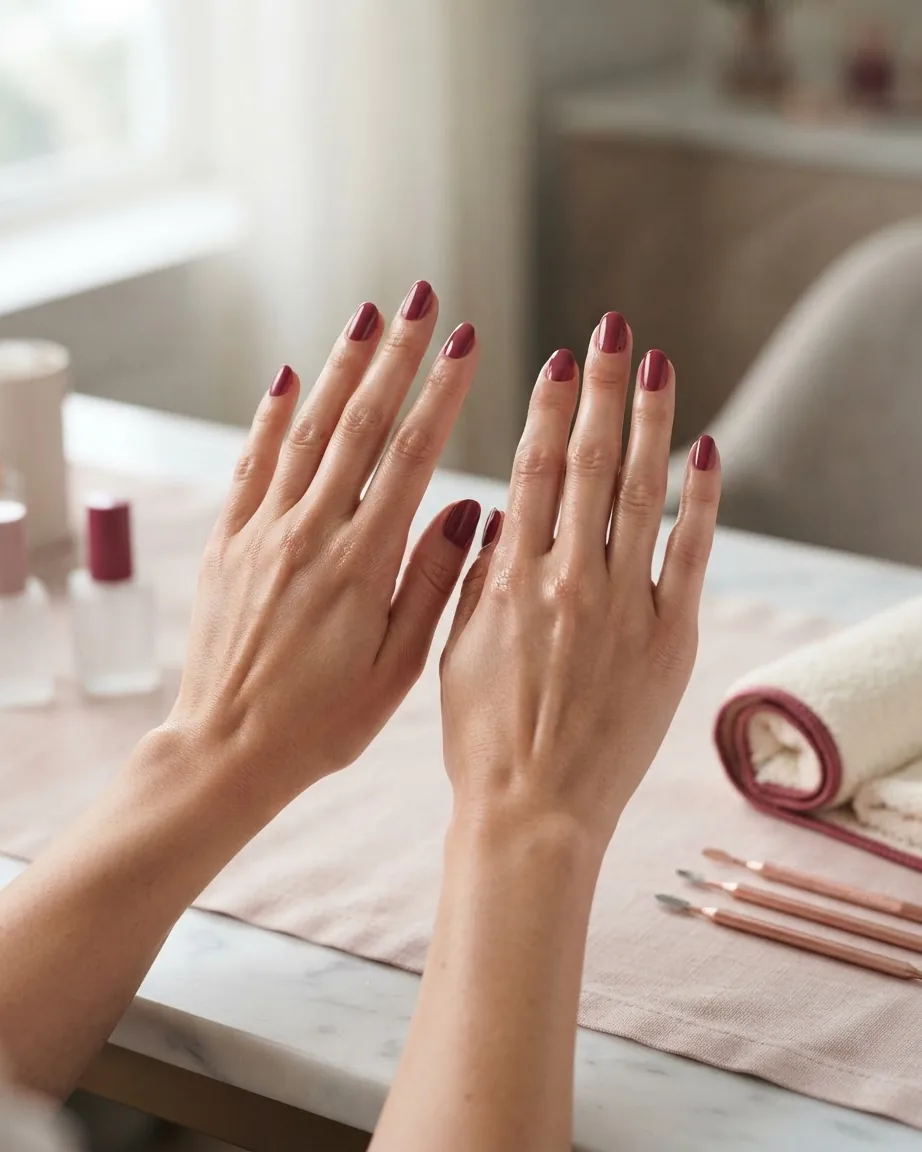
The single biggest misread of drying time is confusing a dry surface with a set manicure. Essie’s guidance draws the line plainly: after your 15 minutes of sitting, the nails will feel dry, but they are “not completely dry for 2-3 hours”. During that stretch the film underneath is still firming up, and the surface that feels solid will still take an impression from a keyboard key, a zipper, or the inside of a pocket.
What this changes for you is behavior, not technique. The smart move after the top coat is to treat the next few hours as fragile even though your fingers say otherwise. Rummaging in a bag, peeling a produce sticker, or sliding under bed sheets are the classic smudge triggers inside that 3-hour window. Pushing a manicure into those activities early is why a polish job that looked perfect at the mirror shows a thumbprint dent an hour later – the color had skinned over but had not hardened through.
Drying between coats: the 30-to-60-second rule
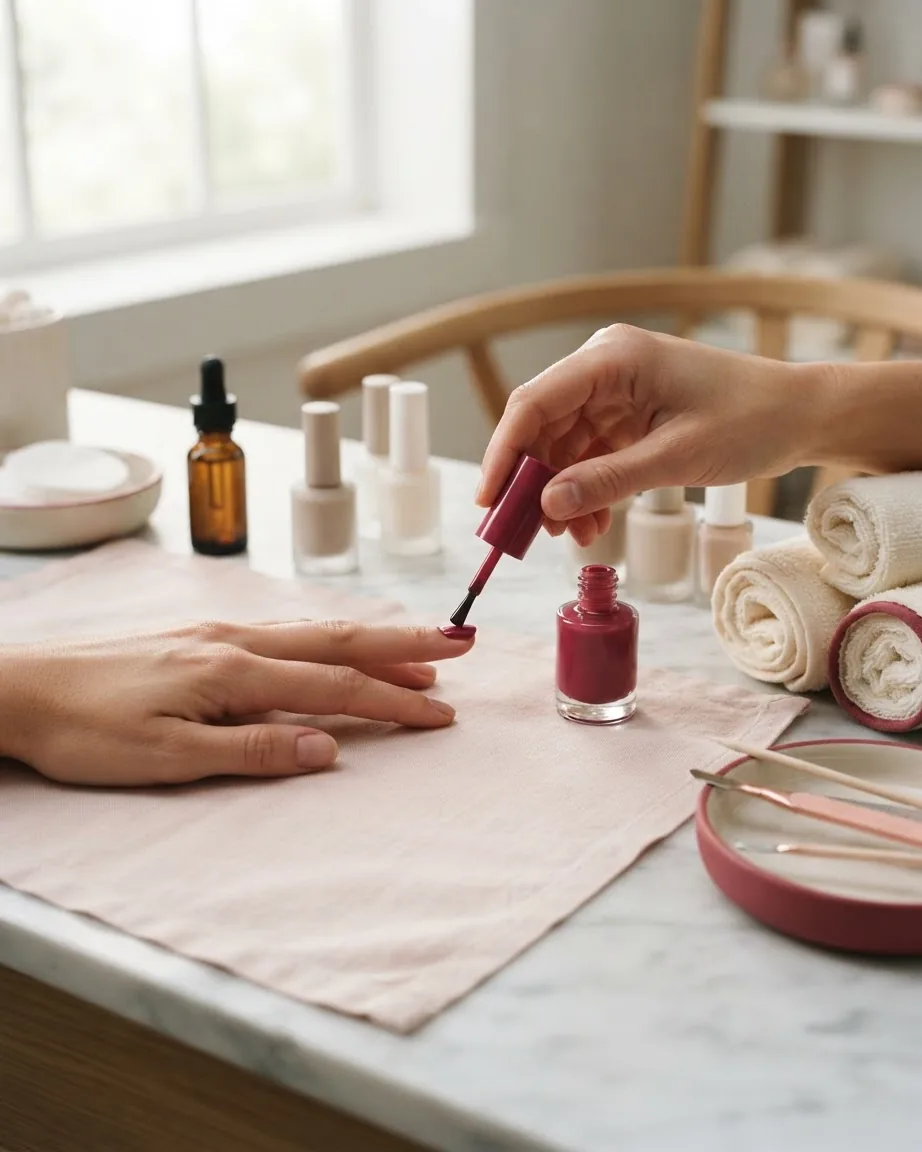
Rushing the layers is a controllable error that quietly extends total dry time. Essie’s direction is to let each coat – base, color, and top coat – dry 30 to 60 seconds before the next goes on. That short pause lets each film release most of its solvent before it gets capped by the next layer.
Skip it, and the problem compounds. Lay a coat down while the one beneath is still wet and you trap solvent between layers; the whole stack then takes far longer to firm up and is prone to bubbling, denting, and that soft, never-quite-hard finish. The counterpart error is going too thick. A heavy coat holds more solvent that has to work its way out, so it dries slower than two thinner passes that each got their 60 seconds. Thin and patient beats thick and fast on the clock.
What “8 ½ minutes” and “about a minute” really cover
Quick-dry claims are real, but they describe a specific product reaching a specific endpoint – not a license to treat every manicure as a one-minute job. CND states VINYLUX is fully dry in 8 ½ minutes, which it positions for natural nail services, pedicures, and nail art where a faster turnaround matters. Essie’s quick-dry Expressie formula is built to dry in roughly a minute for on-the-go application.
The gap between those two figures and the 2-to-3-hour full-dry window on a standard system is the whole reason to name your product first. A one-minute quick-dry number is doing a different job than a traditional lacquer’s set time; applying the fast figure to a slow formula is how people end up disappointed. If speed is the priority, buy a formula whose published time is fast – do not expect a classic cream to behave like one. For shade-driven coat decisions on softer colors, see our nude nail polish guide.
Why a fan sets the top coat but not the color underneath
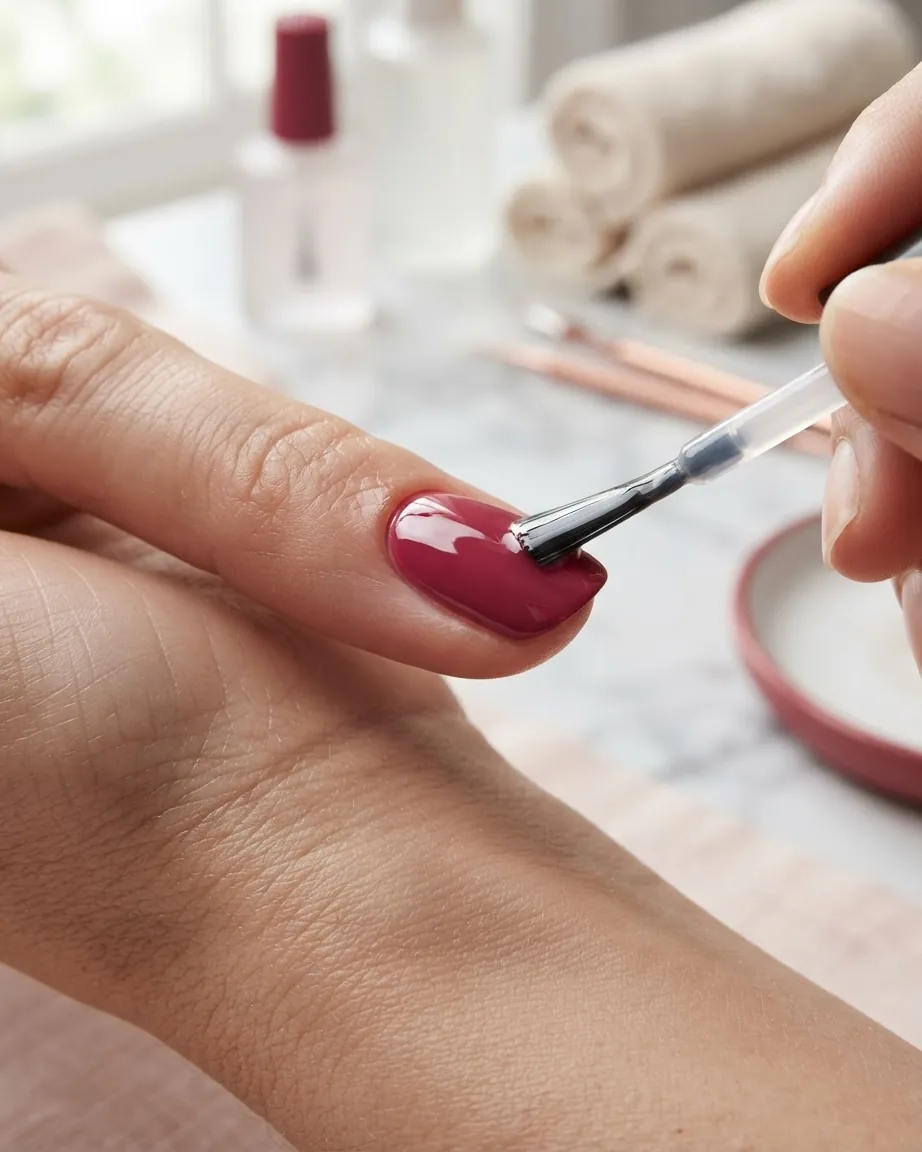
Blowing air across fresh polish is the most common “speed hack,” and it only half works. According to Essie, moving air can quicken the surface of the top coat, but that air cannot reach the color layers sealed beneath it. So a fan buys you a faster dry-to-touch skin while the layers that actually need to harden keep setting on their own schedule. Reading a dry surface as a dry manicure is exactly the trap the 2-to-3-hour window warns about.
Two more factors sit outside the bottle. Essie notes that temperature and humidity shift drying time – a cold, damp room slows solvent evaporation, so the same polish takes longer than it would in warm, dry air. Combine that with over-thick coats, and you get the slowest possible result: trapped solvent, a surface that lies about being set, and a long tail of smudge risk. The controllable levers are coat thickness, the 30-to-60-second pause, and realistic patience – not the fan alone.
Two definitions of “dry” – and working safely while you wait
Part of the confusion is that “dry” has more than one technical meaning. A peer-reviewed article in the National Library of Medicine collection defines a measurable dry-to-touch endpoint as the point where touching the film leaves no material deposited on a clean fingertip. That is a surface test – it marks when a film stops transferring, not when it has fully hardened. Worth a caveat: that definition comes from the experimental development of a medicated nail lacquer, not from a drying-time trial of ordinary consumer polish, so it supports the endpoint distinction rather than giving you a consumer timing.
Hold the two ideas side by side and the Essie figures stop contradicting each other. Dry-to-touch (no transfer) can arrive at the 15-minute mark while complete drying still sits hours out. One is a handling milestone; the other is when the manicure is genuinely safe from dents.
While any manicure dries, the air carries solvent vapor, and that matters more the longer you wait. The U.S. Food and Drug Administration’s guidance on nail care products points to good ventilation when using them. Keep the room aired out, open a window or run extractor airflow rather than sealing yourself in with the fumes, and wash skin promptly if liquid product lands where it should not. If your skin or nails react to a product – redness, swelling, lifting, or persistent irritation – stop using it and see a licensed professional. Nail-health symptoms are a clinician’s call, not a drying-time question.
The touch test covers only a fraction of the real dry time
Essie puts “feels dry” at about 15 minutes and “completely dry” at 2-3 hours. Convert those hours to minutes (2 x 60 = 120, 3 x 60 = 180) and the two numbers stop living in different units, which is where the real picture shows up: the manicure stays smudge-prone far longer after it feels safe than the time you actually sat still.
- Full dry time: 120 to 180 minutes (2-3 hours).
- Hidden wait after it feels dry: 120 – 15 = 105 min, up to 180 – 15 = 165 min. That’s the dent-risk window your fingertips don’t warn you about.
- Multiple: 120 / 15 = 8x, 180 / 15 = 12x. Full setting takes 8 to 12 times longer than reaching “feels dry.”
Frequently asked questions
Does a cold or humid room change how fast polish dries?
Yes. Essie notes that both temperature and humidity affect the process. A chilly, damp bathroom slows solvent from leaving the film, so the same bottle that firms up quickly in warm, dry air drags in cold, moist conditions. No published figure fixes the exact delay, so treat a cool or humid setting as a reason to pad your patience rather than trust the standard timing.
How long is an opened bottle of polish still usable?
Storage, not drying, but a frequent follow-up. Essie states that with proper care, nail polishes can last up to 2 years. Keep the cap sealed tight, store the bottle away from heat and direct sun, and roll rather than shake it to mix. A lacquer that has thickened, separated, or gone stringy past that point will also apply and dry badly – thick, gluey polish fights every timing above.
Do these quick-dry times apply to gel polish?
No. Every figure here describes air-drying lacquer, where solvent evaporates to leave a hard film. Gel cures chemically under a UV or LED lamp and does not set by sitting in open air at all, so an 8 ½-minute or one-minute air-dry claim tells you nothing about a gel service. For any reaction to gel products on skin or nail, stop and consult a licensed professional.