The band of light that shifts across a cat eye manicure is not a trick of the pigment. It comes from microscopic iron particles suspended in the gel, pulled into formation by a magnet while the coat is still wet. Pull the magnet away, cure the nail under a lamp, and those particles freeze exactly where they stopped. That single sequence governs everything about cat eye gel nail polish: the effect lives or dies in the few seconds between brushing on the color and hitting the lamp. Get the distance and timing wrong and the shimmer scatters. Cure one second too early and there is no way back.
The hard part for most people is not the application itself but the fact that four different manufacturers publish four different magnet distances and hold times, none of which transfer cleanly to another brand’s magnet. This guide sorts out which numbers belong to which tool, where the sources genuinely disagree, and what the durability claim actually rests on.
What Cat Eye Gel Polish Is and Why the Magnet Does the Work
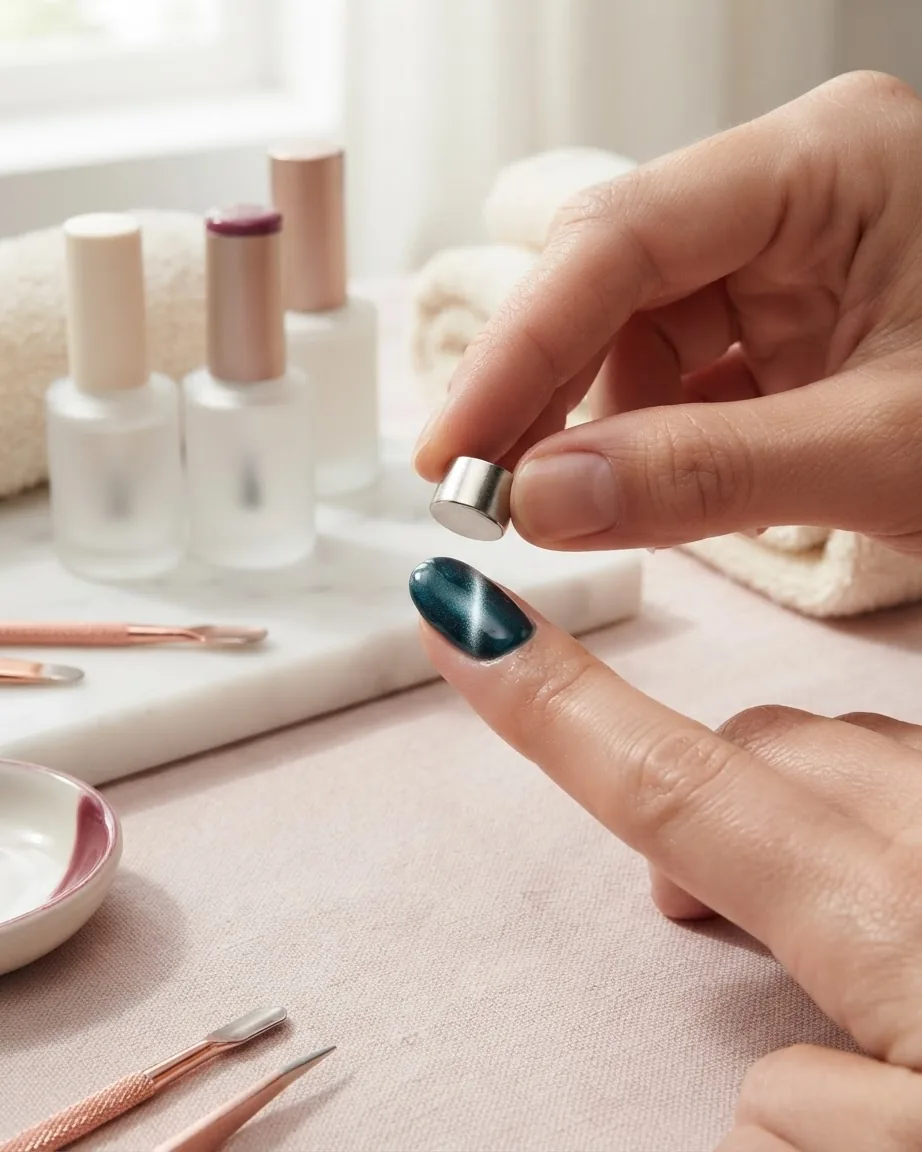
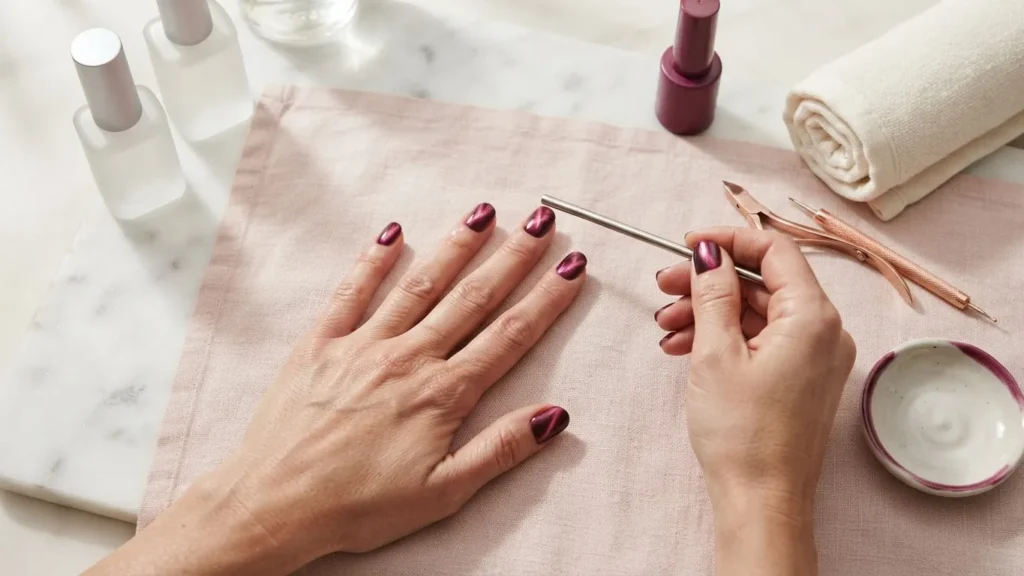
Cat eye gel is a standard soft-gel color coat with one addition: suspended magnetic particles, typically iron, mixed into the pigment. On the brush it looks like an ordinary dark or pearlescent shade. The optical stripe appears only when a magnet draws the metal flecks into a line or curve, concentrating them so light reflects off a defined ridge rather than a flat, even field.
The magnets used are neodymium, chosen for field strength and because their polarity can be shaped into bars, domes, or diagonal faces that produce different patterns. Brands cut and orient these magnets differently, which is the core reason their published numbers do not match. Paola Ponce Nails notes that magnetic gels “hit the market, maybe like 5 to 7 years ago,” so the category is relatively young and far from standardized across suppliers.
Base color changes the result more than most buyers expect. A black base under the magnetic layer yields a high-contrast pop where the light band reads sharp against near-darkness. A clear or nude base produces a softer, velvet-like depth instead. Neither is correct; they are different finishes from the same technique.
The One Rule That Never Changes: Do Not Cure Before You Magnetize
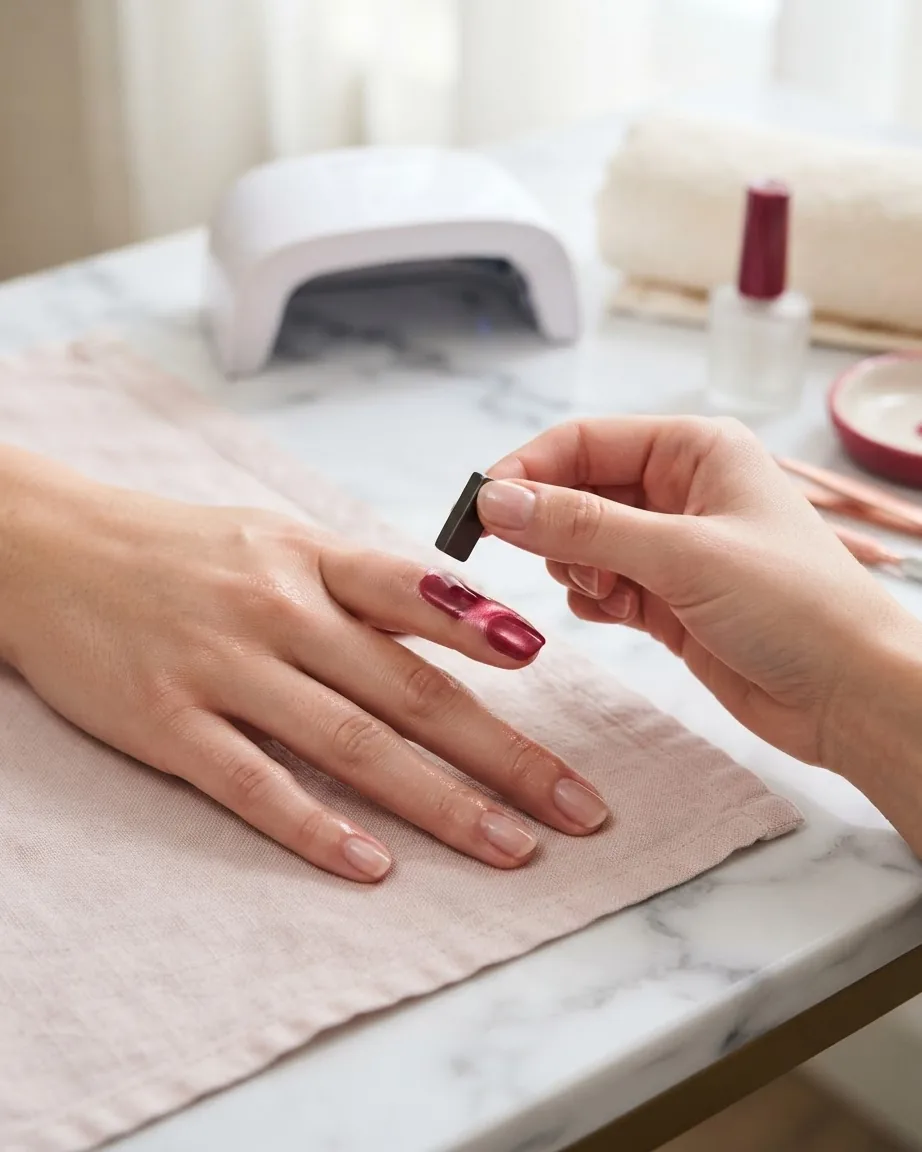
Everything else about this polish is brand-dependent. This is not. The magnetic effect can only form while the gel is liquid, because the particles need to be free to move. Once the coat goes under the lamp, it polymerizes and the particles lock in place permanently. Cure a flat, un-magnetized coat and you have a flat, un-magnetized nail with no recovery possible.
Here is the standalone sequence to hold onto. Apply one thin coat of cat eye gel polish over a cured base. Before curing that colored coat, bring the magnet close to the wet surface and hold it still so the iron particles pull into the pattern you want. Only after the stripe forms do you cure. Curing is the one step you cannot undo. Before you cure, the coat is fully reversible: wipe it off with the appropriate cleanser and start over. That reversibility is the safety net every beginner should lean on.
Magnet Distance and Hold Time by Brand (They Do Not Agree)

This is where tutorials pull in different directions, and the disagreement is real rather than sloppy. Each brand writes for its own magnet, and magnet strength and polarity differ, so the numbers are not directly comparable. Treating one brand’s figure as universal is the most common reason a first attempt comes out weak.
The published figures, each tied to its source:
- Beetles Gel Polish instructs you to position the magnet within 10-15 seconds of application, hold it 2-3mm above the nail surface, never touching the wet polish, and keep it steady for 30-60 seconds. See Beetles’ at-home cat eye guide.
- Vettsy says to hold the magnet 3mm to 5mm above the wet gel for 5 to 10 seconds, then flash cure for 10 seconds to freeze the look. Their walkthrough is Vettsy’s magnetic techniques page.
- PN Selfcare places the magnet roughly 3-5 mm from the nail and tells you to keep your hand steady and still for at least 10 seconds, per PN Selfcare’s cat eye tutorial.
The resolution is not to average them. Use the number your own kit’s maker published, because that figure was written for the magnet in your hand. If no instruction came with your magnet, Beetles’ and Vettsy’s figures bracket the sensible range, and you dial in by watching the stripe form rather than trusting a stopwatch.
One lower-bound caution carries real weight. PN Selfcare warns that moving the magnet too close, less than 3 mm, can cause the particles to clump or make the pattern too harsh and uneven. So 3 mm functions as a practical floor even for brands whose stated range starts there. Beetles’ 2-3mm sits right at that edge; keep to the upper end of a brand’s range if your first pass looks blotchy.
Cure Timing: The Flash Cure That Freezes the Stripe
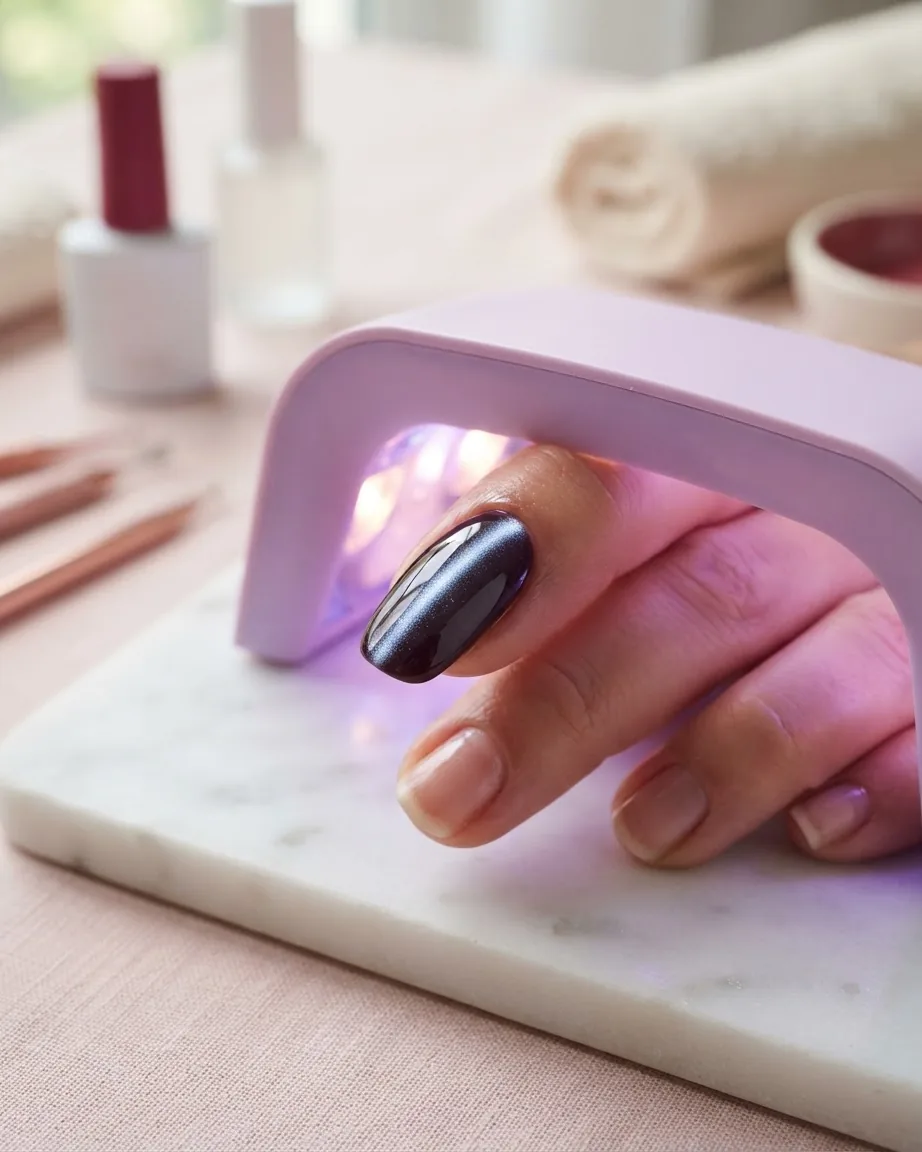
Once the pattern reads the way you want it, the stripe has to be locked before the particles drift. Vettsy’s method is a short flash cure of 10 seconds immediately after pulling the magnet away, which stiffens the surface enough to hold the design before a full cure. The flash exists because a magnetic coat left sitting will slowly self-level, softening a crisp band into a smear.
Lamp wattage matters for the full cure that follows, and higher-output lamps cure faster than low-wattage ones, so follow the cure time printed for your specific polish and lamp pairing rather than a generic figure. For the broader mechanics of how lamp-cured gel hardens, the desk’s gel nails reference lays out the chemistry category this polish belongs to.
Weak, Blurry, or Disappearing Effect: A Single Diagnostic
No one tutorial assembles the failure modes into one place, so here they sit together. When a cat eye comes out faint or muddy, the cause is almost always one of a short list, and each has a direct fix.
- The band is faint or washed out. The magnet sat too far away or the coat was too thin to carry enough particles. Use a slightly thicker single coat and move to the nearer end of your brand’s distance range, respecting the 3 mm floor.
- The stripe is harsh, clumped, or uneven. The magnet came too close, under 3 mm per PN Selfcare, pulling particles into a hard clot. Back off to the upper end of the range.
- The effect fades or drifts after you lift the magnet. You waited too long before curing and the gel self-leveled, letting particles settle back into a flat spread. Flash cure sooner, within seconds of pulling the magnet.
- Bubbles or pits in the finish. The bottle was shaken rather than rolled. Roll a magnetic gel between your palms to blend it; shaking whips in air that cures as pits.
- The magnet physically touched the wet gel. That smears the surface and drags particles out of pattern. The magnet must hover; contact ruins the coat.
There is a counterintuitive one worth naming: more magnet time is not better. Over-holding, or bringing a magnet back to a coat you already shaped, can dull the effect or cause the field to repel particles out of the line you built. Pull away once the pattern reads right and stop.
Reversibility: You Can Start Over Until the Lamp Turns On
The reason magnetic gel forgives beginners is that nothing is permanent until the cure. A blurry stripe, a clump, a band sitting at the wrong angle, all of it wipes off while the coat is still liquid and uncured, and you reapply. This is why it pays to magnetize and inspect before committing to the lamp rather than curing on faith and hoping.
Work one nail at a time for this reason, and for a second one: a magnet brought to one wet nail can activate the particles on an adjacent wet nail, pulling two patterns out of alignment at once. Color, magnetize, flash cure or fully cure that single nail, then move to the next.
Cat Eye Gel Polish Durability: The 2-3 Week Figure and Where It Comes From
Be clear-eyed about the wear claim. The figure in circulation is that cat eye gel polish, when applied correctly, can last up to 2-3 weeks without chipping or fading. That number comes from Vendeeni’s longevity page, a manufacturer and supplier source, and it is the only place the duration appears. None of the four how-to tutorials from PN Selfcare, Beetles, Vettsy, or Paola Ponce Nails commits to a wear number at all.
So treat 2-3 weeks as manufacturer-stated and single-sourced, not as an independently corroborated benchmark. The “when applied correctly” qualifier does real work: it means a clean prep, a proper top coat seal, and a full cure, without which the number does not hold. Magnetic gel wears like any soft gel otherwise, and a shade with staining potential behaves the same way standard color does, as covered in the desk’s note on red nail polish staining.
The same source gives one early-wear rule worth following: minimize contact with water, especially during the first 24 hours after application. The first 24-hour window is when a fresh gel finish is most vulnerable to lifting at the edges, and water exposure in that stretch is the avoidable mistake.
HEMA-Free Does Not Mean Hypoallergenic
This is the correction that matters most and the one tutorials skip. HEMA-free cat eye gels do exist, and some buyers choose them hoping to avoid a reaction. But Luxie Nail states plainly that HEMA-free products, meaning free of 2-Hydroxyethyl methacrylate, are not hypoallergenic. Removing one common sensitizer does not make a product safe for everyone; other ingredients can still trigger a reaction.
Allergen warning
The protective takeaway is straightforward. If irritation occurs, discontinue use immediately and seek a licensed medical professional. This guide offers cosmetic information only and no medical advice; any suspected allergy, persistent redness, or nail damage is a question for a professional, not a tutorial. Keep uncured gel off skin, work with good ventilation, and wash off any product that contacts skin right away.
Choosing Your First Setup Without Overbuying
You need three things: a cat eye gel in a shade you like, a compatible top coat, and the right magnet, ideally the one sold for that polish so the published distance and hold figures apply. A bar magnet gives the classic single light band; shaped and diagonal magnets produce curves and galaxy effects, which Vettsy catalogs across its range of techniques.
A base color decision comes before purchase, not after. Decide whether you want the high-contrast look of a black base or the softer depth of a clear or nude ground, because that shifts which shade you buy. For readers assembling a broader kit, the desk’s rundown of nail art instruments sorts the tools by function. The full application walkthroughs live with each brand: Paola Ponce Nails, PN Selfcare, Beetles, and Vettsy each publish their own, and the right one for you is whichever matches the magnet in your kit.
How Far Apart the Brands Really Are: The Numbers Behind “They Don’t Agree”
Everyone says the brand figures diverge, but no tutorial tells you by how much. Run the arithmetic on the numbers already quoted above and the spread is wider than it looks. That is why grabbing a random tutorial’s number instead of your own kit’s is the top reason a first cat eye comes out weak.
- Hold time: 12× spread. Beetles’ upper hold of 60 s divided by Vettsy’s lower hold of 5 s = 12×. In plain seconds that is a 55-second gap (60 − 5) between the two extremes – not a rounding difference, a different technique.
- Distance: 2.5× spread. The farthest quoted distance of 5 mm divided by Beetles’ closest of 2 mm = 2.5×.
The takeaway the ratios force: these aren’t interchangeable settings you can average. A 12× gap means one brand’s “done” is another brand’s “barely started.” Use the figure your own magnet’s maker published, and treat any borrowed number as a starting guess to adjust by eye.
FAQ
Can I use any magnet with any cat eye gel polish?
You can, but the published figures stop applying. Each brand’s distance and hold numbers were written for that brand’s own neodymium magnet, and strength and polarity differ between tools. A mismatched magnet still produces an effect; you simply lose the printed guidance and must judge the pattern by eye, pulling away once the band looks right.
Why does my stripe move after I lift the magnet?
Uncured magnetic gel self-levels, so particles slowly drift back toward a flat spread the moment the field is gone. That is normal physics, not a defective polish. The fix is speed: flash cure within a few seconds of removing the magnet so the surface stiffens before the design can soften.
Is 2-3 weeks of wear a reliable number?
Treat it with caution. That duration traces to a single manufacturer page and carries a “when applied correctly” condition; no independent tutorial confirms a wear figure. Expect it as a best case with clean prep and a full cure, and know that water exposure in the opening window undercuts it faster than anything else.
Should I shake the bottle before applying?
No. Shaking whips air into the gel, and those bubbles cure as visible pits in the finish. Roll the bottle between your palms instead, which blends the suspended iron particles back into the pigment without introducing air. This matters more for magnetic gels than ordinary color because settled particles need remixing.