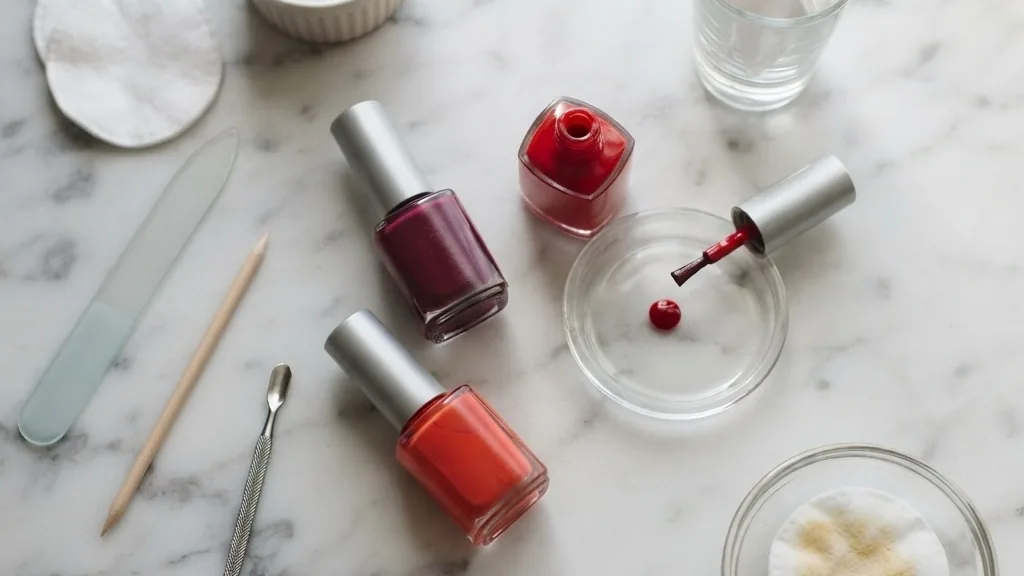
Red nail polish leaves a yellow-orange tint on the bare nail plate more readily than almost any other shade, and the reason is chemical, not cosmetic: the pigments that make a red look saturated are small enough to migrate into the keratin surface. That single fact explains why the “right” red is only half the decision. The other half is what sits between the color and your nail. Most guides stop at the swatch. The interesting problems start after the bottle is open.
Two more things decide whether a red works: your skin undertone, which determines whether a blue-red or an orange-red flatters you, and the formula behind the label, where terms like “3-free” and “10-free” carry real meaning that regulators have actually weighed in on. Get all three right and a red lasts, flatters, and washes off clean. This guide walks through every stage of that decision, from the first self-diagnosis of your undertone through the label on the bottle, the brush technique that keeps it on your nails, and the removal habit that determines whether your nail bed looks healthy a month from now.
Quick answer: The best red nail polish for you depends on your skin undertone, not on price or brand. Cool undertones suit blue-based reds and wine; warm undertones suit orange-reds, tomato, and brick; neutral undertones carry true red. Always apply a base coat first, because highly pigmented reds stain the nail plate. “X-free” labels tell you which historically flagged chemicals a formula omits, such as toluene, dibutyl phthalate, and formaldehyde. Match undertone, use a barrier base coat, and read the ingredient list.
Why highly pigmented reds stain the nail plate yellow
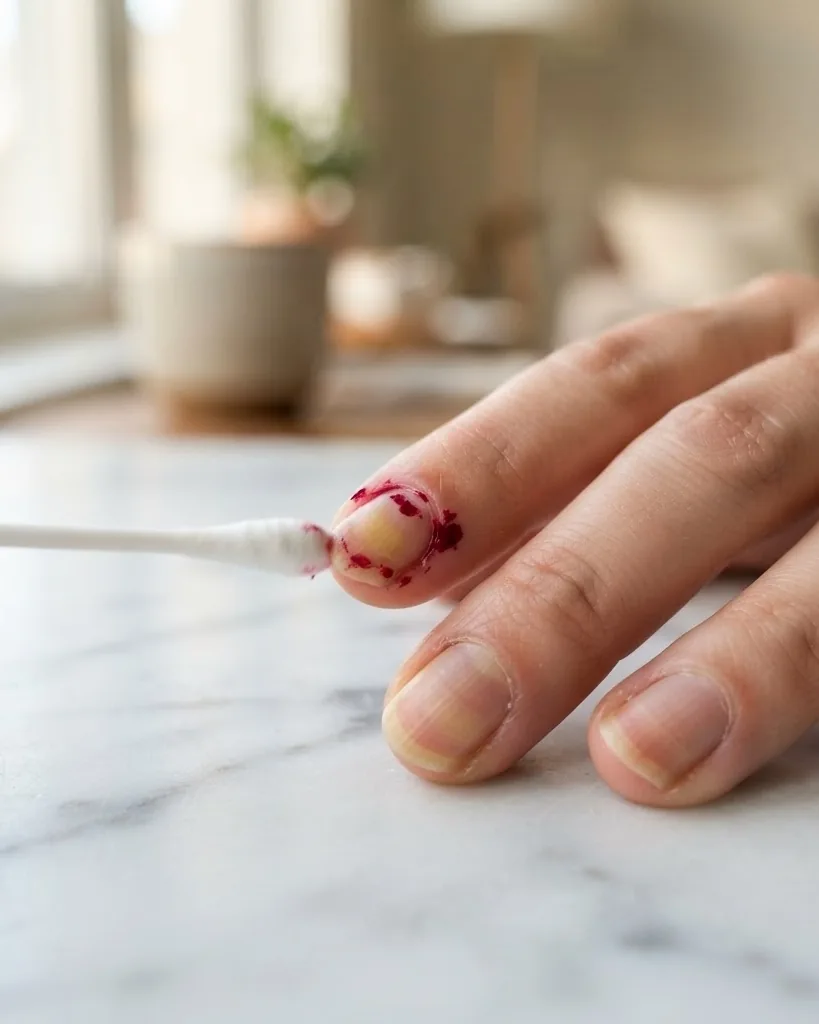
Staining happens because red pigment particles are physically small and chemically clingy, and bare keratin is porous enough to absorb them. When you paint a saturated red directly onto an unprotected nail, some of the colorant seeps into the top layers of the nail plate and stays there after the polish is gone, leaving the notorious yellow-to-orange cast. The darker and more pigment-dense the red, the worse the tint. This is the single most common complaint people have after wearing red, and it is almost entirely preventable with a barrier layer applied before the color.
Not every red stains equally. A sheer or jelly red, where pigment is diluted and suspended in a translucent base, transfers far less colorant into the nail than an opaque, densely pigmented creme formula built for full coverage in two coats. Deep wine and burgundy shades, which rely on heavy layers of red and blue pigment to achieve their depth, tend to leave the most stubborn discoloration of any red family. If you have been burned by staining before, that history is a useful clue about which finish to avoid without a barrier in place.
- Base coat as a barrier. A base coat forms a clear film between pigment and keratin, so the color has nothing porous to sink into.
- Thin coats over thick. Thick single coats pool pigment against the edges and cuticle, where staining shows most.
- Prompt, clean removal. Pigment left sitting under a chipped, degrading top coat has more time and more broken film to seep through.
- Formula density. Deeply saturated wine and true red creme formulas stain more than sheer jelly reds of the same color family.
If a stain has already set in, it fades as the nail grows out, since the discoloration lives in the plate rather than the living tissue underneath. A gentle buff with a fine-grit block can lift some surface tint immediately, and a few polish-free days let natural growth push the discolored keratin toward the free edge, where it gets trimmed away. Soaking the nail in diluted lemon juice or a whitening toothpaste for a few minutes is a common home remedy, though the effect is mild and temporary rather than a real fix. The staining mechanism, the barrier fix, and the sheer-versus-opaque tradeoffs of light reds are covered in more depth in our guide to getting a sheer, no-streak look without wrecking your nails, which shares the same base-coat logic in reverse.
Blue-red, orange-red, or true red: reading your own undertone
The difference between a red that flatters you and one that fights your skin comes down to undertone, and you can diagnose yours in about a minute. Skin undertone is the color underneath the surface, and it falls into three families: cool, warm, and neutral. Cool undertones pair with blue-based reds, raspberry, and wine. Warm undertones pair with orange-based reds, tomato, and brick. Neutral undertones handle a balanced true red, the shade that sits exactly between blue and orange. Three quick self-tests settle the question, and they agree with each other more often than not.
- Vein test. Look at the veins on your inner wrist in daylight. Blue or purple veins suggest a cool undertone; green veins suggest warm; a mix suggests neutral.
- Jewelry test. If silver flatters your skin more, you likely lean cool. If gold flatters you more, you likely lean warm. If both look good, you are probably neutral.
- Sun-reaction test. Skin that burns before it tans often runs cool; skin that tans easily and rarely burns often runs warm.
Once you know your undertone, mapping shade families is straightforward. Cool skin: blue-red, cherry, wine, burgundy. Warm skin: tomato, coral-red, brick, rust. Neutral skin: true red and most classic “signature” reds. Deep skin tones carry both saturated wine and bright true red with striking contrast, while very fair skin often reads best in a slightly muted red that avoids the “costume” look of pure primary color. None of this is a rule you must obey, but it removes most of the guesswork at the drugstore shelf.
Here is a worked example. Someone with green-tinted wrist veins who reaches for gold jewelry and tans easily has a warm undertone, so a bottle labeled tomato red or brick red will likely photograph and read better on their skin than a blue-based cherry, even if the cherry looks good on the model in the ad. Conversely, someone with clearly blue veins who wears mostly silver and burns before tanning is cool-leaning, and a wine or blue-red will sit more naturally against their skin than a bright orange-red, which can look slightly clashing rather than well-matched on cool skin. When the three tests disagree, treat yourself as neutral and lean toward a balanced true red, which is the most universally forgiving shade in the whole category.
What “3-free” through “16-free” labels actually remove
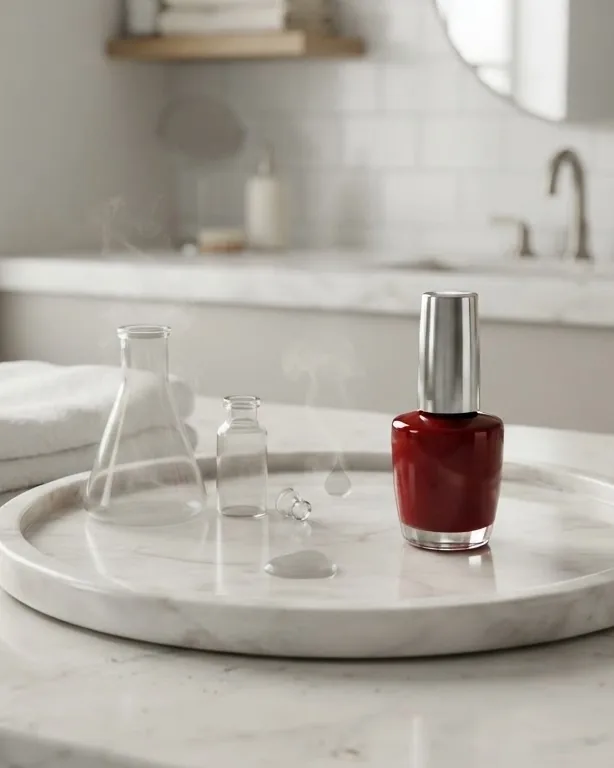
The “X-free” numbers on a red nail polish bottle count how many historically flagged ingredients a formula deliberately leaves out, and the baseline everyone starts from is “3-free.” According to the U.S. Food and Drug Administration, the marketing term “3-free” refers to a formula made without toluene, dibutyl phthalate (DBP), and formaldehyde, three ingredients long associated with health concerns in traditional lacquer. Higher numbers add more exclusions on top of those three. The count is a marketing convention, not a legal standard, so a “10-free” from one brand may exclude a different list than another brand’s “10-free.”
As the number climbs, the additional substances typically dropped include formaldehyde resin, camphor, xylene, triphenyl phosphate (TPHP), parabens, and various acrylate resins. Each was included historically for a functional reason: toluene helps pigment flow smoothly, dibutyl phthalate adds flexibility so the film resists chipping, and formaldehyde-related chemistry hardens the finish. Camphor was traditionally used to add gloss and a distinctive smell, xylene acted as a fast-evaporating solvent, and TPHP served as a plasticizer that kept the dried film from becoming brittle. Removing all of them at once, as “16-free” formulas claim to do, means the brand has had to reformulate the plasticizer, the leveling agent, and the hardening chemistry simultaneously without losing performance.
- 3-free: no toluene, no dibutyl phthalate, no formaldehyde.
- 5-free and up: also drops formaldehyde resin and camphor.
- 10-free and up: commonly adds xylene, TPHP, parabens, and acrylate exclusions.
- 16-free: a marketing ceiling reached by further excluding additional resins, gluten-derived ingredients, and various synthetic fragrance components, though the exact list still varies by brand.
Why does the count matter? Formaldehyde is classified as a known human carcinogen, per the National Cancer Institute, which is the strongest single reason it disappeared from mainstream formulas. That does not make every “3-free” gap dangerous in a finished polish, but it explains why the labeling exists at all. A useful habit is to stop counting the number on the front of the bottle and instead scan the actual ingredient list on the back, since two “10-free” bottles from different brands can genuinely differ in what they still contain. If you want a formula that also skips animal-derived and certain synthetic ingredients, our breakdown of how to read the label, trust the logo, and buy the real thing walks through the certifications that actually mean something versus the ones that are pure marketing.
How the FDA, ECHA, OSHA and the EU actually regulate your polish
Nail polish is regulated as a cosmetic rather than a drug in both the United States and the European Union, and that classification shapes everything about what a manufacturer must prove before selling to you. Under U.S. cosmetics law, the FDA does not require pre-market approval of a finished nail polish, so no agency signs off on the bottle before it ships. There is one hard exception that matters enormously for red: the color additives used to pigment nail polish do require FDA approval before they can be used in cosmetics. For a category defined by color, that pigment-approval requirement is the real regulatory backbone.
Red pigments carry a specific labeling rule worth knowing. The FDA requires that carmine, a red colorant derived from insects and occasionally used in cosmetic pigments, be declared by name on the ingredient list because of its documented potential to cause allergic reactions. If you have reacted to a red before, carmine is a name to scan for. This single-ingredient labeling requirement is a good example of how narrow and specific U.S. cosmetic regulation tends to be: rather than banning a category of colorants outright, the rule targets disclosure for one named substance with a known allergy profile.
The transatlantic gap is where the “X-free” marketing gets its energy. The EU Cosmetics Regulation (EC) No 1223/2009, administered by the European Chemicals Agency (ECHA), prohibits or restricts substantially more substances in cosmetics, commonly cited as over 1,300, than the current list of substances explicitly banned or restricted under U.S. federal cosmetics law.
- United States (FDA): no finished-product pre-approval; mandatory color-additive approval; a comparatively short banned-and-restricted list.
- European Union (ECHA, Regulation (EC) No 1223/2009): over 1,300 substances prohibited or restricted.
- Practical result: American brands market “X-free” heavily to voluntarily match protections that EU rules already mandate.
Workplace exposure is a separate axis of risk that consumers rarely think about. The Occupational Safety and Health Administration (OSHA) publishes specific guidance for nail salon workers on exposure to volatile organic compounds and solvents, including chemicals historically found in polish and polish-remover formulations. That guidance targets the technician breathing fumes eight hours a day, not the person wearing a red manicure for a week, which is a useful distinction to keep in mind when a headline blurs the two. You can read the agency’s own material on nail salon chemical safety at the OSHA nail salons resource, and the FDA’s overview of the category at its nail care products page. Advocacy groups add another layer: the Environmental Working Group runs its Skin Deep ingredient database, which many clean-beauty writers cite, though it is advocacy research rather than a regulatory authority and should be read that way.
Applying red so it lasts: prep, thin coats, and the free edge
A red manicure lasts longer and stains less when the application follows a fixed sequence, and the order matters as much as the products. Start by cleaning and lightly dehydrating the nail so oils do not sabotage adhesion, then lay down a base coat as your stain barrier. Apply color in two or three thin coats rather than one thick one, letting each set before the next, and cap the free edge by dragging the brush across the very tip of the nail. Cap-sealing is the step almost everyone skips, and it is the single biggest predictor of whether red chips off the tip within two days.
- Prep: push back cuticles, buff lightly, wipe the plate free of oil.
- Base coat: one thin layer, fully dry, acting as the pigment barrier.
- Color: two to three thin coats; thin coats dry faster and pool less.
- Free edge: cap each coat by swiping the brush along the nail tip.
- Top coat: seal, and reapply a fresh top coat every few days to extend wear.
Thin coats are non-negotiable with red specifically. A thick coat traps solvent underneath, stays tacky, dents against bedsheets, and gives pigment more time and more depth to sink toward the nail. If your bottle has thickened and drags, the fix is a proper thinner, never acetone or remover, and the difference between the two is explained in our guide to what thinner really is, how to dose it, and when it ruins your polish. Dose it a drop at a time; over-thinning ruins the film’s ability to level and cap the edge cleanly.
A few troubleshooting notes save most red manicures. If the color streaks or drags on the second coat, you likely applied it before the first coat fully set, so wait an extra thirty to sixty seconds. If bubbles appear as the polish dries, you shook the bottle instead of rolling it between your palms, which whips air into the formula. If the finish dries dull rather than glossy, the top coat was applied too thin or over a color layer that had not finished off-gassing solvent, so give the color an extra minute before sealing it. Formula type also changes drying time: regular solvent-based lacquer typically needs several minutes per coat to touch-dry, gel or hybrid long-wear formulas cure quickly under UV or LED light but still need a proper base and top step, and quick-dry formulas trade a small amount of durability for a shorter wait between coats.
Removing red without wrecking the nail underneath
Red comes off cleanly when you match the removal method to the formula, and the wrong method is where most nail damage actually happens. Regular solvent-based red lacquer lifts with acetone or non-acetone remover; acetone is faster and better on stubborn pigment, while non-acetone is gentler and slower. Saturate a cotton pad, press it flat against the nail for ten to fifteen seconds so the film softens, then wipe from cuticle toward tip in one direction. Wiping back and forth just smears red pigment across the skin and into the cuticle folds, which is exactly where stains linger.
Gel and hybrid reds are a different job. A true UV or LED gel must be gently soaked off, not peeled, because peeling tears away layers of the nail plate along with the color. The peel-off habit is the leading cause of the thin, weak, flaking nails people blame on the polish itself. Proper gel removal involves lightly buffing the top layer to break the seal, wrapping the nail in an acetone-soaked cotton pad and foil for ten to fifteen minutes, and then gently pushing off the softened gel with a wooden cuticle stick rather than scraping or prying. If you have layered regular lacquer over a gel base, the two layers can behave unpredictably during removal, and the interaction is worth understanding before you start; our guide to layering regular lacquer over a gel manicure without wrecking it covers exactly that combination.
- Regular lacquer: acetone or non-acetone, press-and-hold, wipe one direction.
- Gel or hybrid: soak off, never peel; peeling strips nail layers.
- After removal: wash hands, apply cuticle oil, and give heavily stained nails a few bare days to grow out the tint.
Cherry, tomato, brick, and wine: choosing among the red families
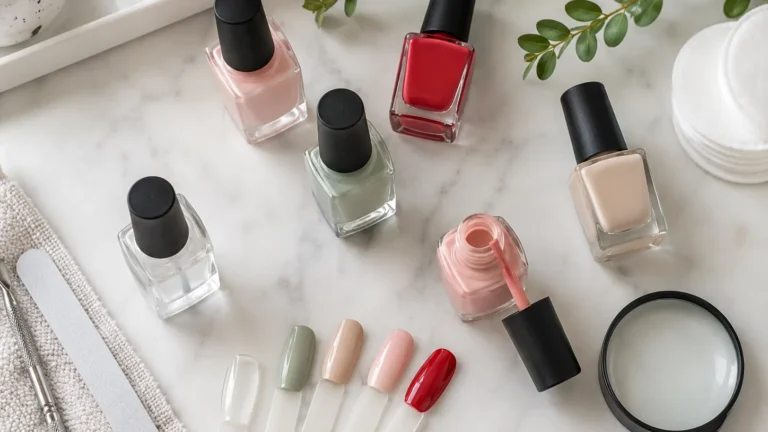
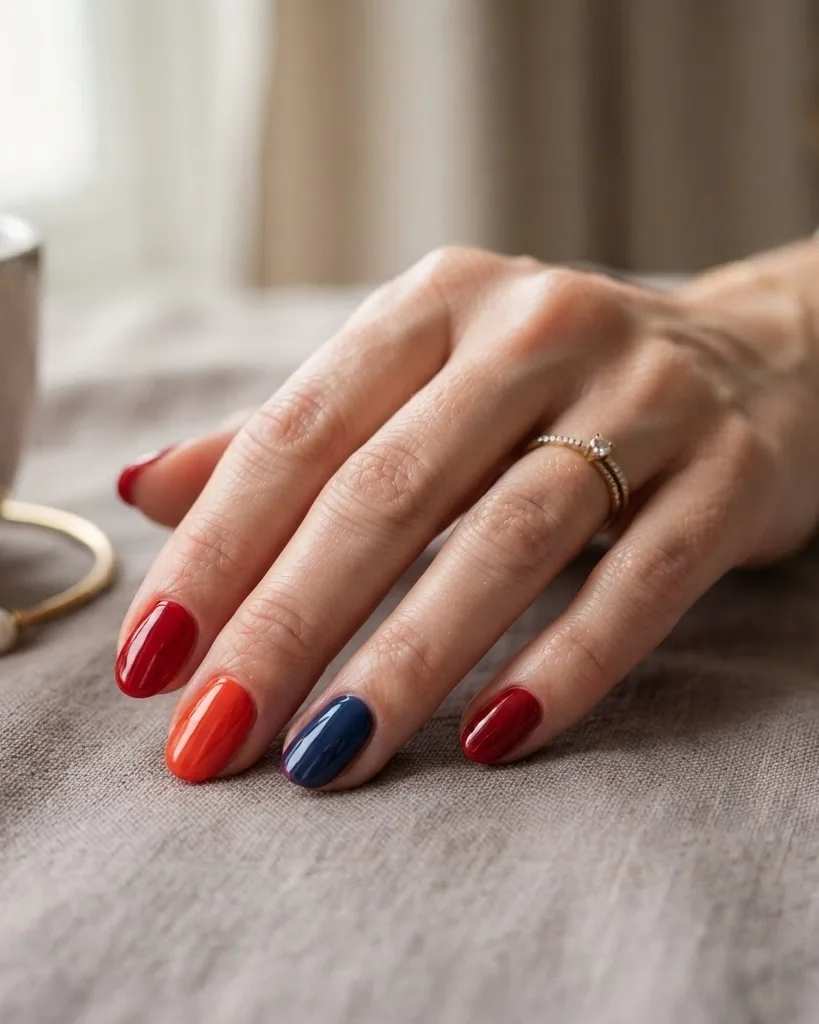
The red category is not one color but a small family of distinct shades, and naming them precisely is what turns a vague “I want red” into a confident purchase. The four workhorses are cherry, tomato, brick, and wine, and each leans toward a specific undertone. Cherry is a bright, slightly blue-leaning red that reads clean and modern. Tomato is warm and orange-forward, energetic against warm skin. Brick is a muted, earthy red-brown that suits autumn palettes and warm undertones. Wine and burgundy are deep, blue-based reds that flatter cool undertones and deeper skin tones with dramatic contrast.
- Cherry: bright, cool-leaning, versatile across seasons.
- Tomato: warm and orange-based, best on warm undertones.
- Brick: muted red-brown, ideal for autumn and warm skin.
- Wine and burgundy: deep blue-reds for cool undertones and deep skin.
Finish changes the personality of any of these. A creme finish is the classic, opaque, high-shine look most people picture. A jelly finish is translucent and glassy, building color with layers; the tinted-glass technique behind it is its own craft, laid out in our guide to how the tinted-glass look works both ways and how to keep it safe. Matte flattens the shine for a modern edge, and shimmer or metallic reds add depth for occasions. Red also anchors design work: a clean red French tip is one of the most requested variations, and getting the line crisp comes down to your brush, a topic our complete brush selection and technique guide addresses directly.
Beyond the French tip, red lends itself to a handful of recurring nail-art looks that show up every season. Negative-space designs, where bare nail is left visible in a deliberate geometric shape against a red background, work especially well because red provides high contrast against skin. Chrome and glitter reds are popular for special occasions, since the extra reflectivity reads as festive rather than everyday. Seasonally, brighter cherry and true reds tend to peak around winter holidays, while brick and wine dominate autumn, and a softer coral-leaning tomato shows up more in spring and summer alongside brighter overall wardrobes.
A short history: how red nail polish became a beauty icon
Red nail color has carried outsized cultural weight for roughly a century, and that history is part of why the shade still feels different from every other color on the rack. Mass-market nail lacquer as a widely available product took off in the early twentieth century, and red was among the first colors marketed at scale, riding alongside the era’s glamour icons and the growing beauty-industry infrastructure of salons and department-store counters. Over subsequent decades, red became shorthand in film and advertising for confidence, sophistication, and a certain kind of deliberate self-presentation, an association that has proven remarkably durable compared with most beauty trends.
That symbolism has not stayed static. In different eras and different cultures, a red manicure has signaled everything from workplace authority to rebellion to bridal tradition, and the specific shade of red carrying that message has shifted with fashion, from the darker vamp reds of mid-century glamour to the brighter, more saturated true reds of later decades. What has not shifted is the basic cultural fact that red nails read as intentional. Almost no other single nail color carries as much unspoken meaning walking into a room, which is part of why so many people treat the choice of red more carefully than they treat any other shade in their collection.
Buying by tier: drugstore, mid-range, and luxury reds
Red nail polish spans an unusually wide price range for what is chemically a fairly similar product, and price does not map cleanly onto quality the way it does in some other beauty categories. Drugstore reds, typically the least expensive tier, can perform extremely well for basic solvent-based lacquer, since pigment and film-forming chemistry at that price point has improved substantially over the years. Mid-range brands often add long-wear or gel-hybrid technology, wider shade libraries within the red family, and more consistent brush quality. Luxury and heritage brands add refined brush ergonomics, denser pigment loads that sometimes need only one coat, and, frankly, brand storytelling and packaging that drugstore lines do not attempt to match.
- Drugstore: solid basic reds, best value, good for testing whether a shade family suits you before committing more money.
- Mid-range: stronger long-wear claims, hybrid gel-lacquer formulas, wider red shade libraries.
- Luxury: the densest pigment loads and most refined brushes, priced largely for brand and experience rather than a proportionally better formula.
Two label claims deserve a skeptical read regardless of tier. “Cruelty-free” is not a legally standardized term in most markets, so two bottles both labeled cruelty-free can rest on very different verification standards, from third-party certification to nothing more than a brand’s own unverified statement. “Clean” beauty is similarly undefined by regulation and functions mostly as a marketing category rather than a safety guarantee. Neither claim is meaningless, but neither should substitute for actually reading the ingredient list against the “X-free” breakdown covered earlier in this guide.
Shelf life is a practical buying-guide detail that gets skipped constantly. An unopened bottle of nail polish typically keeps its performance for one to two years, though solvent evaporation eventually thickens the formula even sealed, which is where a nail polish thinner becomes useful rather than optional. Some brands print a Period-After-Opening symbol, a small jar icon with a number and the letter M for months, indicating how long the formula is expected to perform well once opened. Storing bottles upright, away from direct heat and sunlight, and tightening the cap fully after every use meaningfully extends usable life regardless of price tier.
Red at work, red for every age: dress codes and inclusivity
Red nail polish crosses age, gender, and workplace lines more successfully than almost any other shade, but context still shapes the practical choice. Conservative workplaces and formal dress codes generally read shorter length and a muted, less saturated red, such as a soft brick or a classic true red in a creme finish, as more professional than long nails in a glossy, high-shine cherry or a glitter finish. Neither look is objectively better; they simply signal differently depending on the room. People who need to keep their look adaptable across settings often keep one true red and one deep wine in rotation, since both flatter a wide range of undertones and both read as neutral rather than trend-driven.
Age and gender are far less limiting than beauty marketing sometimes implies. A deep wine or true red reads as classic rather than youthful, which is part of why the shade has stayed popular across generations, and an increasing number of brands now market red polish without gendering it, reflecting a broader shift in who wears nail color and why. The undertone-matching logic in this guide applies identically regardless of age or gender, since it is a function of skin, not of any demographic category.
Frequently asked questions about red nail polish
Does red nail polish stain your nails?
Yes, highly pigmented reds are known for staining the nail plate a yellow-to-orange tint, because the small pigment particles migrate into porous keratin. The fix is simple: always apply a clear base coat first so the color sits on a barrier instead of bare nail. Any stain that does appear lives in the plate and grows out over time.
What does “5-free” mean on a red polish?
“5-free” builds on the “3-free” baseline, which the FDA describes as a formula without toluene, dibutyl phthalate, and formaldehyde. “5-free” typically drops two more, usually formaldehyde resin and camphor. Because the count is a marketing convention rather than a legal standard, the exact list can vary between brands, so scan the ingredients rather than trusting the number alone.
How do I know which red suits my skin?
Diagnose your undertone first. Cool undertones, indicated by blue veins and a preference for silver jewelry, suit blue-based reds and wine. Warm undertones, shown by green veins and gold-flattering skin, suit tomato and brick. Neutral undertones carry true red. Use the vein and jewelry tests together for a reliable read before you buy.
Is nail polish approved by the FDA before it is sold?
No. Under U.S. cosmetics law, manufacturers are not required to obtain FDA pre-market approval for the finished nail polish. There is one key exception that matters for red: the color additives used to pigment the polish do require FDA approval before use. For a product defined by its color, that pigment rule is the real regulatory safeguard.
Should I be worried about formaldehyde in red polish?
Formaldehyde is classified as a known human carcinogen by the National Cancer Institute, which is exactly why it was phased out of mainstream formulas and why “3-free” exists. Most modern polishes omit it. If you want certainty, choose a formula that lists “formaldehyde-free” or a higher “X-free” count, and check the ingredient panel yourself.
Why do American brands advertise “X-free” so heavily?
Because U.S. and EU rules differ sharply. The EU Cosmetics Regulation (EC) No 1223/2009, administered by ECHA, restricts or prohibits over 1,300 substances, far more than the shorter U.S. federal list. American brands use “X-free” labeling to voluntarily signal protections that EU regulation already requires by law, which makes the marketing far more visible in the American market.
Is “cruelty-free” a guaranteed standard on red polish labels?
No. “Cruelty-free” is not a legally standardized term in most markets, so the claim can rest on anything from independent third-party certification to an unverified brand statement. It is worth taking seriously as a signal of intent, but it should not replace reading the actual ingredient list if animal-derived ingredients like carmine are a concern.
Red nail polish rewards a little literacy. Match the shade to your undertone, treat the base coat as a stain barrier rather than an optional step, and read the ingredient panel instead of the number on the front. Do that, and the color you love will look better, last longer, and leave your nails cleaner than the shelf ever promised.