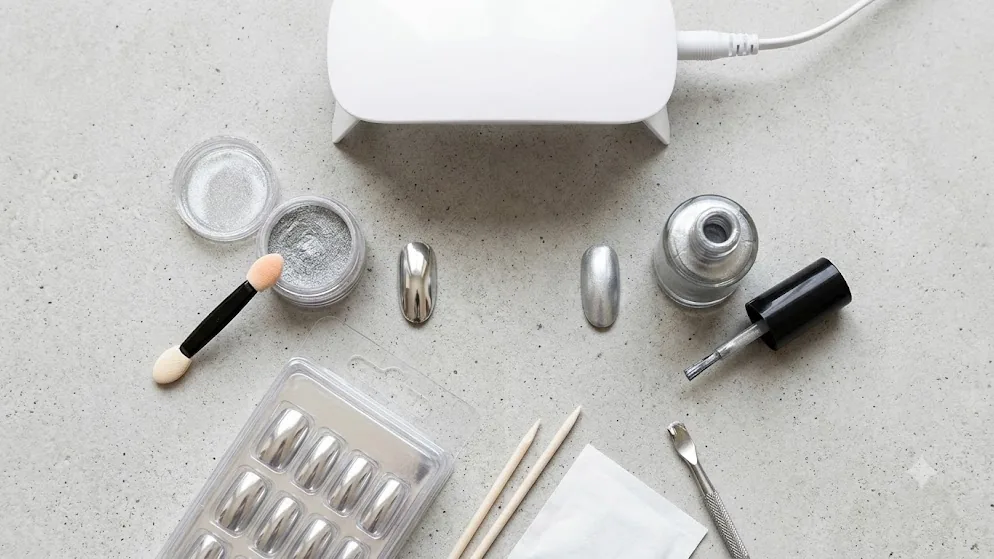
Chrome nail polish creates a liquid-metal mirror on the nail that ordinary metallic lacquer never manages, and the gap between a flawless result and a patchy mess usually comes down to one detail most tutorials skip: the top coat underneath the pigment. The mirror effect is not a trick of the polish alone. It depends on a specific sequence of curing, buffing, and sealing, and on knowing which of the three chrome formats you are actually holding. Get the base wrong and the reflection turns cloudy. Cure the wrong layer too long and the powder refuses to grab. The look reads as expensive; the technique behind it is fussy in ways worth understanding before you spend money on it.
There is also a second story here that nail blogs rarely tell, and it matters more than shade selection. Chrome finishes almost always ride on gel systems cured under lamps, and both the curing chemistry and the lamps themselves have drawn attention from the U.S. Food and Drug Administration, the European Commission, and peer-reviewed dermatology journals. If you plan to wear this look repeatedly, the ingredient and exposure questions deserve the same seriousness as the buffing motion.
Quick answer: Chrome nail polish is a family of products that produce a mirror or metallic finish. It comes in three forms: chrome powder rubbed over a cured no-wipe gel top coat, a one-step chrome lacquer, and peel or press-on chrome. Powder and most gel versions need a UV or LED lamp; one-step lacquers and press-ons usually do not. The finish lasts weeks on gel and days on lacquer. The main safety concerns are HEMA and other acrylate contact allergies, plus UV-lamp exposure, both manageable with simple precautions.
What separates a chrome mirror from ordinary metallic polish
The difference between chrome and a metallic lacquer is optical, not just marketing. A metallic polish suspends reflective flakes in a colored base, so you see many tiny glints scattered across a slightly textured surface. Chrome does the opposite: an ultra-fine pigment is pressed into a perfectly smooth, cured layer until it forms a continuous reflective film, so the nail behaves like a shrunken mirror and throws back a recognizable reflection. That continuity is why the surface underneath has to be glass-smooth and fully sealed. Any ridge, wipe residue, or dull patch breaks the mirror and reads instantly as a flaw.
Understanding your nail’s shape helps here, because the mirror exaggerates every contour. For a primer on filing before you ever open a bottle, see this guide on choosing and filing the right nail shape. A curved free edge that is not smoothly capped will show chipping first, since the pigment sits proudest there.
- Regular gloss: transparent shine, no mirror, no metal read.
- Metallic: scattered flake sparkle, textured, semi-reflective.
- Glitter: discrete particles you can feel, high grit, no continuous film.
- Chrome: continuous mirror film, reflects surroundings, dead smooth.
The three chrome formats, and which one needs a lamp
Chrome nail polish is sold in three genuinely different systems, and choosing the wrong one for your setup is the fastest route to disappointment. The first is chrome powder, a loose pigment you rub over a cured gel top coat. The second is a one-step chrome lacquer you apply straight from a brush like normal polish. The third is press-on or peel chrome, a pre-made overlay. The lamp question is the practical divider: powder and gel systems require a UV or LED lamp to cure, while most one-step lacquers and press-ons dry in open air and skip the lamp entirely. If you do not own a lamp and do not want one, you are shopping for a lacquer or a press-on, not powder.
How the formats compare
| Format | Lamp needed | Skill | Typical wear |
|---|---|---|---|
| Powder over gel | Yes, UV or LED | High | Weeks |
| One-step lacquer | Usually no | Low | Days |
| Press-on / peel | No | Low | Days |
Wear expectations follow directly from the format. As a published product benchmark, essie’s enamel chrome-effect polish is rated for about 7-day wear when used with a base and top coat, while OPI’s Chrome Clawz gel is rated for 3 weeks of wear and cures in 30 seconds under a lamp. That contrast is the whole trade-off in numbers: the lamp-cured route roughly triples the wear of the brush-on lacquer.
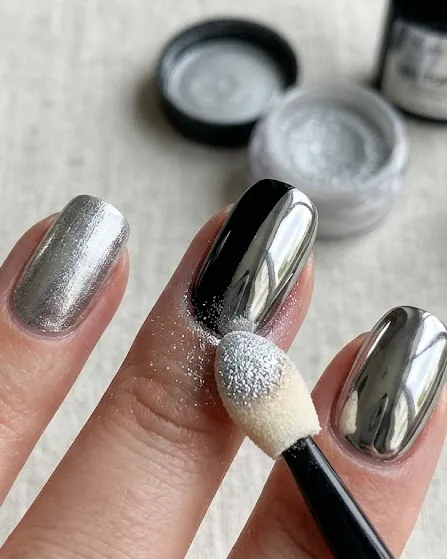
The full powder-over-gel method, step by step
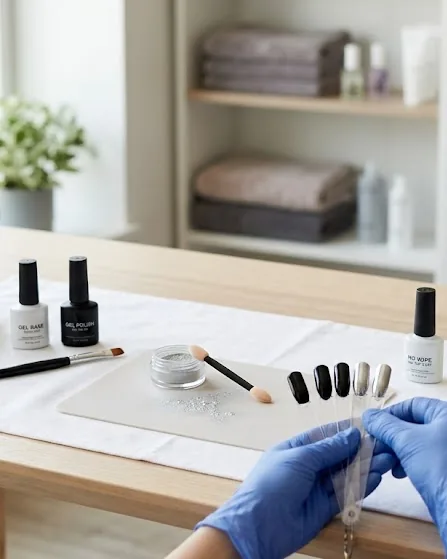
Powder over gel is the technique that produces the deepest, most durable mirror, and it rewards precision at every stage. Start with prep: push back the cuticle, lightly refine the surface with a fine file in the 220 to 240 grit range, brush away dust, and cleanse the plate with isopropyl alcohol so nothing repels the gel. Apply and cure a base coat, then a color gel, curing each layer fully under your lamp. The next layer is the one that decides whether the whole thing works: a no-wipe top coat, cured until it is hard but still faintly tacky at the molecular level. You then rub the chrome powder into that cured surface with a firm, burnishing motion using a soft applicator, working until the mirror appears, and finally seal with another top coat, capping the free edge, and cure once more.
The order is not negotiable. Each cured layer is the foundation for the next, and the burnishing step only works on a correctly cured no-wipe top coat.
- Prep: cuticle push, 220 to 240 file, dust off, isopropyl alcohol cleanse.
- Base coat: apply thin, cure fully.
- Color gel: apply, cure. A dark or black base yields the deepest mirror.
- No-wipe top coat: apply, cure to hard, do not wipe.
- Powder: burnish in with pressure until the surface flashes to mirror.
- Seal: top coat, cap the free edge, final cure.
Why the base color changes the mirror
The pigment layer is thin enough to be semi-transparent, so whatever sits beneath it tints the reflection. A black or very dark base produces the deepest, most defined silver mirror because it absorbs stray light and lets the chrome film read as pure metal. Lighter or colored bases shift the reflection warmer or cooler and soften the contrast. This is also how a single silver powder can be sold as several looks: change the base, change the metal.
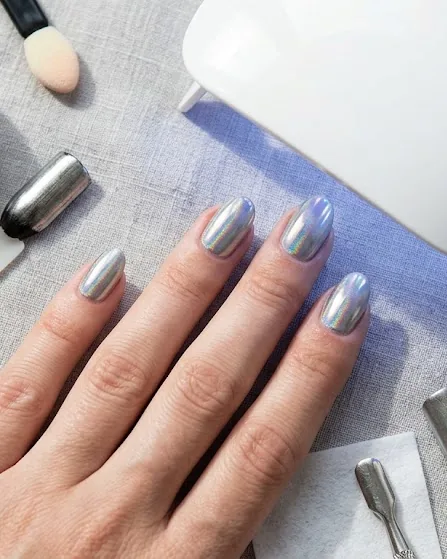
The no-wipe top coat rule that decides everything
The no-wipe top coat is the single most common point of failure in chrome application, and it fails in two opposite directions. If you use a top coat with a sticky inhibition layer and then wipe it, you strip away the exact surface the powder needs to bond to, and the chrome comes out dull or refuses to appear at all. If instead you over-cure the no-wipe top coat, leaving it under the lamp far longer than instructed, the surface hardens past the point of any residual tack and the powder again has nothing to grip. Both mistakes look identical from the reader’s chair: you rub and rub and the mirror never arrives. The fix is to use a genuine no-wipe top coat and to cure it for the manufacturer’s stated time, not longer.
Regular polish struggles here for a structural reason. Chrome pigment needs a cured, uniform, slightly reactive surface to press into, and gel systems produce that; air-dry lacquer does not, which is why serious chrome work lives on gel.
Shade and finish taxonomy, from silver to glazed donut
Chrome is a family of finishes, and knowing the vocabulary saves you from buying the wrong jar. The base metals are silver, gold, and rose, each reading as a polished version of that metal. Beyond the metals, holographic chrome splits light into a rainbow shift as your hand moves. Aurora chrome, often marketed as the glazed-donut look, is a softer pearlescent shimmer rather than a hard mirror, popularized as a subtle everyday finish. Multichrome sits at the dramatic end, flipping between two or more colors depending on viewing angle. Choosing among them is partly about occasion and partly about how forgiving you want the finish to be, since the softer aurora look hides minor application flaws far better than a razor-sharp silver mirror does.
- Silver / gold / rose: classic solid metal mirrors.
- Holographic: rainbow diffraction on movement.
- Aurora / glazed donut: soft pearlescent glow, forgiving.
- Multichrome: angle-dependent color flip, high drama.
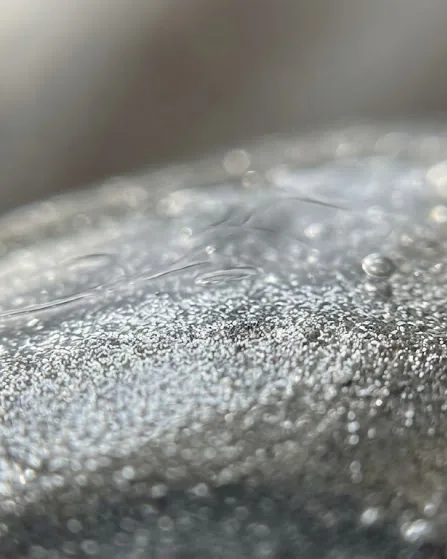
Troubleshooting patchy, cloudy, and chipping chrome
Most chrome failures trace back to three causes, and naming the cause tells you the fix. Patchiness and bald spots usually mean the no-wipe top coat was wrong or over-cured, so there was no tack for the powder to grab; cloudiness typically means residue or contamination on the surface before burnishing; and chipping at the tip almost always means the free edge was not capped, leaving loose powder exposed at the most fragile point of the nail. Lifting, where the whole layer peels from the plate, points back to prep, usually skipped dehydration or a base coat that never bonded. Work through these in order and you resolve the overwhelming majority of chrome problems without guesswork.
A quick diagnostic pass before you blame the product:
- Patchy or bald: wrong or over-cured no-wipe top coat, no tack.
- Cloudy: residue, dust, or oil on the surface before burnishing.
- Chips at the tip: free edge not capped, loose powder exposed.
- Lifting from the plate: weak prep or a base that never bonded.
How to remove chrome without wrecking the nail
Removal is where impatience does real damage, and it is the step every short tutorial omits. Gel chrome comes off by soak-off: gently break the top-coat seal with a fine buffer, then soak in acetone-saturated cotton wrapped in foil until the layers soften and lift. Do not try to scrape or acetone-buff a healthy gel you want to keep wearing; you will thin and damage the natural nail underneath. Press-ons peel or soak by their own instructions, and one-step lacquers remove with ordinary polish remover.
Permits, ingredient rules, and what safety actually costs
The safety and regulatory picture is the part almost every chrome guide ignores, and it is the part that governs whether repeated wear is a good idea. Two bodies set the rules that reach your fingertips. In the United States, the U.S. Food and Drug Administration regulates nail products as cosmetics and also oversees UV curing lamps as devices, and it publishes plain-language guidance on nail care products for consumers. In Europe, the European Commission through DG GROW enforces the EU Cosmetics Regulation, and national agencies such as Ireland’s Health Products Regulatory Authority translate those rules into enforcement. These are the entities deciding which photoinitiators and monomers can legally sit in the bottle you buy.
The most consequential recent change concerns TPO. Trimethylbenzoyl diphenylphosphine oxide, a photoinitiator used in many UV and LED gel and hybrid polishes, has been prohibited in EU cosmetics, nail products included, since 1 September 2025, after being classified as a CMR category 1B reproductive toxicant. According to the Health Products Regulatory Authority notice, member states adopted that prohibition by a vote of 25 in favour, 1 against, and 1 abstention. You can read the regulator’s own explanation of the change on the HPRA notice on the TPO prohibition, and the European Commission’s questions-and-answers page walks through what it means for salons and manufacturers.
The allergy question is where the numbers get specific. HEMA, or 2-hydroxyethyl methacrylate, is a monomer common in gel systems and a known contact allergen. In an 8-clinic Italian study of 7,133 patch-tested patients, 147 people, or 2.1 percent, reacted positive to 2-HEMA, and that rate climbed from 1.6 percent in 2019 to 2.7 percent in 2023. Artificial nails were the leading exposure source in 75.0 percent of occupational cases and 72.2 percent of non-occupational cases. The full dataset is available through the NIH PubMed Central record of the HEMA patch-test study.
A tempting shortcut is to buy anything labeled HEMA-free and assume you are safe. The clinical literature says otherwise. A documented 28-year-old patient developed allergic contact dermatitis from a HEMA-free gel polish because cross-reacting methacrylates were still present. In other words, HEMA-free does not mean allergy-free. The case report is published in The Journal of Allergy and Clinical Immunology: In Practice, and a broader clinical review appears in the peer-reviewed journal Contact Dermatitis. If your fingertips itch, blister, or the skin around the nail thickens after wear, that is a reason to stop and see a professional, not to switch brands blindly.
UV lamps: the numbers behind the scare headlines
Lamp exposure gets alarming headlines, so it helps to sit with the actual figures. Both UV and LED curing lamps emit UVA. A 2014 JAMA Dermatology analysis, summarized by Harvard Health Publishing, found that the UVA exposure from a gel manicure every two weeks is likely not high enough to significantly raise skin-cancer risk. The FDA advises limiting nail-dryer and UV-lamp use to no more than 10 minutes per hand per session and applying broad-spectrum sunscreen to the hands beforehand. Industry-cited modeling from RadTech and the Nail Manufacturers Council estimates that roughly 250 years of weekly sessions would be needed to equal the theoretical low risk of a single UV treatment used for psoriasis, an exposure lower than midday natural sunlight. You can read the medical framing directly at Harvard Health’s page on LED nail lamp safety and the industry-science position on the RadTech UV nail-lamp facts explainer.
Two more precautions are worth naming. Avoid any product or salon using MMA, methyl methacrylate, which is not appropriate for nail use. And if you are pregnant or taking medication that increases photosensitivity, treat the UV-exposure question as one to raise with a clinician before committing to a lamp-cured routine.
At-home versus salon: cost, time, and honest trade-offs
The choice between doing chrome yourself and booking a salon comes down to what you value more, control or convenience. At home, your upfront cost is the lamp plus a base, color gel, no-wipe top coat, and powder, after which each application is nearly free and you set the pace. The catch is the learning curve: the no-wipe top coat rule and the burnishing motion take practice, and early attempts often come out patchy while you calibrate cure times. A salon buys you a trained hand and a controlled result, but you pay per visit and rebook every few weeks as the mirror grows out with your nail. Neither is wrong; the honest question is whether you will do this often enough to justify owning the equipment.
Aftercare protects whichever route you pick. Daily cuticle oil keeps the surrounding skin supple and slows lifting, and giving your natural nails a break between sets, rather than reapplying continuously, gives the plate time to recover. The finish is only as healthy as the nail carrying it.
Frequently asked questions
Is chrome nail polish safe to wear?
For most people, yes, with sensible precautions. The main risks are contact allergy to HEMA and other acrylates and UVA exposure from curing lamps. The FDA advises limiting lamp use to no more than 10 minutes per hand per session and using broad-spectrum sunscreen on the hands. Stop and see a clinician if you notice itching, blistering, or skin thickening around the nail after wear.
Can I do chrome nails without a lamp?
Yes, but only with certain formats. Chrome powder over gel and most gel chrome systems require a UV or LED lamp to cure. If you want to skip the lamp, choose a one-step chrome lacquer, which air-dries and lasts roughly a week, or a press-on chrome overlay. These trade some durability for convenience, since lamp-cured gel chrome can last weeks by comparison.
Why does my chrome powder look patchy or dull?
Almost always the no-wipe top coat. If you wiped a tacky top coat or over-cured it under the lamp, there is no residual tack for the powder to bond to, so the mirror never forms. Use a genuine no-wipe top coat, cure it for the stated time only, and burnish the powder in firmly. Cloudiness instead usually signals dust or oil on the surface.
Does HEMA-free mean allergy-free?
No. A documented 28-year-old patient developed allergic contact dermatitis from a HEMA-free gel polish because cross-reacting methacrylates remained in the formula. HEMA-free removes one common allergen but not the whole class. If you have reacted before, patch-test cautiously and consult a dermatologist rather than assuming a HEMA-free label makes any product safe for you.
How do I remove chrome nails without damage?
Gel chrome comes off by soak-off. Lightly break the top-coat seal with a fine buffer, then soak the nails in acetone-saturated cotton wrapped in foil until the layers soften and lift away. Do not scrape or acetone-buff a healthy gel you intend to keep, since that thins the natural nail. Press-ons and one-step lacquers remove by their own, gentler instructions.
How long does chrome nail polish last?
It depends on the format. Gel chrome, powder or otherwise, typically wears for weeks; OPI’s Chrome Clawz gel is rated for 3 weeks. A one-step chrome lacquer such as essie’s enamel chrome-effect polish is rated for about 7-day wear with a base and top coat. Press-ons fall in the shorter range. Capping the free edge and daily cuticle oil extend any of them.
Chrome is one of the few nail looks where the science and the technique reward equal attention. Nail the no-wipe top coat, cap your free edge, respect the allergy and lamp facts from the FDA, the European Commission, and the dermatology literature, and the mirror finish stops being a gamble. For the groundwork that makes any finish sit cleaner, revisit how to file the right nail shape for your hands before your next set.