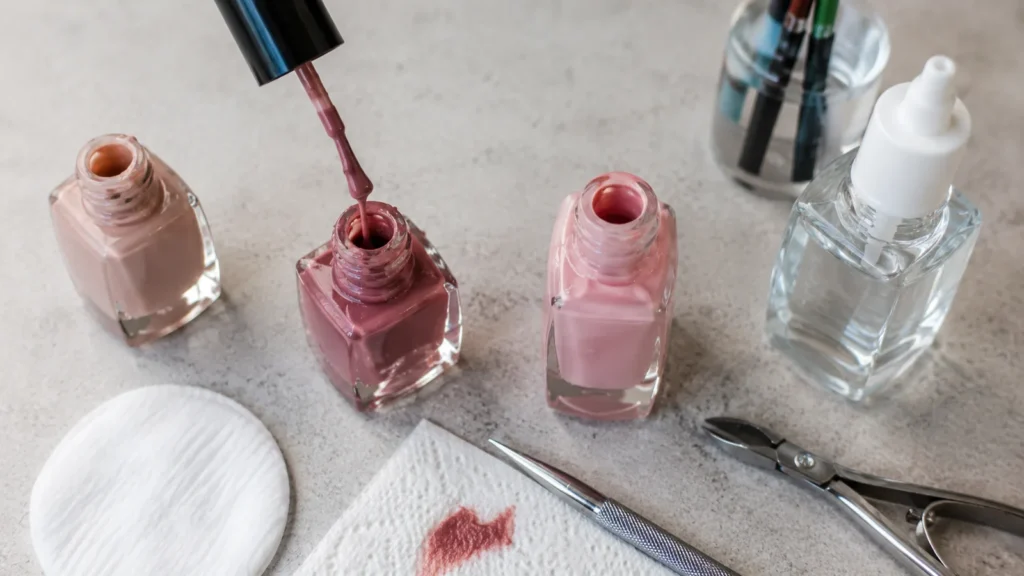
Nail polish thinner is a solvent blend that rebuilds the liquid your bottle lost to evaporation, and it is not the same chemical as a remover even though both feel wet and smell sharp. The distinction matters more than any brand label. Reach for the wrong bottle and you do not just fail to fix a gloopy polish; you dissolve the film that makes it stick, or you kill the pigment that made you buy the shade in the first place. The active ingredients doing the real work are usually ethyl acetate and n-butyl acetate, and knowing that one fact tells you more about whether a product will help or wreck your collection than any marketing copy ever will.
Most bottles thicken because those volatile solvents escape every time the cap comes off, so the resin and pigment left behind grow syrupy. A thinner replaces the missing solvent. A remover strips everything. The gap between those two sentences is where nearly every ruined bottle happens.
Quick answer: what nail polish thinner is and how to use it
Nail polish thinner is a solvent blend, typically ethyl acetate and n-butyl acetate, that restores the volatile carrier a lacquer loses through evaporation. Add a small amount of thinner to a thickened bottle, cap it, and roll it between your palms rather than shaking. Test on a nail, then repeat only if needed. It works on standard nail lacquer. It does not fix cured gel or UV polish, and it can wreck special-effect pigments like holographic, multichrome, magnetic, and thermal shades. Never substitute acetone or a remover; those dissolve the film instead of loosening it.
Why polish thickens and what a solvent actually replaces
Polish thickens because the volatile solvents that keep it fluid evaporate faster than any other part of the formula. A nail lacquer is basically pigment and film-forming resin suspended in a carrier of light solvents. Every time you open the bottle, some of that carrier leaves as vapor. A loose cap, a warm bathroom shelf, and repeated air exposure all speed it up. What stays behind is a higher and higher ratio of solids to liquid, which is why the brush drags, the coat streaks, and the color goes stringy. A thinner works by putting back the exact class of solvent that left, restoring the original balance rather than diluting the color.
This is the single idea the loudest myths get wrong. Water separates the formula because polish is not water-based; the two refuse to mix and you get a cloudy split. Rubbing alcohol and acetone attack differently: they degrade the resin and can leave pigment gummy and dead-looking.
Three habits do most of the damage:
- An unsealed cap neck. Dried polish on the threads stops the cap from closing tight, so solvent keeps escaping between uses.
- Heat. A sunny windowsill or a steamy bathroom accelerates evaporation dramatically.
- Shaking. Vigorous shaking whips air bubbles into the resin, which later print as pits on the nail.
If your bottle is thick but the color still looks true on the brush, you are dealing with solvent loss, not spoilage, and that is exactly the situation a thinner is built for.
How to tell if your bottle needs thinner at all
Not every sluggish bottle is actually thickened. Before adding anything, pull the brush out and look at how the polish falls off it. If it drips in a smooth, even stream and simply feels slightly heavier than usual, you may just have a cold bottle; solvents get more viscous at low temperature, and a few minutes at room temperature can fix that with no thinner at all. If instead the polish strings, clumps at the neck, or leaves visible drag lines on the first stroke, that is genuine solvent loss and thinner is the right tool.
A simple check: run the brush along the inside neck of the bottle once. If it comes away clean and glossy, the formula is fine. If it leaves a crust or a partially dried ring, the bottle has already started losing solvent at the seal, and you should expect to thin it soon even if today’s coat still applied acceptably. Catching this early, before the whole bottle dries, means you need far fewer drops to fix it.
Ethyl acetate and butyl acetate: the two solvents that do the work
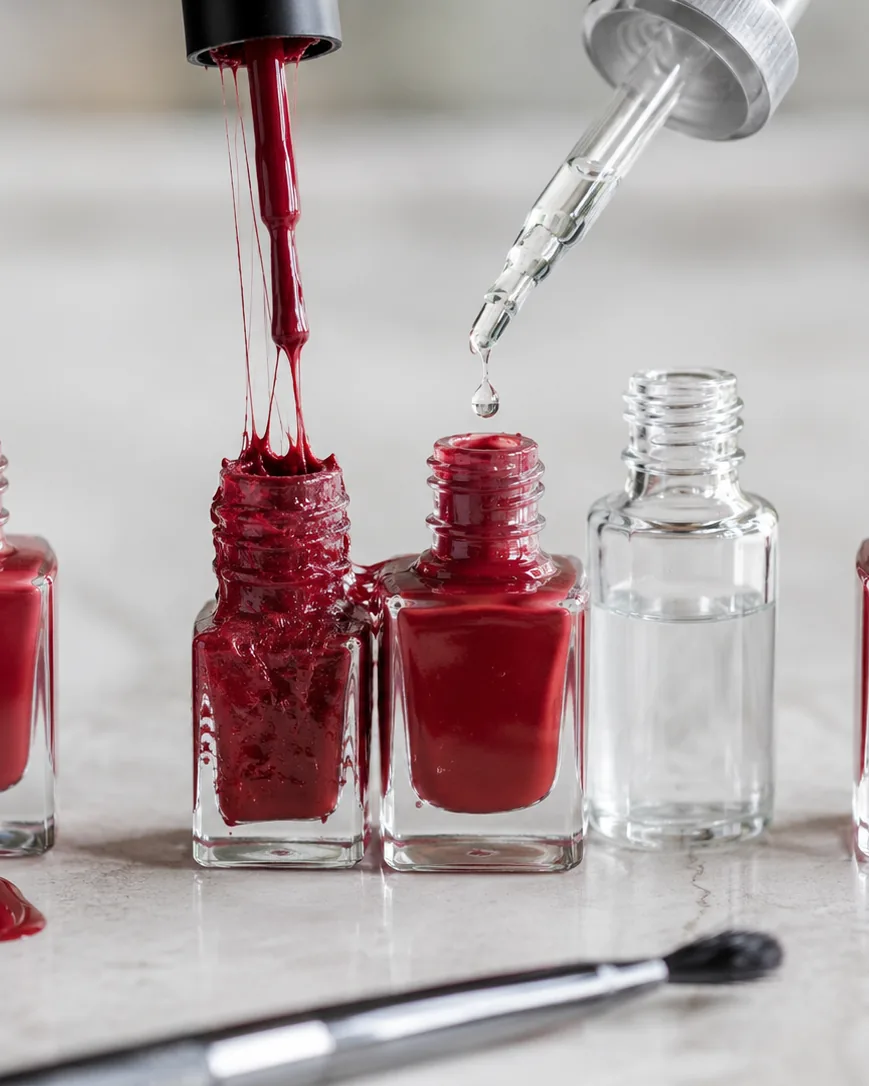
Ethyl acetate and n-butyl acetate are the workhorse solvents in most nail polish thinner formulas, and reading them on a label is the fastest way to judge compatibility. Ethyl acetate is the faster-evaporating of the pair and gives polish its quick surface set; n-butyl acetate evaporates more slowly and keeps the film flowing long enough to level out brush strokes. A thinner rebuilds the same solvent profile the polish was born with, which is why an acetate-based thinner slots back into a lacquer cleanly while a remover does not. Some brand thinners add toluene, heptane, or isopropyl alcohol to tune drying speed and flow, which is worth knowing before you buy.
The reason this matters is safety and behavior, not chemistry trivia. Both solvents are volatile and flammable, so how you store and dose them is a real question, not a formality.
Here is how the two compare on the numbers that affect you:
| Solvent | Evaporation role | Flash point | Occupational limit |
|---|---|---|---|
| Ethyl acetate | Fast set | 24 degrees F | TWA 400 ppm (1400 mg/m3) |
| n-Butyl acetate | Slow flow-out | 72 degrees F | TWA 150 ppm (710 mg/m3) |
Those exposure figures come from the CDC and its National Institute for Occupational Safety and Health, whose Pocket Guide entry for ethyl acetate lists both the recommended limit and the flash point. The parallel entry for the second solvent, the Pocket Guide entry for n-butyl acetate, lists its own recommended exposure limit and flash point, and the two together explain why a thinner behaves differently depending on which solvent dominates the blend. A fast-drying thinner leans more on ethyl acetate; a slower, smoother one leans more on n-butyl acetate.
For a lacquer that has only lost a little solvent, an acetate thinner is the closest thing to a factory reset. If you also work with layered systems, our guide to layering regular lacquer over a gel manicure explains why solvent choice changes again the moment a cured base is involved.
Thinner vs remover vs acetone: why swapping them ruins the bottle
Thinner, remover, and acetone are not interchangeable, and treating them as though they were is the fastest way to destroy a bottle you were trying to save. A thinner replaces evaporated solvent so the existing film can flow again. A remover, whether acetone-based or the milder non-acetone type, is engineered to dissolve and lift the dried film off the nail. Acetone in particular breaks down the polish structure completely. Drop remover or acetone into a thickened bottle and you do not restore it; you start dissolving the resin that holds pigment together, which leaves the color gummy, dull, and permanently changed. The smell overlap fools people, but the jobs are opposites.
Some how-to advice floating around recommends a splash of acetone or non-acetone remover as an emergency substitute. Treat that as a warning, not a tip. Even a small amount of acetone mixed into a bottle of lacquer changes the resin’s behavior permanently. There is no way to undo it once it happens; the only fix at that point is to discard the bottle rather than keep dosing it further.
The failure modes break down cleanly:
- Acetone in the bottle. Dissolves the film former, so the polish never sets right again and can separate for good.
- Rubbing alcohol. Leaves pigment clumped and dead-looking because it degrades rather than dilutes.
- Water. Refuses to blend into an oil-and-resin system, producing a cloudy, split layer that no amount of rolling fixes.
People often confuse product categories the same way they confuse adhesives, a mix-up we untangle in our breakdown of the two products buyers confuse when shopping for gel. The lesson is identical: the label word is not the chemistry. Read what a product is formulated to do, not just what aisle it was sold in.
Dosing by severity: a decision tree from slightly thick to fully dried
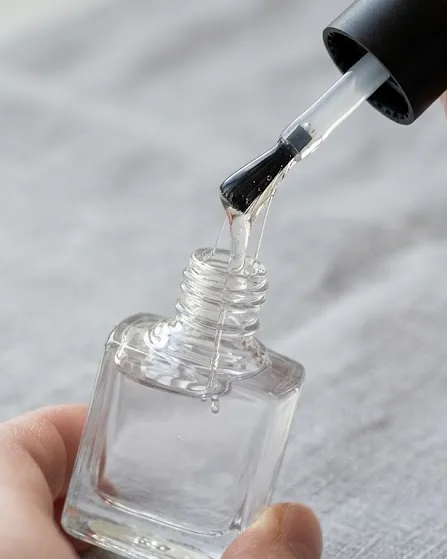
Dosing nail polish thinner correctly means matching the amount to how far gone the bottle actually is, because a slightly sluggish lacquer and a dried-out one need very different treatment. The universal rule that ruins bottles is adding too much at once, since you cannot pull solvent back out. Start small, cap, roll the bottle between your palms to mix without bubbles, then paint a test stroke on a nail or a scrap surface. Judge the result before adding more. Rolling instead of shaking is not fussiness; shaking beats air into the resin and those bubbles surface as tiny craters once the coat dries on the nail.
Work from the mildest case up:
- Slightly thick. The brush drags a little but color is true. Add a small amount of thinner, cap, roll gently to mix, test. Repeat once only if still stiff.
- Gloopy. The polish strings and pulls. Add a few drops, roll, and let it rest a few minutes so solvent can redistribute before you test.
- Dried or separated. The formula has pulled apart or barely moves. Fill with thinner up to the shoulder line inside the neck, cap tightly, and let it sit overnight so the solvent can rehydrate the solids. The next day, stir gently with a solvent-proof tool and roll.
If you over-thin, do not panic and do not add more color; leave the bottle open on a ventilated surface for a short while so a little excess solvent escapes, then re-test. Over-thinned polish paints sheer and runs into the cuticle, so catching it early with the test stroke is the whole point of the drop-by-drop method.
A useful mental model is a kitchen analogy: you would not dump a whole cup of stock into a thick sauce hoping to fix it in one move; you add a splash, stir, taste, and repeat. Thinner works the same way. Each round of a few drops, a roll, and a test stroke costs you almost nothing, while one heavy pour can cost you the whole bottle. Patience here is the entire technique.
Which polishes a standard thinner saves, and which it destroys
A standard acetate thinner rescues regular nail lacquer and only regular lacquer, so before you dose a bottle you need to know which category it belongs to. Cured gel and UV polish are chemically hardened under a lamp into a solid film; nothing you drop into the bottle re-liquefies a polymer that has already set, and adding thinner to uncured gel changes its cure behavior unpredictably. Special-effect polishes are the real trap. Holographic, multichrome, magnetic, and thermal formulas rely on precisely suspended particles and pigments, and flooding them with extra solvent can disperse those particles, dulling the flip or killing the magnetic pull entirely. Match the thinner to the polish type first, dose second.
Use this as your compatibility map:
| Polish type | Standard acetate thinner? | Why |
|---|---|---|
| Regular lacquer | Yes | Same solvent class it was built on |
| Cured gel / UV | No | Already a hardened polymer film |
| Holo / multichrome | Risky | Can disperse the effect pigment |
| Magnetic / thermal | Risky | Disturbs suspended particles |
If your bottle is a special-effect shade, a brand-specific thinner formulated for that line is the safer bet, and even then you dose conservatively, one drop at a time, with longer rest periods between tests so you can see how the effect responds before adding more. If the flip or shift starts to look muddy after a drop or two, stop immediately; that particular bottle has reached the point where more thinner does more harm than the current thickness was doing.
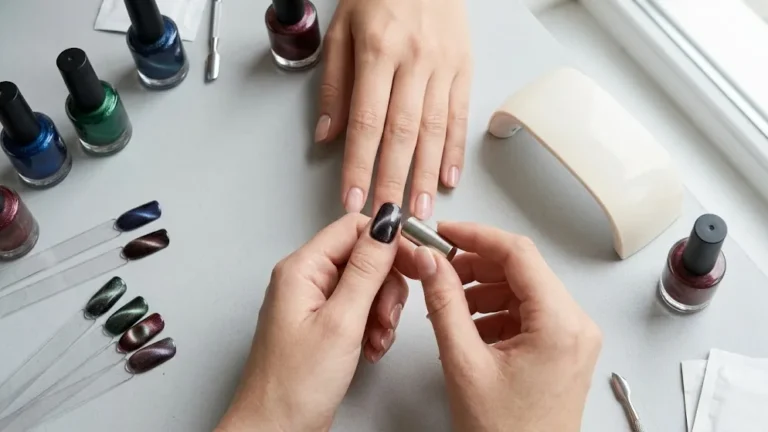
The physics of those pigments is the same reason application technique is so finicky; our walkthrough of the magnetic shimmer effect in cat eye polish shows how sensitive suspended particles are to disturbance. Special-effect formulas reward a light hand at every stage, from the first drop of thinner through the final topcoat.
Brand-specific versus universal thinner: does it actually matter
Most brands sell a thinner labeled for their own polish line, and the honest answer is that the underlying chemistry overlaps heavily with a generic acetate thinner, but the details are not identical. Brand-specific formulas are tuned to match the resin and plasticizer blend that brand uses, so the drying speed and flow after thinning tend to match the original polish more closely. A universal thinner still works on most standard lacquers because the core solvents are the same class, but you may notice a slightly different feel, dry time, or gloss on some brands.
For everyday drugstore or mass-market lacquer, a universal acetate thinner is fine and far more economical than buying a separate bottle per brand. For niche indie polish makers, especially ones running special-effect or hand-mixed formulas, using their own thinner (when they sell one) reduces the risk of an unexpected reaction with proprietary pigments or suspension agents. When in doubt, test on an inexpensive or nearly-empty bottle before committing your favorite shade to an untested combination.
Troubleshooting the brush and cap, not just the bottle
A clumped or splayed brush is often mistaken for a formula problem when it is really a tool problem. If bristles are stiff with dried polish, dip just the brush tip into a small amount of thinner, work it gently against the side of the bottle or a lint-free cloth, and repeat until bristles separate cleanly. Do not soak the whole brush handle, since prolonged solvent contact can loosen the glue holding bristles in the ferrule over repeated cycles.
If polish keeps building up in a crust around the cap threads no matter how carefully you wipe, that crust is actively feeding the thickening problem by breaking the seal every time you close the bottle. Clean it fully with a cotton swab dipped in a little remover before storage, let it dry, then close firmly. A bottle that seals properly can go months without needing a single drop of thinner; a bottle with a compromised seal will thicken again within weeks even right after you fix it.
The safety facts none of the popular guides mention
Nail polish thinner is a volatile, flammable solvent blend, and the exposure and fire data behind it are the part most how-to guides skip entirely. Ethyl acetate is a Class IB flammable liquid with a flash point of 24 degrees F and an immediately-dangerous-to-life-or-health value of 2000 ppm, while n-butyl acetate is also Class IB with a flash point of 72 degrees F and an IDLH of 1700 ppm. Both figures come from the CDC and its National Institute for Occupational Safety and Health. In plain terms, the vapor ignites at ordinary room and body temperatures, so an open bottle near a candle, a stove, or a lit cigarette is a genuine hazard, not a theoretical one.
The exposure limits are set by public agencies for a reason. The Occupational Safety and Health Administration lists a permissible exposure limit for ethyl acetate at a time-weighted average of 400 ppm, matching the NIOSH recommendation, and its Annotated Table Z-1 of permissible exposure limits is where those workplace numbers live. NIOSH also distinguishes brief spikes in n-butyl acetate exposure from sustained exposure across a work shift, treating short-term peaks separately from the everyday limit.
Translate those into home rules:
- Ventilate. Work near an open window or with airflow so vapor never concentrates in a small closed bathroom.
- Kill ignition sources. No open flame, no smoking, no lit candles anywhere near an open bottle, given those low flash points.
- Protect skin and eyes. These solvents dry and irritate skin and sting eyes; cap promptly and wipe spills.
- Store it away from children and pets and never leave it decanted into an unlabeled cup.
The U.S. Food and Drug Administration regulates the safety and labeling of cosmetic nail products, and its nail care products guidance page is the primary federal reference for what these formulas may and may not contain. Because a thinner concentrates the very solvents that make polish volatile, it deserves more caution than the polish itself, and treating it as just another cosmetic accessory undersells the actual hazard sitting on your vanity.
What if you feel dizzy or irritated while thinning polish
If you notice a headache, dizziness, or throat irritation while working with thinner in a small room, stop immediately, cap the bottle, and move to fresh air. These are early signs that vapor concentration in the room has climbed past a comfortable level, well before it reaches anything close to the IDLH figures cited above, which describe emergency thresholds rather than a normal comfort zone. Open a window, use a fan to move air out rather than just around the room, and do not resume until you feel clear. If symptoms persist after moving to fresh air, treat it like any other chemical exposure and seek medical advice rather than pushing through it.
Labels, pregnancy, and salon exposure: reading X-free claims
The “3-free,” “5-free,” and “9-free” labels on polish and thinner claim the product leaves out a rising count of ingredients of concern, but independent testing has repeatedly shown those claims cannot be taken at face value. A screening analysis cited in occupational risk work found that 83 percent of nail products claiming to be toluene-free actually contained toluene, and 14 percent of products claiming to be DBP-free contained dibutyl phthalate at concentrations up to 88,000 ppm. That is the core reason a person who is pregnant, or a salon worker exposed all day, cannot rely on marketing text alone. The label reduces your odds of exposure; it does not guarantee zero exposure.
The regulatory picture is shifting fast. The Cosmetic Ingredient Review assessed toluene in 1987 and found it safe in nail products up to 50 percent, the highest concentration then observed, and the FDA now notes that toluene use in nail products is being phased out. A peer-reviewed review of nail product safety in the International Journal of Dermatology, available through an open-access clinical review of nail-product health threats, compiles the exposure evidence that makes salon-worker health a live public issue.
State law is moving ahead of federal rules. Under California’s Toxic Free Cosmetics Act, formaldehyde is now banned in nail products, and toluene in nail products has been regulated in the state since 2023. A 2026 laboratory study published in Science of the Total Environment, viewable at its peer-reviewed lab analysis of chemicals in U.S. nail products, detected chemicals of concern, including toluene, formaldehyde, and DBP, in U.S. nail products, some at concentrations above 10,000 ppm.
If you are pregnant or work in a salon all day, a few practical adjustments reduce your exposure without needing to give up polish entirely:
- Favor low-VOC or water-based formulas where possible, and treat X-free claims as a starting point, not a guarantee.
- Work in ventilated spaces with airflow moving vapor out of the room rather than just circulating it.
- Wear nitrile gloves during repeated daily exposure, since solvents also absorb through skin, not only through inhalation.
- Take breaks outdoors during long salon shifts rather than working through an entire day in one closed room.
Prevention and disposal: keeping the bottle usable and dumping it safely
Preventing re-thickening is cheaper and safer than repeatedly dosing a bottle with nail polish thinner, and it comes down to controlling the two things that drive evaporation: air exposure and heat. Wipe the cap neck clean with a lint-free cloth after every use so the threads seal fully, because dried polish on the rim is the number one cause of a cap that never quite closes. Store bottles upright in a cool, dark drawer rather than a warm, sunlit bathroom, since heat and light both speed solvent loss. Roll rather than shake to mix, and keep the thinner itself tightly capped and away from any ignition source between uses.
A few extra habits extend bottle life further. Avoid storing polish near a radiator, a sunny windowsill, or inside a hot car, all of which push internal temperature well above the cool, dark ideal. If you buy in bulk or stockpile shades, a drawer or box works better than an open shelf, since even indirect light and ambient room heat add up over months. Rotating older bottles to the front so you use them before they sit untouched for a year also reduces the odds you will need to thin them at all.
Disposal is the step people get wrong. Because a thinner is a flammable solvent, you should not pour meaningful quantities down the drain.
- Small residue. Let a nearly empty bottle air out in a ventilated spot, then dispose of the dried container per local rules.
- Larger volumes. Take leftover thinner to a household hazardous waste collection point rather than the sink or trash.
- Never combine it with other chemicals in a shared container.
Good storage habits also protect your tools and technique investment. If you are precise enough to maintain your polish this carefully, the same discipline pays off in application, whether you are refining your files with our guide to choosing and filing the right nail shape or extending the life of your color between manicures.
Frequently asked questions about nail polish thinner
Can I use nail polish thinner on gel polish?
No. Cured gel and UV polish are hardened into a solid polymer film by a lamp, and no solvent you add to the bottle re-liquefies that set structure. Thinner is built for regular lacquer that lost volatile solvent to evaporation. Adding it to uncured gel also changes how the gel cures, so keep the two systems and their products completely separate.
How many drops of thinner should I add?
Start with a small amount for a slightly thick lacquer, cap the bottle, and roll it between your palms rather than shaking to avoid air bubbles. Test a stroke on a nail before adding more, because you cannot remove solvent once it is in. Dried-out bottles need more, filled to the neck shoulder and left overnight, but always build up gradually.
Does nail polish thinner expire or go bad?
A capped thinner is a stable solvent blend, but its whole job depends on staying sealed, since the same volatile acetates that fix your polish evaporate from the thinner too. Keep it tightly closed, cool, and dark, away from heat and ignition sources given its low flash point. If a bottle has sat open and lost volume, it will simply be weaker than fresh product.
Can I make my own nail polish thinner at home?
Skip it. The myth substitutes, water, rubbing alcohol, and acetone, each fail for a specific reason: water refuses to blend and separates, alcohol leaves pigment gummy, and acetone dissolves the film former outright. A proper thinner is a tuned blend of ethyl acetate and n-butyl acetate matched to polish chemistry. Buying a purpose-made or brand-specific thinner is safer and far cheaper than the bottles a homemade mix ruins.
Is nail polish thinner safe to use around candles or a gas stove
No. Both of its main solvents are Class IB flammable liquids with flash points well below normal room temperature for ethyl acetate and only slightly above it for n-butyl acetate, meaning vapor can ignite from a nearby flame, spark, or hot surface. Always thin polish in a ventilated area away from any open flame, lit cigarette, or gas appliance, and recap the bottle as soon as you finish dosing it.