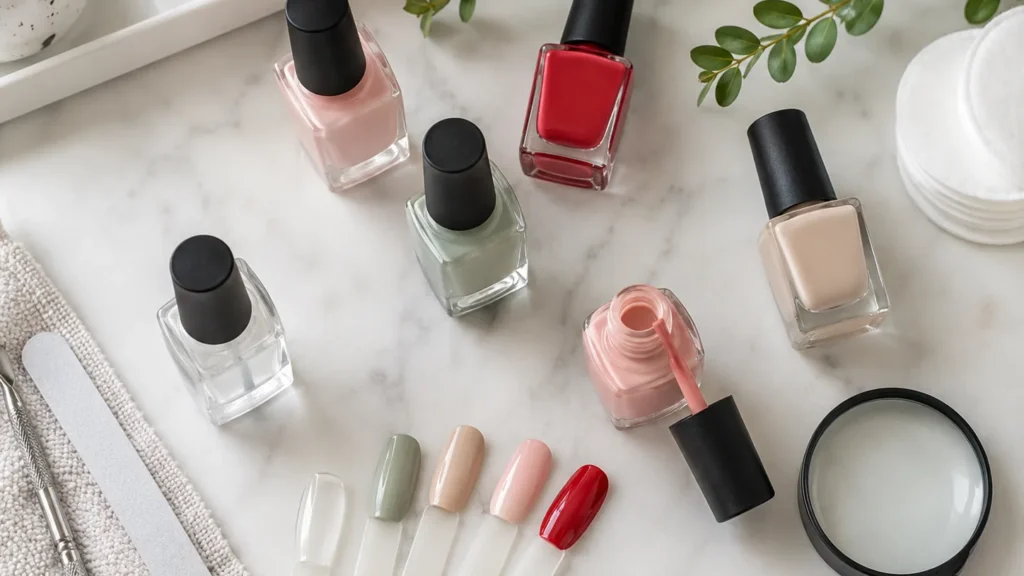
Vegan nail polish gets confused with cruelty-free and “clean” polish constantly, and that confusion is where shoppers lose money and get misled. The three claims describe different things. A bottle can be one, two, or all three, and the word on the front tells you almost nothing until you check who verified it. This guide takes the term apart at the ingredient level, shows you how to read the label yourself, and maps which certification logos actually mean what they say.
Here is the uncomfortable starting point. In the United States, “vegan,” “cruelty-free,” and “X-free” are marketing language, not legal categories. No federal agency defines them for a nail product. That means the burden of verification falls on you, and the skill you need is reading an ingredient list, not trusting a font.
Quick answer: what makes a nail polish vegan
Vegan nail polish contains no animal-derived ingredients and no animal by-products. The usual culprits are carmine (red pigment from crushed cochineal insects), guanine or “pearl essence” (shimmer from fish scales), keratin, oleic acid, shellac, and beeswax. A vegan formula swaps these for nitrocellulose film former, ethyl and butyl acetate solvents, synthetic pigments, and mineral or aluminium shimmer. Vegan is not the same as cruelty-free, which concerns animal testing, not ingredients. To confirm a specific bottle, read the INCI list and check for a recognized certification like the Vegan Society Vegan Trademark or PETA’s Animal Test-Free and Vegan designation.
Carmine, guanine and the other animal ingredients hiding in polish
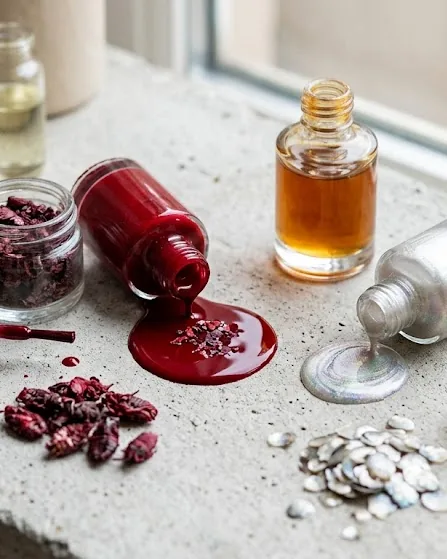
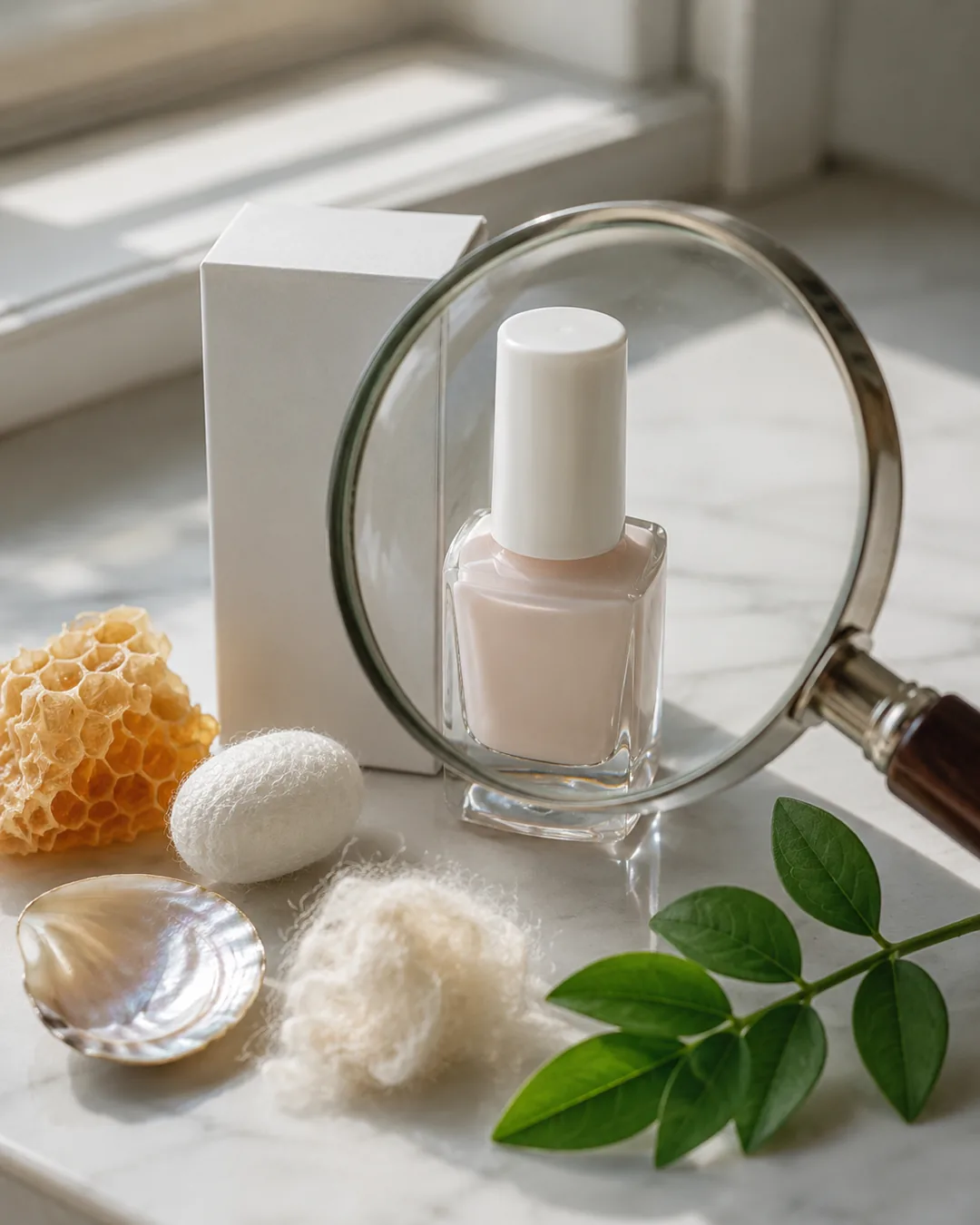
The animal content in conventional nail polish is not obvious because it hides inside functions you never think about: color, shimmer, hardness, and shine. Carmine, also written on labels as CI 75470, is a red pigment made from crushed cochineal insects and appears in reds, pinks, and berries. Guanine, sold as “pearl essence,” is a shimmer derived from fish scales. Keratin comes from animal hooves, horns, and feathers and gets added as a strengthener. Oleic acid can be animal-fat derived. Shellac is a resin secreted by the lac insect. Beeswax and honey turn up as conditioners. Each one has a plant or synthetic equivalent, so a formula can drop every one of them and still perform.
- Carmine (CI 75470): red and pink pigment from cochineal insects. Swap: synthetic organic or mineral pigments.
- Guanine / pearl essence: iridescent shimmer from fish scales. Swap: mica, synthetic pearl, or aluminium particles.
- Keratin: strengthener from hooves, horns, feathers. Swap: plant proteins or none at all.
- Oleic acid: can be animal-fat sourced. Swap: plant-derived oleic acid.
- Shellac: resin from the lac insect used for gloss and film. Swap: nitrocellulose.
- Beeswax (cera alba) and honey: conditioners. Swap: plant waxes or omission.
Miss one of these and the vegan claim collapses. That is why per-ingredient scrutiny beats a front-of-bottle label. Liberation Nails, a brand blog that explains formula composition, walks through these same culprits and their plant swaps in useful detail if you want a second read on the chemistry.
The reason shimmer matters so much here is worth a pause. A lot of shoppers assume pigment is the only risk. In practice the pearlized and frost finishes are where guanine sneaks in, so a “nude” shade can be less vegan-friendly than a bright creme.
Reading the INCI label: spot animal derivatives by their real names
The single most useful skill is decoding the INCI list, and it takes about thirty seconds per bottle once you know the terms. INCI stands for the International Nomenclature of Cosmetic Ingredients, the standardized naming system that appears on cosmetic packaging worldwide. Ingredients are listed in descending order of predominance, so what sits near the top makes up most of the formula and what sits near the bottom, often the pigments, appears in trace amounts. Animal derivatives frequently hide under Latin or code names: carmine as CI 75470, beeswax as cera alba. If you can match the term to its function, you can clear or reject a bottle without emailing the brand.
The U.S. Food and Drug Administration sets the rules for how those ingredients must be declared on cosmetic packaging. Its labeling guidance lays out the requirement to list ingredients and the conventions manufacturers follow, which is the reason your bottle carries that dense back-panel list at all. You can read the agency’s own reference in its cosmetics labeling guide.
A quick decoding routine:
- Scan for the flagged terms above, including their code and Latin aliases (CI 75470, cera alba).
- Note position in the list. Pigments and shimmer sit low, so they are easy to skim past.
- Cross-check any unfamiliar CI number, since colour-index dyes can be plant, mineral, or animal.
- Remember the list confirms ingredients, not testing history. A clean list does not make a polish cruelty-free.
Label reading pairs naturally with the other checks people run at the counter, the same way you would inspect adhesion before layering shades. If you are the type who audits a manicure end to end, our guide to putting regular lacquer over a gel manicure shows the same habit applied to wear and removal.
Vegan, cruelty-free and “clean” are three different claims
Vegan, cruelty-free, and “clean” are not synonyms, and treating them as one word is the most expensive mistake a shopper makes. Vegan is an ingredient claim: no animal-derived content. Cruelty-free is a process claim: the finished product and its ingredients were not tested on animals. “Clean” or “non-toxic” is a health-adjacent claim about excluded chemicals, and it is the vaguest of the three because no authority defines it. A polish can be vegan and still tested on animals somewhere in its supply chain. It can be cruelty-free and still contain carmine. Reading the front label as a single virtue signal is how those contradictions slip through.
Mirellé, an ingredient-focused guide, frames this well by treating vegan as a formula question decided layer by layer rather than a vibe. Its point that most conventional polish sold in the European Union is already cruelty-free yet not automatically vegan is exactly the distinction that trips up buyers. You can see that framing in its breakdown of vegan nail polish ingredients.
Green Matters, an editorial outlet, offers a plain-language starting definition and a practical habit worth keeping: search “is [brand] vegan?” before you buy, then verify against the certification and the ingredient list rather than the answer alone. Its overview lives in a broad guide to vegan and cruelty-free polish, though it predates the recent shifts in the certification landscape covered further down.
Why the distinction has real consequences
If you buy for ethics, the gap between the two claims changes your decision. Someone avoiding animal testing needs the cruelty-free check. Someone avoiding animal ingredients needs the vegan check. Someone concerned about chemistry needs the free-from check. One logo rarely covers all three, so you match the claim to the reason you care.
Certification logos: what each one actually verifies
Certification logos are the shortcut that works, but only if you know what each one guarantees and what it ignores. Three names dominate nail polish packaging: the Vegan Society’s Vegan Trademark, the Leaping Bunny mark, and PETA’s Animal Test-Free and Vegan designation. They are not interchangeable. The Vegan Trademark verifies the ingredient side. Leaping Bunny verifies the testing side. PETA’s dual designation covers both when a brand qualifies for the vegan tier. Matching the logo to the claim you care about is the entire game, because a cruelty-free bunny says nothing about carmine, and a vegan mark says nothing about testing.
The numbers behind these programs tell you how established each one is:
- The Vegan Society Vegan Trademark was created in 1990 and now certifies over 70,000 products worldwide. The Vegan Society also coined the word “vegan” back in 1944, which is part of why its standard carries weight.
- Leaping Bunny, run by the Coalition for Consumer Information on Cosmetics in the US and Canada, has operated since 1996 and certifies the cruelty-free (no animal testing) side, not veganism.
- PETA maintains a database that has grown to more than 6,300 companies and brands. To earn the “Animal Test-Free and Vegan” tier, a company must refuse all animal-derived ingredients such as honey, beeswax, or carmine.
One detail shoppers rarely see: PETA’s logo licensing carries a one-time $350 fee for the company using it. That is worth knowing because it means the logo reflects a formal application, not an independent lab audit of every batch. You can review who qualifies and how on PETA’s own reference for its Ultimate Cruelty-Free List, and the vegan-tier requirements on its business join page.
The claim-by-claim breakdown
| Claim | Who defines it | What it guarantees |
|---|---|---|
| Vegan | The Vegan Society (Vegan Trademark); vegan.org (Certified Vegan) | No animal-derived ingredients or by-products |
| Cruelty-free | Leaping Bunny; PETA | No animal testing of product or ingredients |
| “X-free” / “clean” | Nobody in US law | Nothing enforceable; a marketing description |
Read that middle column carefully. The “clean” row is empty by design, because no government body in the United States defines it for a cosmetic.
Permits, inspections and the regulatory reality behind the claims
The regulatory truth that surprises most buyers is how little pre-market oversight a nail polish faces in the United States, and how differently the European Union handles the same product. The Food and Drug Administration regulates nail products as cosmetics. Under that framework, cosmetic products and ingredients, including nail products, do not need FDA approval before going to market, with one exception: most color additives. So the pigments in your polish are among the few components that face a pre-market gate, while the “vegan” and “cruelty-free” words on the front carry no federal definition at all. That is the compliance gap the certification bodies exist to fill.
Here is how the main authorities divide the territory, and what each one costs or requires of the brand in practice:
- FDA governs cosmetic safety and labeling in the US. It requires ingredient declaration but does not pre-approve most formulas or vet marketing terms like “vegan.” Its authority over nail products is explained in its nail care products reference.
- The European Commission (DG GROW) enforces the EU’s animal-testing and marketing bans, a far stricter regime than the US model.
- The Vegan Society runs the private Vegan Trademark certification a brand applies and pays for; it verifies ingredients, not testing.
- Leaping Bunny (CCIC) and PETA run the cruelty-free certifications, with PETA’s $350 one-time licensing fee as the entry cost for its logo.
The European timeline is the sharpest contrast with the US. In the EU, animal testing of finished cosmetic products has been banned since 11 September 2004. Testing of cosmetic ingredients has been banned since 11 March 2009. A full marketing ban, meaning cosmetics or ingredients tested on animals cannot be sold, has applied since 11 March 2013. Those three dates are why “most conventional polish sold in the EU is already cruelty-free” is true as a baseline, while it remains a voluntary claim in the US. The Commission’s own summary of these animal testing and marketing bans sets out the full framework.
Because this sits in health-and-safety territory that affects purchasing decisions, treat unverified “non-toxic” language with the same skepticism you would apply to any claim a seller writes about their own product. The word carries no enforceable meaning on a US label.
The REACH loophole: why EU-sold polish may still not be cruelty-free
The most counterintuitive fact in this whole subject is that a polish sold legally in the European Union may still fail to qualify as cruelty-free. The cosmetics testing ban is not the only law in play. Under REACH, the EU’s chemicals regulation, an ingredient can in certain cases be required to undergo animal testing for worker-safety or environmental purposes, even though testing that same ingredient for cosmetics is banned. That creates a testing loophole: the ingredient enters the market having been animal-tested under chemicals law, which is exactly why some polish sold in the EU cannot honestly be listed as cruelty-free by the stricter certification bodies.
This is the freshness angle the older guides miss entirely. In 2025, PETA rebranded its long-running “Beauty Without Bunnies” program to the “Ultimate Cruelty-Free List,” with a new name and look. Guides written before that shift, including popular editorial pieces from 2019, describe a landscape that no longer matches the logos and lists you will actually find while shopping.
For the shopper, the practical takeaway is that “made in the EU” is a strong signal but not an ironclad guarantee. The certification check still matters, and the Leaping Bunny program addresses cases like the REACH situation directly in its published guidance. If you want the authoritative source rather than a paraphrase, the program lays it out on its frequently asked questions page.
Does vegan polish wear as well, and which format to choose
Performance anxiety keeps a lot of shoppers on conventional polish, and the honest answer is that “vegan” describes the ingredient sourcing, not the wear time. A vegan formula built on nitrocellulose film former with ethyl and butyl acetate solvents behaves like any other polish using those same building blocks, because it is using the same building blocks minus the animal-derived extras. Shine comes from the film former and top coat, not from shellac resin. Shimmer from mica or synthetic pearl reflects light as readily as guanine did. So the format you pick, rather than the vegan status, is what mostly determines chip resistance and longevity.
The three formats you will meet:
- Regular lacquer: air-dries, easiest to remove, shortest wear. Vegan versions are the most common and the simplest to verify.
- Vegan gel (UV/LED): cures under a lamp for longer wear. Verify both the base and top gel, since each is a separate formula that must clear the ingredient check.
- Water-based: lower-solvent, often marketed as gentler; wear time varies and top coat matters.
If you are moving toward gel for durability, the adhesion and removal steps deserve as much attention as the shade, and confusing the wrong bonding product is a classic error. Our breakdown of the two products buyers confuse for gel covers that specific trap so you do not undo a good vegan manicure with the wrong glue.
Vegan does not mean toxin-free
This is the trap for health-minded buyers. A polish can be fully vegan and still contain formaldehyde, formaldehyde resin, toluene, dibutyl phthalate (DBP), camphor, or xylene. The “free-from” claim and the “vegan” claim are separate axes. If you care about both, you check both, because no single logo screens for the chemistry and the animal sourcing at once.
How to verify one specific bottle before you pay
Verification comes down to a three-part check you can run in the store aisle in under a minute. The front label starts the conversation, but the ingredient list and the certification finish it. Do not accept any one of the three alone. A logo without a matching ingredient list, or an ingredient list without a testing claim, leaves a gap that the vegan-versus-cruelty-free distinction can slip through. This is the routine that turns a marketing word into a confirmed fact, and it works whether you are looking at a regular lacquer, a vegan gel, or a water-based bottle.
The three-part check:
- Read the INCI list for the flagged terms: carmine/CI 75470, guanine, keratin, oleic acid, shellac, beeswax/cera alba. Remember they sit low in the list.
- Find a real certification and match it to your claim: Vegan Trademark or Certified Vegan for ingredients, Leaping Bunny or PETA for testing.
- Confirm on the brand’s own site when the bottle is ambiguous, then cross-check against the certifier’s public database rather than the brand’s word alone.
Color choice interacts with all of this, since reds and pinks are the shades most likely to carry carmine and pearlized nudes the ones most likely to carry guanine. If you are choosing a shade to flatter your hands as much as your ethics, our guide to choosing and filing the right nail shape pairs well with a vegan shade decision.
Frequently asked questions
Is vegan nail polish the same as cruelty-free?
No. Vegan means the formula contains no animal-derived ingredients such as carmine or beeswax. Cruelty-free means the product and its ingredients were not tested on animals. A polish can be one without the other. If you care about both, look for a certification that covers each claim, since a single logo rarely verifies ingredients and testing together.
Is regular nail polish automatically vegan?
Not automatically. Many conventional polishes use nitrocellulose and synthetic pigments that happen to be vegan, but others include carmine for red tones, guanine for shimmer, or keratin as a strengthener. You cannot tell from the shade alone. Read the INCI list for animal-derived terms, and treat the “vegan” word on the front as unverified until a certification confirms it.
Does the FDA certify a polish as vegan?
No. The Food and Drug Administration regulates nail products as cosmetics and requires ingredient labeling, but it does not approve most formulas before market and does not define or verify “vegan.” Only most color additives face pre-market review. The vegan claim is verified by private bodies like The Vegan Society or PETA, not by any US government agency.
Is vegan gel polish real, and does it last?
Yes. Vegan gel polish exists and cures under a UV or LED lamp like any gel. Wear time depends on the formula and application, not on vegan status, because shine and hardness come from the film former and top coat rather than animal ingredients. Verify both the base and top gel separately, since each is its own formula that must clear the ingredient check.
How do I know if a red polish contains carmine?
Check the INCI list for “carmine” or the code “CI 75470,” which is the crushed-cochineal pigment used in many reds and pinks. It usually sits low in the list because pigments are present in small amounts. If you see it, the polish is not vegan. A vegan red uses synthetic or mineral pigments instead, so look for those or a vegan certification.
The bottom line for buyers
Strip away the marketing and the subject is simple: vegan is an ingredient claim, cruelty-free is a testing claim, and “clean” is a claim nobody enforces. The US leaves all three to private certifiers, while the EU’s bans since 2004, 2009, and 2013 set a stricter cruelty-free baseline, complicated by the REACH loophole. Your leverage as a shopper is the INCI list and a certification that matches the exact thing you care about. Learn the six flagged ingredients, match the logo to the claim, and confirm the ambiguous bottles against the certifier’s own database. Chemistry, not fonts, decides whether a polish is really vegan.