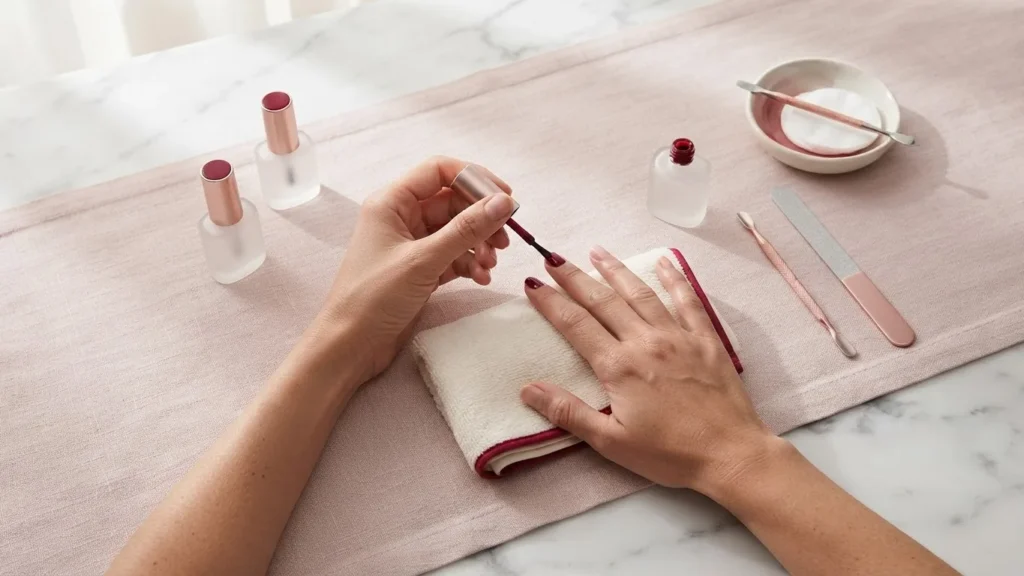
The most useful fact about metallic nail polish is counterintuitive: despite looking heavy and pigment-packed, it usually dries faster than a dark creme, because reflective formulas ride on thinner solvent bases. That single property changes how the whole manicure should be sequenced. This guide covers what actually causes the streaks, how to grip a slippery formula, which drying numbers to trust when brands disagree, and how to get every reflective particle off without scraping the nail bed. The reader who finishes this can decide their layer timing, their base coat, and their removal window before opening the bottle.
Metallic nail polish grips best over a smooth, matte-textured base and goes on in thin, even coats with 2 to 5 minutes between layers. Reflective pigment sits in suspension, so a warmed, well-mixed bottle prevents patchy color. Metallics behave like glitter at removal: they need a 5-minute wrapped soak, not scraping. Manufacturer drying claims range widely – Ella + Mila lists 1 to 2 hours for a full set, while some air-dry formulas claim under 2 minutes to touch-dry. Treat touch-dry and fully cured as separate stages, and avoid water or any scraping for at least 4 hours after application.
Why Metallic Nail Polish Streaks and How the Matte-Base Hack Fixes It
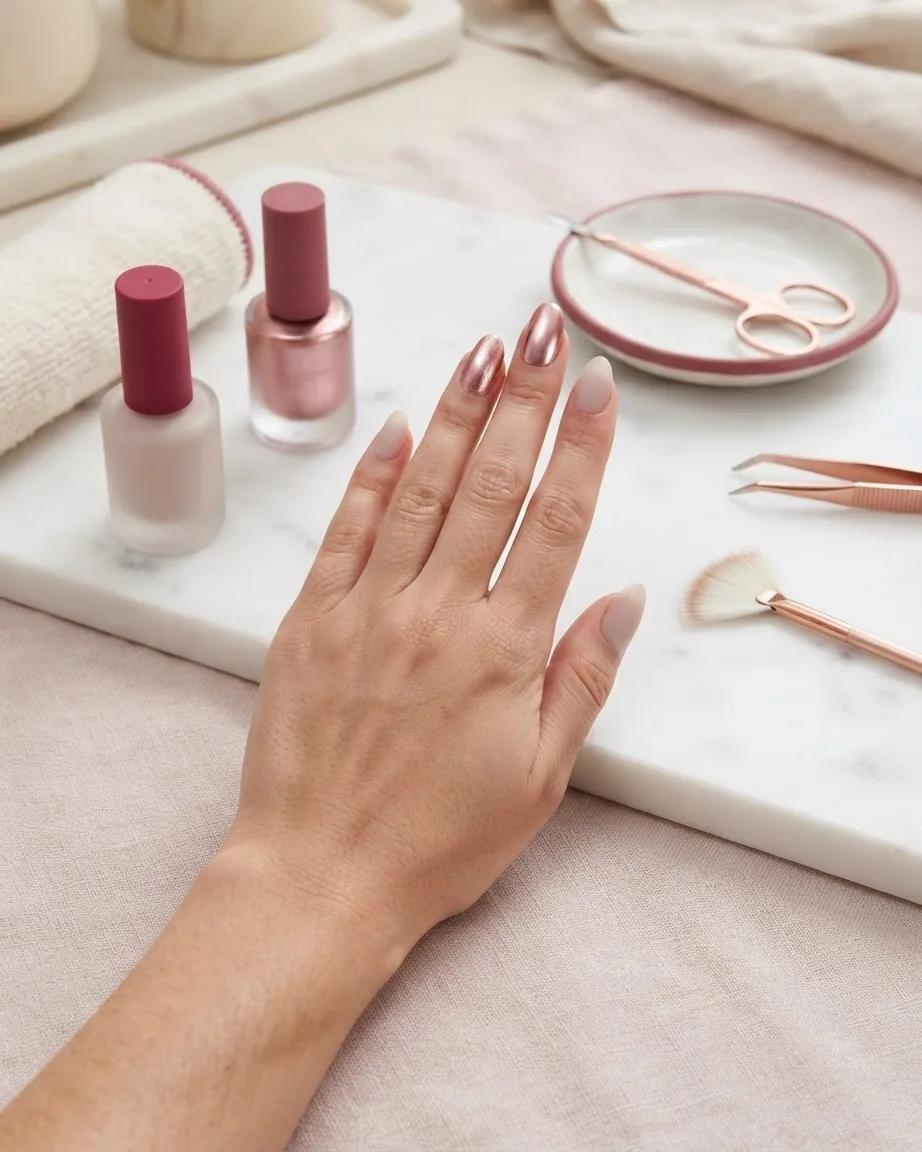
Streaking is the defining complaint with reflective formulas. The pigment particles are flat platelets that need to lie parallel to the nail to reflect light evenly. Drag the brush back over a half-set coat and you disturb their alignment, leaving visible tracks. The fix that official brand guides mostly skip comes out of the enthusiast communities on Reddit – the r/Nailpolish and r/RedditLaqueristas boards repeatedly point to a matte top coat used as an extra base layer under the metallic.
The logic is texture, not chemistry theater. A glossy base coat is slick, so the metallic slides and pools; a matte finish leaves microscopic tooth on the surface for the pigment to catch and hold in place on the first pass. That grip is what lets you lay down one confident stroke instead of correcting a second time. For the standard smooth base coat approach and its trade-offs, the broader technique overlaps with what applies to any reflective finish, including the related work covered in our guide to chrome nail polish and the mirror finish.
The unresolved gap: no source gives a specific matte-versus-gloss test with numbers, so the matte-base trick remains a community-validated workaround rather than a manufacturer-published protocol. It costs one thin extra layer of drying time. If your metallic already lays flat over a normal base, you do not need it.
Prepping the Bottle: Warming and Thinning a Reflective Formula
Reflective pigment settles. Left standing, the heavy metallic particles sink and the top of the bottle turns thin while the bottom turns sludgy, which is the second hidden cause of patchy color. Rolling the closed bottle between the palms warms the formula slightly and redistributes pigment without whipping in air bubbles – shaking hard introduces bubbles that dry as pinholes in the finish.
When a metallic has thickened with age, Saviland’s product guidance points to nail polish thinner rather than acetone or remover to restore flow; the Saviland gold metallic notes frame viscosity control as part of getting even saturation. Here the pack is honest about a limit: no source supplies a drop-count ratio. Thinner is added a single drop at a time, capped and re-rolled between additions, because over-thinning breaks the pigment suspension and you cannot un-thin a bottle. Acetone is not a thinner – it degrades the resin. When a bottle is too far gone, replacement beats rescue.
Application: Thin Coats and the 2-to-5-Minute Layer Window

Metallics reward patience between coats more than most finishes because a second stroke over tacky pigment is exactly what smears the platelets. Two thin coats read cleaner than one thick one. The between-layer wait is where manufacturers converge closely: Ella + Mila’s drying breakdown advises giving it 2 to 5 minutes between layers whether the polish is regular or quick-dry, and Saviland’s metallic guidance lists roughly 2 minutes before the next coat to build color saturation.
So the working window is 2 to 5 minutes: closer to 2 for thin quick-dry formulas, closer to 5 for denser pigment or humid rooms. On pace, Beetles UK states a full manicure of two coats across both hands lands at about 15 minutes of active work. The number to distrust is your own eyes – a metallic surface can look set while the layer underneath is still mobile. Time the gap; do not judge it by shine.
Metallic Gradients: Sponging Onto Foil First
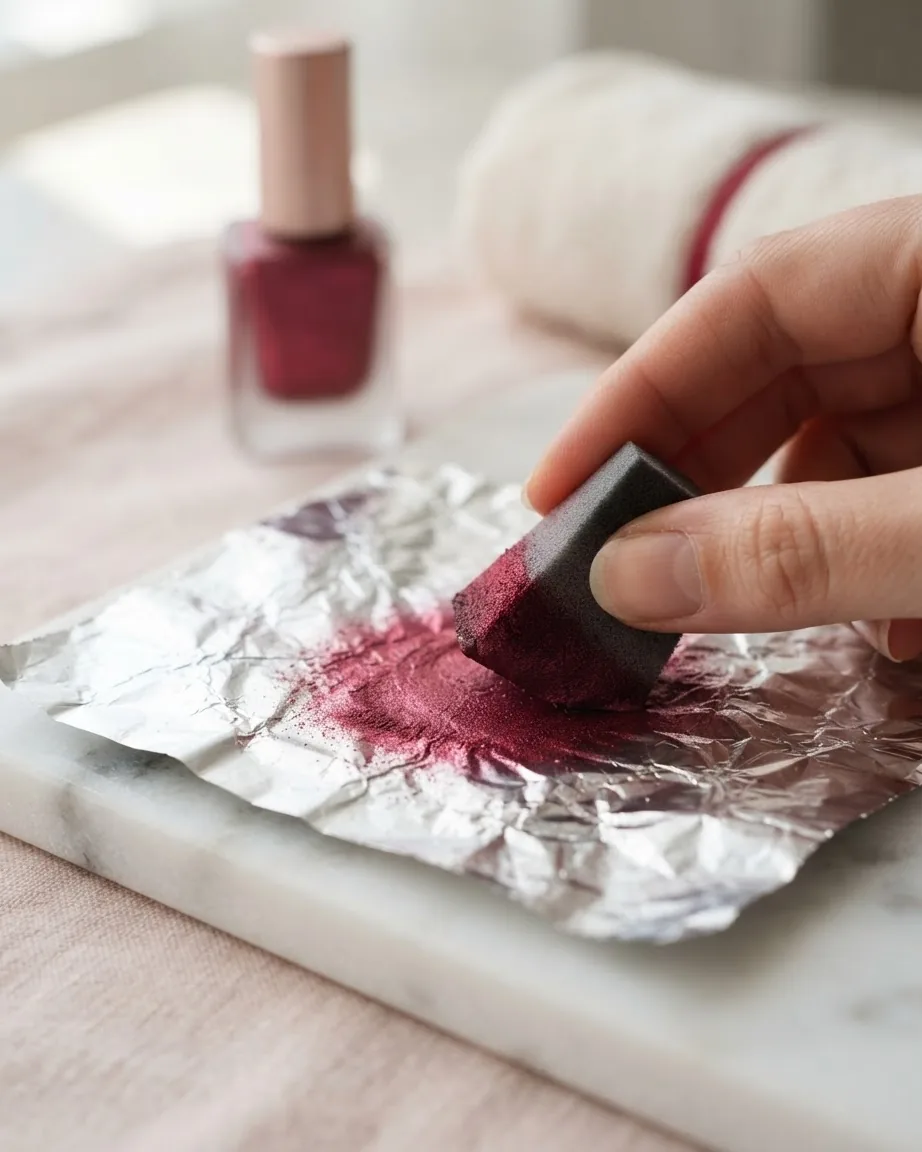
For an ombré or gradient in a metallic, applying polish directly to a makeup sponge and then to the nail wastes product and dulls the reflection, because the sponge drinks the thin solvent base. The adaptation is to dispense the metallic onto a foil or palette first, load the sponge from the foil, then dab it onto the nail. The foil step controls how much pigment transfers and keeps the reflective platelets wetter on contact, which preserves the shine that dry-sponging kills.
This is a controlled, brush-and-tool technique rather than a freehand one, and the tool choices matter as much as the polish; the sponge, dotting tools, and foil setup are catalogued in our overview of nail art instruments. Keep the gradient coats thin for the same reason full coats stay thin – a thick sponged layer takes far longer than the standard window to set and smears on the follow-up dab.
Drying Times: Which Number to Trust When Brands Disagree
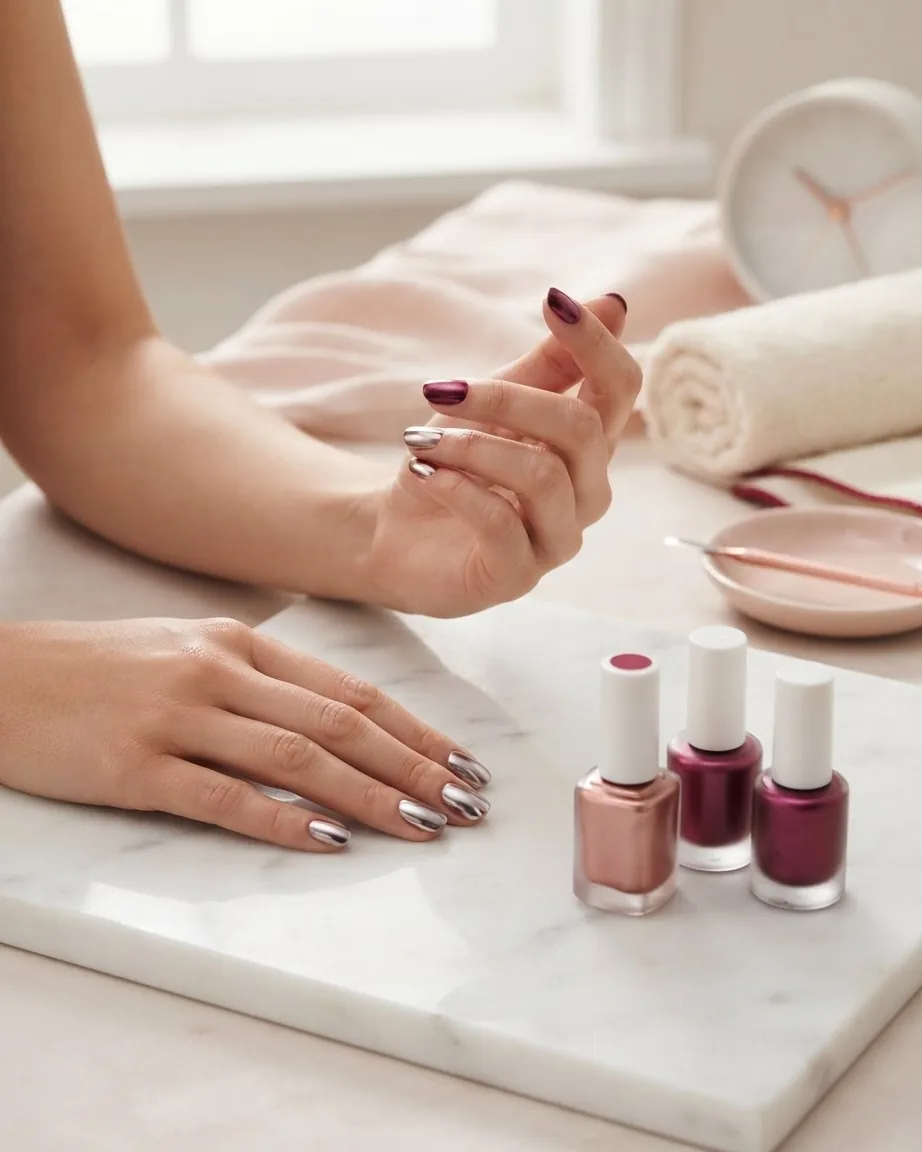
General drying time is where manufacturer claims genuinely conflict, and the honest answer is that “dry” is being defined two different ways. Ella + Mila states that regular polish takes around 1 to 2 hours to fully set. Beetles UK, on its drying-speed guide, states it typically takes 10 to 30 minutes – and separately that its own air-dry formula reaches fully dry in under 2 minutes. Those figures are not all measuring the same thing.
The resolution is to split the stages. Touch-dry (the surface no longer transfers to a light tap) can arrive in 10 to 30 minutes, or under 2 minutes for a formula engineered for it. Fully set – hard enough that a firm press or a sheet crease won’t dent it – is the 1-to-2-hour figure. Because metallic and glitter formulas ride on thinner solvent bases, they typically reach touch-dry on the faster end of that spread. The confusion this settles: a metallic that feels dry in 15 minutes is not the same as a metallic that is safe from dents, and the pack notes brands rarely mark that line clearly.
Practical decision: plan around the slow number. Whatever a bottle claims for touch-dry, treat the manicure as fully vulnerable until the longer window has passed, which the next section pins to a concrete figure.
Aftercare: The 4-Hour Water-and-Scraping Rule
The single figure that governs whether a fresh metallic survives is 4 hours. Saviland’s metallic guidance directs avoiding contact with water or any scraping for at least 4 hours after application. Water is the overlooked culprit: even after the surface feels dry, warm water can soften a not-yet-cured film, and dish soap or a hot shower within that window is a common way an otherwise clean manicure clouds or wrinkles.
That 4-hour figure is longer than the 1-to-2-hour “fully set” claim for a reason – it builds in margin for the reflective layer plus base and top coat curing together. During the window, avoid anything that presses, submerges, or drags across the surface: no gripping keys, no peeling labels, no hot dishwater. If you cannot protect the nails for 4 hours, wearing gloves for wet tasks preserves the finish. Nail-bed or skin irritation from any product is not a cosmetic issue to push through – stop and see a professional.
Safe Removal: The 5-Minute Soak-Off for Reflective Pigment
Metallics resist ordinary swipe-off removal the same way glitter does, because the reflective particles cling to the polish film and to each other. Scraping to force them loose is what actually damages the nail plate. The method that avoids that is a saturated soak held in contact with the polish, not a quick wipe.
Nicole Loves Nails frames the timing by finish type: a glitter and metallic removal guide notes cremes release in 1 to 2 minutes while stubborn reflective formulas need up to 5 minutes of soak. OPI’s application-and-care guidance describes the mechanics in its nail polish blog: let the wrap sit up to 5 minutes, then twist as you pull each wrap off, pressing gently to help the pigment let go. Twisting shears the softened film off in one motion instead of scraping it.
- Saturate, then seal: An acetone-soaked pad held against each nail and wrapped keeps the solvent in contact instead of evaporating off.
- Wait the full 5 minutes for a dense metallic – pulling early is what leaves clingy specks and tempts scraping.
- Twist and pull, don’t scrape: the softened film should slide with the wrap; if it resists, re-wrap for another minute rather than digging.
- Ventilate and protect skin: acetone is drying and an irritant, so work in an aired room and rinse skin immediately on contact.
One thing that does not work: reaching for a metal cuticle pusher or file to shift leftover pigment. That trades a slow soak for a fast gouge in the nail surface. The same soak-off discipline applies to enhancements, covered separately in our guide to removing acrylic nails safely.
Building a Palette: Metallics Against Skin and Season
Reflective finishes read differently than cremes because they throw the ambient light color back, so the room and the light change the shade more than they change a flat color. Verified shade names help here: OPI carries metallic and reflective lines under its own naming, and brands like Londontown and Beetles UK publish metallic ranges, but the value for the reader is category, not marketing copy. Warm golds and bronzes tend to sit close to warm undertones; cool silvers and gunmetals contrast against them. This desk does not rank which metallic suits a given hand – that is a subjective call.
Where metallics overlap with a strong pigment base, the label-reading discipline carries over from our work on red nail polish and undertone matching. Judge any metallic from a real swatch on a nail wheel in the light you will wear it in, not from a bottle cap, because the reflective layer distorts the bottle color more than a creme does.
Your Real Metallic Timeline: From First Stroke to Safe-to-Wash
Every wait in this guide is quoted separately, but nobody adds them up for you. Do the arithmetic and the real commitment becomes clear: the manicure is not “done” when your hands stop moving – it is done when the aftercare window closes. Using only the figures in this article, here is the full clock for a standard two-coat metallic on both hands.
- Between-layer waits: the working window tops out at 5 minutes per gap, and two coats means one gap – but plan the worst case at 5 + 5 = 10 minutes if you also matte-grip a base first.
- Active work to the last stroke: Beetles UK puts two full coats on both hands at about 15 minutes; add the 10 minutes of waiting and you are hands-busy for roughly 25 minutes.
- Time until safe from water and scraping: the 4-hour rule starts after application, so from your first brushstroke that is (4 × 60) + 25 = 265 minutes, about 4 hours 25 minutes, before a hot shower or dishwater is safe.
- Why the 4-hour rule is not overkill: it runs 4 − 2 = 2 hours longer than the 1-to-2-hour “fully set” claim, buying margin for the base, metallic, and top coat to cure together.
The takeaway: a metallic that feels dry in 15 minutes still needs the better part of a movie’s runtime before it survives water – schedule the manicure so nothing wet is due for at least four and a half hours.
Frequently Asked Questions
Does metallic nail polish really dry faster than dark cremes?
Often, yes. Metallic and glitter formulas typically use thinner solvent bases than dense creme colors, so they reach touch-dry sooner despite looking heavier. That speaks to surface dryness only. Full setting still runs to the 1-to-2-hour range Ella + Mila cites, and the safe-from-water window remains 4 hours regardless of finish.
Can I add regular nail polish remover to thin a thick metallic?
No. Remover and acetone break down the polish resin and the pigment suspension rather than restoring flow. Use a dedicated nail polish thinner, added one drop at a time with the bottle re-rolled between additions. Saviland’s guidance frames viscosity control this way. Over-thinning cannot be reversed, so stop the moment the formula flows again.
Why does my metallic look patchy even over two coats?
Two causes usually stack: settled pigment and a slick base. Roll the closed bottle to redistribute the metallic particles before use, and try a matte top coat as the layer directly under the polish for grip, a fix widely reported on r/Nailpolish and r/RedditLaqueristas. Thin, unhurried coats with a full 2-to-5-minute gap finish the job.
How long should I soak to remove a stubborn metallic?
Up to 5 minutes of wrapped, acetone-saturated contact per nail, per Nicole Loves Nails, versus 1 to 2 minutes for a plain creme. Following OPI’s method, twist each wrap as you pull so the softened film shears off with it. If pigment resists, re-wrap for another minute rather than scraping with any metal tool. When is a fresh metallic manicure actually safe from smudges? Treat touch-dry and safe as two separate marks. A metallic can feel dry to a light tap in 10 to 30 minutes, or under 2 minutes for an air-dry formula per Beetles UK, but that surface still dents. The manicure is not truly protected until the 4-hour water-and-scraping window from Saviland’s guidance has passed, which covers the base, metallic, and top coat curing together. The Metallic Manicure in Sequence Read end to end, the reflective finish rewards one habit above the rest: separating how a coat looks from what it is doing underneath. Roll the bottle to fix the settled pigment, thin only a drop at a time if the formula has thickened, and lay grip down first with a matte layer when the metallic slides. Build in thin coats on the 2-to-5-minute window rather than trusting the shine, then hold the manicure clear of water and pressure for the full 4 hours even after it feels done. At the end, soak for up to 5 minutes and twist the wraps off rather than scraping. Every number here comes from a manufacturer or community source that measures things slightly differently, so the safe move is always to plan around the slower figure and protect the nail plate over speed. Where a brand claim and a community workaround disagree, the pack has flagged which is published protocol and which is enthusiast-tested, and both have earned a place in a finish this unforgiving of shortcuts.