Two bottles labeled “blue” rarely produce the same manicure: an icy baby blue reads nearly white in a single coat, while a navy covers like a near-black in two. That spread is the first thing to settle before buying, because blue nail polish spans more tonal range than almost any other color family on a shelf. The second thing to settle has nothing to do with color at all. Deliberately applied pigment and a naturally blue-gray nail bed are two different subjects that happen to share a word, and conflating them causes needless worry. This guide separates the shade decision from the health signal, and treats each with the attention it needs.
The Nailhandbook Editorial Desk compiles shade terminology, application protocols, and product specifications from manufacturer and editorial sources, holding each figure to the record it came from.
Quick answer: Blue nail polish divides into three working families – navy, cobalt, and icy baby blue. Navy behaves as a near-neutral and suits any season; cobalt and brighter blues lean spring and summer; pale baby blue pairs with winter whites and warm-season looks alike. ORLY lists its blue nail lacquers at $10.50 and its breathable 1-step blue lacquers at $11.00. Separately, a bluish tint on the actual nail bed or skin – not pigment you applied – can signal low blood oxygen or poor circulation. One blue nail usually means localized trauma; all nails turning blue is a different, more urgent matter.
Navy, Cobalt, or Icy Baby Blue: Which Blue Family Fits
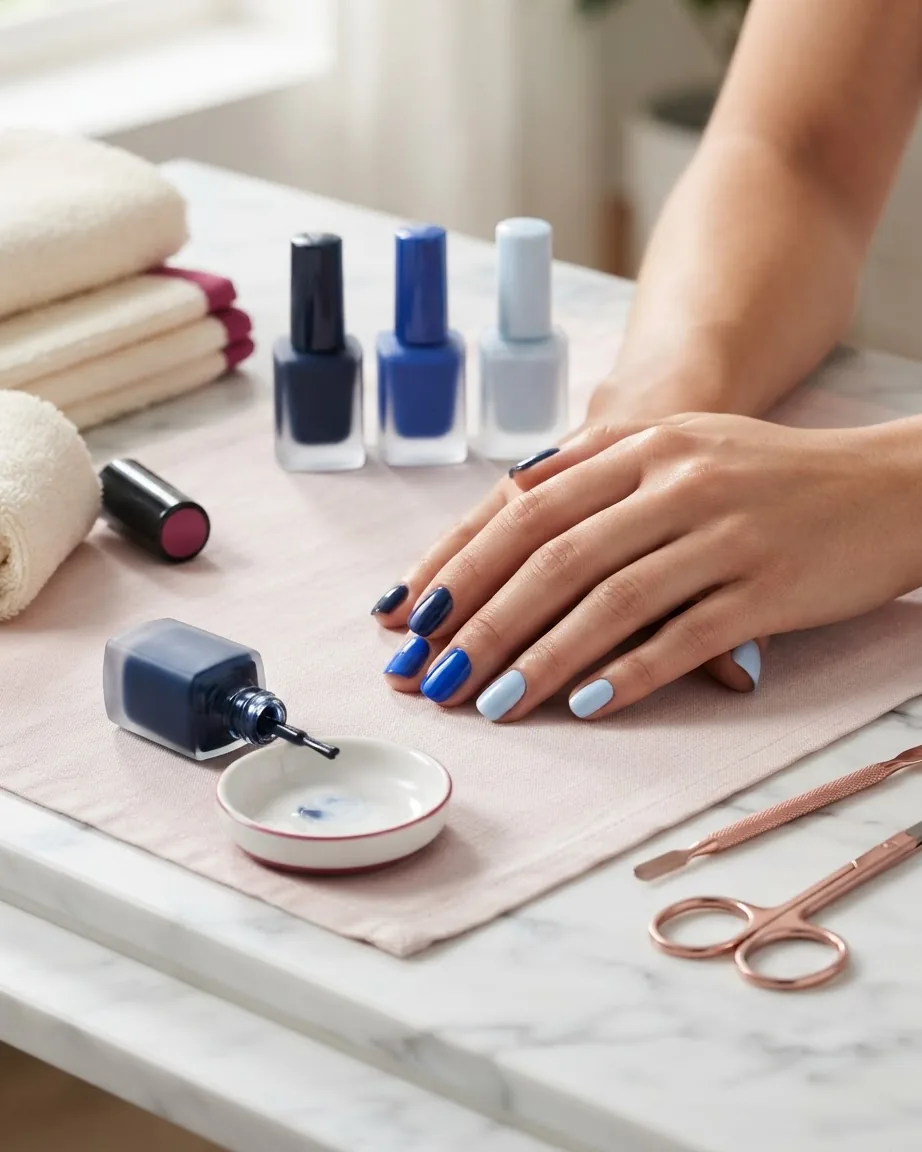
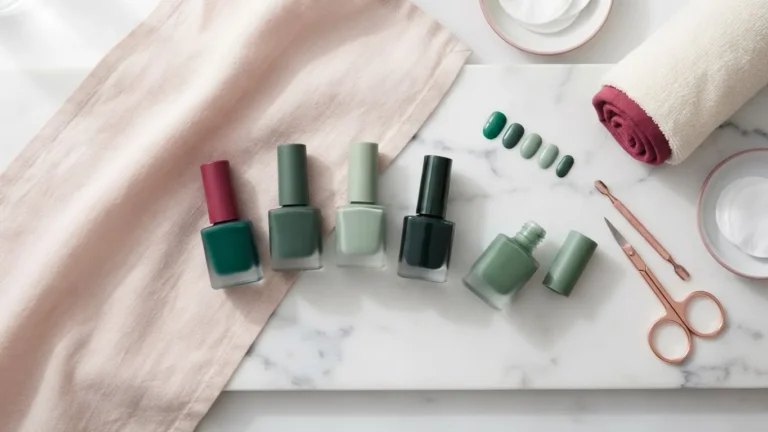
The three blue families divide on depth and saturation, and that division decides coverage, mood, and how many coats a bottle costs you. Navy sits at the dark end: low lightness, muted saturation, and enough depth to cover in two coats. Cobalt is the mid-range workhorse – a clean, saturated primary shade that reads unmistakably blue from across a room. Icy baby blue sits at the pale end, pastel and low in pigment load, which is why it often needs an extra coat to avoid a streaky, see-through finish.
Beyond Polish, a multi-brand retailer, carries blue across its nail polish range, and the trending pairings there span this whole tonal spread rather than clustering at one end. The independent reviewer Lots of Lacquer, who has swatched blue shades across multiple years, treats the family as broad enough to warrant its own roundup. For how pale shades behave once they thin out toward white, the same coverage logic appears in our soft pastel nail polish guide.
- Navy – darkest, most forgiving coverage, reads as a near-neutral. Best for readers who want depth without the starkness of black.
- Cobalt – saturated true tone, highest visual impact, covers cleanly in two coats.
- Icy baby blue – palest, lowest pigment, usually the one that needs a third coat to read evenly.
Navy Nail Polish as a Near-Neutral Alternative to Black

For readers who find black polish too hard or too stark, navy does most of the same work with a softer edge. It anchors an outfit the way black does, pairs with the same wardrobe, and photographs as a deep dark hue rather than a flat void. Who What Wear, a beauty editorial team that tests polishes and tracks manicurist and celebrity shade trends, devotes an entire roundup to navy for exactly this reason – it functions as the grown-up, less severe stand-in for black.
The decision rule is simple. If you reach for black because you want depth and versatility, but the result always looks heavier than you intended, navy gives you the depth without the weight. Because it borders on neutral, navy also layers under clear topcoats or alongside metallics without clashing. Readers weighing other quiet, wardrobe-friendly colors can compare against our nude nail polish approach, which solves a related “goes with everything” problem from the opposite end of the spectrum.
Matching Blue Shades to Season and Occasion

Blue nail polish is no longer boxed into two months of the year. According to Lots of Lacquer, blue nails “used to only trend in deep winter months, like January, and in the height of summer patriotic season, peaking in July,” but are now worn year-round. That shift is the practical takeaway: you are not off-season in October for wearing cobalt. Still, the seasonal leanings are useful when you want a shade to feel intentional rather than random.
Pale icy baby blue reads as a spring and summer pastel, but it also sits cleanly against winter whites and silver-season looks, which makes it the most flexible of the three. Cobalt and brighter blues carry the warm-weather energy best. Navy, being near-neutral, ignores the calendar entirely and works in any season or occasion.
- Spring / summer – cobalt, brighter blues, and pastel baby blue.
- Winter – navy, plus baby blue styled against winter whites.
- Any season / formal or office – navy, as the safe default.
Styling Blue Polish: Neutrals Versus Bold Contrast

Blue takes direction in two broad styling paths, and picking one up front keeps a look from reading accidental. The first path pairs it with neutrals – white, gray, beige, denim – so the polish supplies the only real color note and reads as considered restraint. The second path leans into contrast, setting the shade against warm tones or metallic accents for a louder result. The pairing spread visible across Beyond Polish’s blue range reflects both routes, which is why the same shade shows up styled calmly on one hand and boldly on another.
Navy slots naturally into the neutral path because it is already behaving like one. Cobalt is the natural anchor for the bold path, since its saturation can carry a high-contrast pairing without being overwhelmed. Baby blue sits comfortably in either, depending on what you set beside it.
What “Something Blue” Means for Nails – and the Theory That Is Not Sourced
There is one documented cultural association worth stating plainly: the “something blue” wedding tradition, long tied to fidelity, purity, and luck. Nails worn to a wedding, or simply chosen for that resonance, draw on that established meaning. It is specific, old, and real.
A separate claim circulates on social media – that wearing blue nails signals being in a relationship. This “blue nail theory” traces only to unverified social posts, with no reliable source behind it. It is lore, not fact, and the honest position is to label it as such rather than repeat it as meaning. If the symbolism matters to you, the “something blue” association is the one with history; the relationship-status reading is internet folklore you can take or leave.
Cosmetic Blue Versus Blue Nail Beds: The Line That Matters
Everything above concerns pigment you apply on purpose. This section concerns the opposite situation – a bluish or blue-gray tint in the actual nail bed or skin, which no one painted on. The two are non-comparable, and treating a natural blue tint as a style note would be a mistake. A naturally bluish nail bed is called cyanosis, and Healthline, a consumer health publisher that covers this topic, addresses its causes and the symptoms that accompany it in its guide to blue fingernails.
The common, benign cause is cold. When fingers get cold, blood vessels constrict and nail beds can look bluish until they warm up. Raynaud’s, a condition where cold or stress triggers that vessel narrowing more dramatically, is another recognized cause of color change in the fingers. These are different from the emergency scenario below, and the distinguishing factor is whether the color comes back with warmth and whether breathing is normal.
If you deliberately wear blue polish, that pigment can mask the nail bed underneath. That alone is not a hazard, but it is a reason to glance at the skin around the nail, not just the plate, if you ever want to check circulation color. For nail-plate health concerns themselves, a professional is the right call – this guide stays strictly cosmetic.
One Blue Nail Versus All Nails Blue: Different Causes, Different Urgency
The single most consequential distinction in this whole subject is how many nails are affected, because it points to entirely different causes. Medical News Today, a consumer health publisher, addresses this split in its article on blue nails: one isolated blue nail typically points to localized trauma – blood pooling under the nail after an injury, known as a subungual hemorrhage – while a generalized blue tint across all the nails points instead to a systemic oxygen or circulation problem.
The reason this matters: a single blue nail from a stubbed toe or slammed finger carries very different urgency from all ten nails turning blue at once. Do not generalize from one to the other. A localized injury blue is a wait-and-watch situation in most cosmetic contexts; a widespread blue is a signal about the body, not the nail.
- One nail blue – usually trauma / blood pooling under the plate. Localized.
- All nails blue – points to a systemic oxygen or circulation issue. Not localized, and more urgent.
When Blue Nails Are a Reason to Seek Help
A bluish tint that appears alongside breathing difficulty or chest symptoms is not a color question – it is a reason to seek emergency help. The cosmetic guides above do not apply here. Cyanosis that comes with trouble breathing points to low blood oxygen, and that combination warrants urgent care rather than observation.
For context on recovery timelines in a related respiratory setting, Medical News Today notes that with pneumonia, “the symptoms can vary from mild to severe, but most people recover from pneumonia in 1 to 3 weeks.” That figure describes pneumonia recovery specifically, not blue nails directly, so read it as adjacent context rather than a rule about nail color. The decision point remains the same: blue skin or nail beds plus breathing or chest symptoms means get help, not reach for remover. This guide offers no diagnosis and no treatment – those belong to a professional.
What a Bottle of Blue Nail Polish Costs
Pricing anchors the shade decision, since a third-coat pastel uses more of the bottle than a two-coat navy. ORLY, which manufactures and sells its own range, lists blue nail lacquers at a regular price of $10.50 and its breathable 1-step blue lacquers at $11.00, as shown on its blue nail polish collection. The breathable 1-step line, which includes shades such as Freudian Flip, carries the slightly higher $11.00 tag.
One currency caveat is worth flagging so a cross-referenced price never trips you up. ORLY’s figures are US dollars from a US retailer. Editorial roundups sourced from the UK, such as the navy coverage from Who What Wear, quote prices in British pounds – a different currency and market, not a contradiction with the ORLY numbers. When comparing, keep the currencies straight.
For how coat count shifts the real cost of pale shades specifically, the same accounting shows up in our light pink nail polish guide, where coverage is treated as a dial rather than a fixed instruction.
Who Tests These Shades, and Why It Changes the Weight of a Recommendation
Not every “best blue” list carries the same authority, and the credentials behind one are worth knowing. The Who What Wear navy roundup is written by an editor with, per the publication, “10 years of industry experience” who “has been highly commended at the BSME Talent Awards” for her work. That decade of trend-tracking is the difference between a tested editorial pick and a thrown-together list.
Lots of Lacquer brings a different kind of authority – independent, multi-year swatching of blue shades with its own trend history. Between a retailer’s live range at Beyond Polish, a manufacturer’s own spec and pricing at ORLY, and tested editorial from Who What Wear and Lots of Lacquer, the shade side of blue is well-documented. For adjacent cool-tone decisions, our lavender nail polish guide handles a neighboring part of the spectrum.
What the Breathable Formula Costs You Over the Standard Line
ORLY lists its standard blue nail lacquers at $10.50 and its breathable 1-step blue lacquers at $11.00. Subtracting one from the other, the breathable formula costs more per bottle than the standard line. So the decision between the two ORLY blue lines is not really a budget question: for the small difference between the two tags, you are choosing formula features rather than saving meaningfully on price.
- Standard blue lacquer: $10.50 per bottle.
- Breathable 1-step blue lacquer: $11.00 per bottle.
- What you pay for “breathable”: the modest gap between the standard and breathable tags, rather than a meaningful saving either way.
FAQ
Why does my baby blue polish look streaky but my navy does not?
Pigment load is the cause. Pale pastels carry far less colorant, so thin coats let light through unevenly and show brush marks. A deeper blue packs enough pigment to lay down opaque fast. Build icy shades in thin, patient layers – often three – rather than one thick coat, which streaks worse.
Can wearing blue polish hide a circulation problem underneath?
Opaque pigment on the plate masks the nail bed color, so you cannot judge cyanosis through painted nails. That is not dangerous by itself. If you want to check circulation color while wearing blue, look at the surrounding skin and lips instead of the covered nail, and consult a professional for any genuine health concern.
Is the “blue nails means you’re in a relationship” idea true?
No reliable source supports it. The claim lives entirely in social media posts with no documented origin. The only well-established symbolic meaning for blue is the wedding “something blue” tradition, linked to fidelity, purity, and luck. Treat the relationship-status version as internet folklore rather than any kind of established code.
What’s the fastest way to tell if blue nails need a doctor?
Count the nails and check your breathing. One blue nail after an injury is almost always localized trauma. Blue across every nail, especially with any shortness of breath or chest discomfort, points to a bodily oxygen issue and warrants emergency attention rather than watchful waiting. Breathing symptoms are the deciding flag.
Shade, Season, and Signal: One Last Pass
Choosing blue nail polish comes down to three concrete calls you can now make. Pick the family for your purpose – navy for a near-neutral that ignores the calendar, cobalt for saturated warm-season impact, icy baby blue for the flexible pastel that costs an extra coat. Budget by coverage: $10.50 for an ORLY lacquer, $11.00 for the breathable 1-step line, keeping the US-dollar pricing separate from any pound-quoted roundup. And hold the hard line between pigment and signal: painted blue is a style choice, while blue in the nail bed itself – one nail from trauma, or all of them with breathing trouble – is a question for a professional, not a remover.