The band of light that runs across a cat eye nail is not a product of the color on the label. It comes from a dark base underneath, two thin coats, and a magnet held over wet polish before the cure. A shopper choosing cat eye nail colors by swatch alone is picking the hue and leaving the part that makes the effect visible to chance. The pigment sitting in these bottles holds suspended iron particles; a magnet pulls those particles into a line, and the color is only the field that line travels across.
This guide separates the shade decision from the technique decision, settles where published handling numbers disagree, and states the one figure most listicle roundups skip: how long the look lasts and how to take it off.
Cat eye nail colors show their stripe because of a dark base and thin, magnetized coats, not because one hue works and another fails. A black or dark base roughly doubles the brightness of the magnetic line compared with the same shade over nude. Jewel tones are the traditional pick, but any magnetic gel reads sharper over dark. The look wears two to three weeks with a top coat; skipping the top coat lets the pattern blur within about a week. Removal is a 100% acetone foil wrap for about 10 minutes. Expect variation nail to nail, since each pattern is pulled by hand.
Does the Color You Pick Decide Whether the Cat Eye Effect Shows Up?
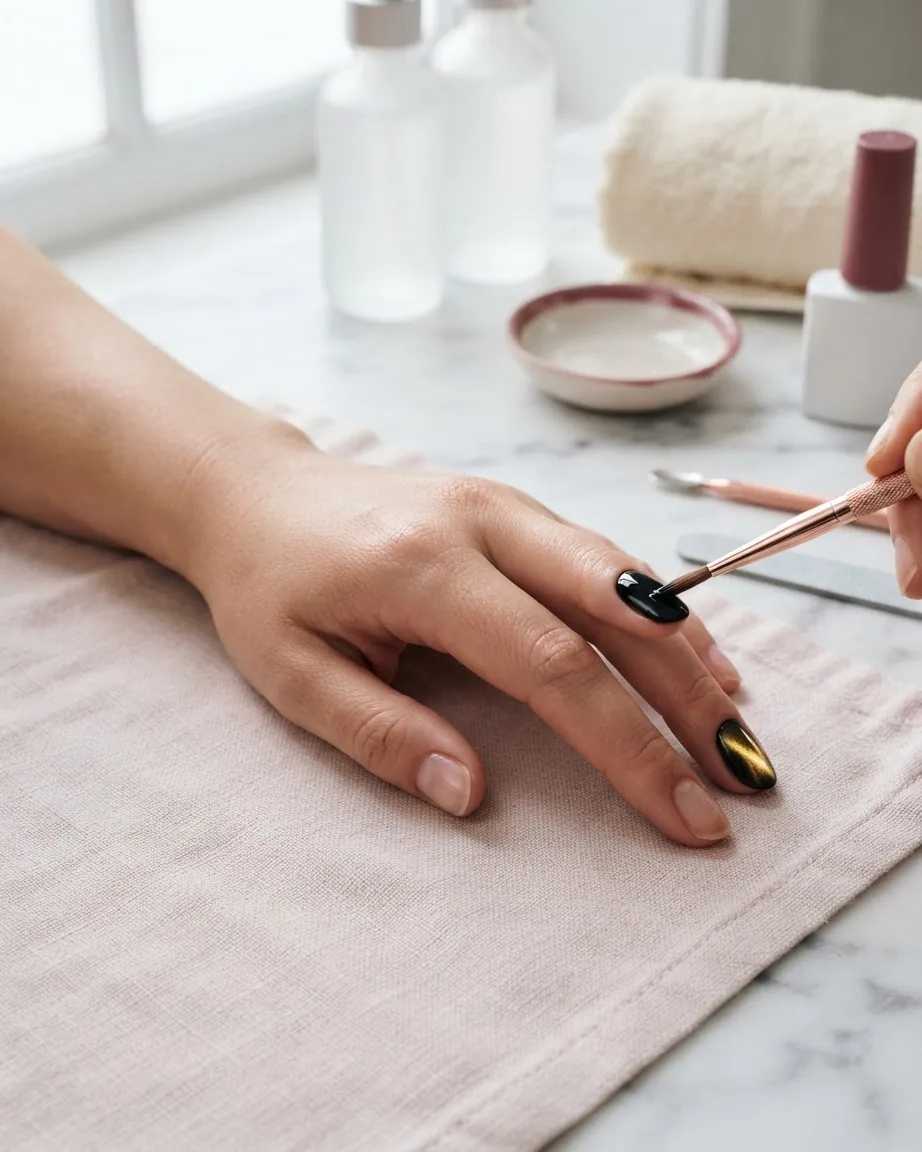
No. The visible stripe comes from magnetic pigment, a dark base, thin coats, and the magnet pass. Change the hue and the band still forms; change the base from dark to light and the same bottle looks flat.
Byrdie describes the look as a subtle metallic line, usually painted in a color close to the base, which creates a near-mirror finish like looking into a cat’s eye. The stripe is the defining feature, not the hue. PN Selfcare traces that stripe to microscopic iron particles suspended in the gel: a strong magnet aligns them, and light reflects off the aligned particles to produce the three-dimensional flash.
The base does the heavy lifting on visibility. ND Nails Supply states that a black or dark base coat roughly doubles the brightness of the magnetic line versus the same color over nude. So a pale cat eye shade over a light base can look washed out while the identical bottle over black snaps into a clean band. If a shade disappoints, the base is the first thing to change, not the color.
Picking Cat Eye Nail Colors for Your Skin Undertone
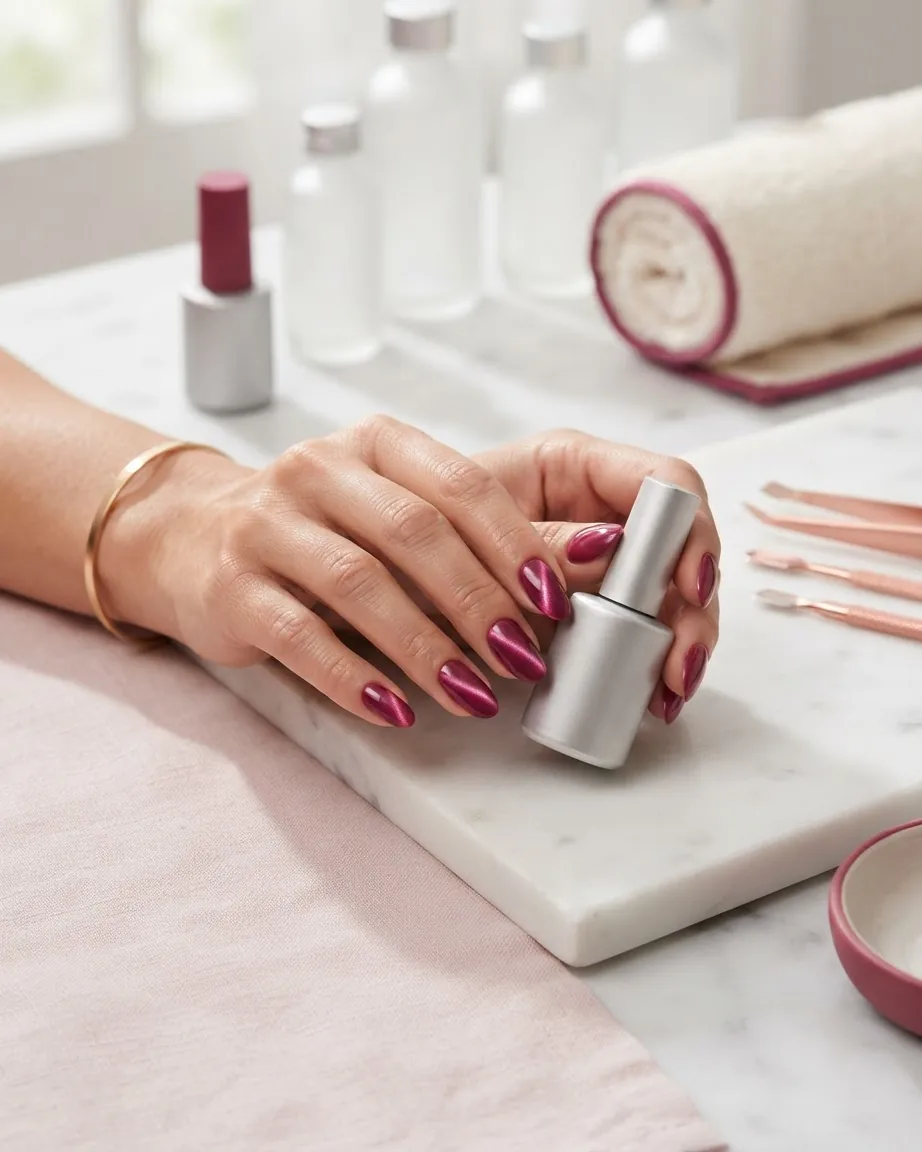
Jewel tones are the traditional cat eye palette, and they do not flatter every hand equally. Byrdie‘s guidance is specific: jewel tones tend to work best on cool or neutral undertones, though going a touch deeper in shade lets warm tones carry them too. The same roundup notes that a yellow-gold and taupe pairing leans toward warm or neutral skin, and that combining a warm earth tone with a cool jewel tone (brown base, teal accent) reads well across undertones.
Practical reads from that set of 43 color ideas:
- Cool or neutral undertones: deep emerald, navy, amethyst purple, and dark jewel tones hold their saturation without going muddy.
- Warm undertones: go a shade or two deeper than a standard red, or reach for brown shimmer and gold rather than icy blues.
- Uncertain or mixed: a brown-and-teal or earth-plus-jewel combination hedges across undertones, since it carries both a warm and a cool note.
Byrdie spans jewel tones alongside pink, gold, brown, blue, purple, and green across its 43 ideas, so the undertone rule narrows a wide field rather than closing it. For readers weighing a specific hue, our purple nail polish notes sit adjacent to the amethyst and vampy cat eye picks here.
Magnet Distance and Hold Time: Where the Published Numbers Disagree
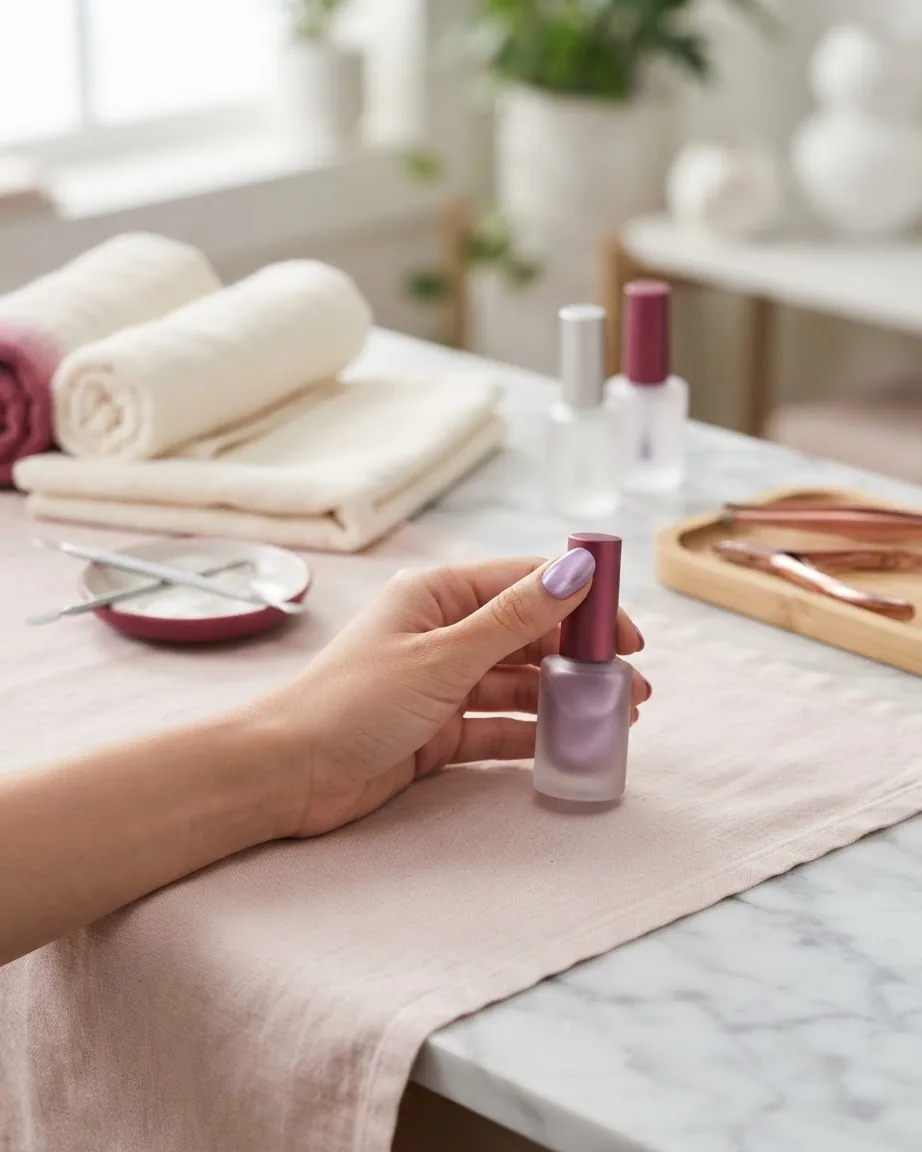
This is the step that decides whether any chosen color shows, and the three brands that document it do not give the same figures. The disagreement is real, and it is worth seeing laid out rather than averaged.
- Beetles Gel: within 10-15 seconds of application, position the magnet 2-3mm above the nail surface, never touching the wet polish, and hold steady for 30-60 seconds; longer holds give a sharper effect.
- PN Selfcare: hold the magnet 3-5 mm above the nail and keep the hand still for at least 10 seconds, with a warning that moving closer than 3 mm can clump the particles and make the pattern harsh and uneven.
- ND Nails Supply: hold the magnet at about 45 degrees, 1 to 2 millimeters above the nail, for 5 to 10 seconds while the stripe forms.
The published figures do not line up across the three brands, and they are not errors to reconcile into one number. They track different formulas, magnet strengths, and workflows, so the right figure is the one printed for the product in your hand. Read the distance and hold time on your own bottle’s instructions first.
Two points hold across all three sources regardless of the figures: the magnet never touches the wet polish, and the hand stays still during the hold. One shared caution also survives the disagreement: closer is not always better. PN Selfcare flags that going nearer than 3 mm can clump particles and harden the line, while ND Nails Supply treats 1 to 2 millimeters as the working distance for its own gels. If your bottle’s instructions set a distance, trust that over any single outside number.
Why Your Cat Eye Stripe Comes Out Faint or Vanishes
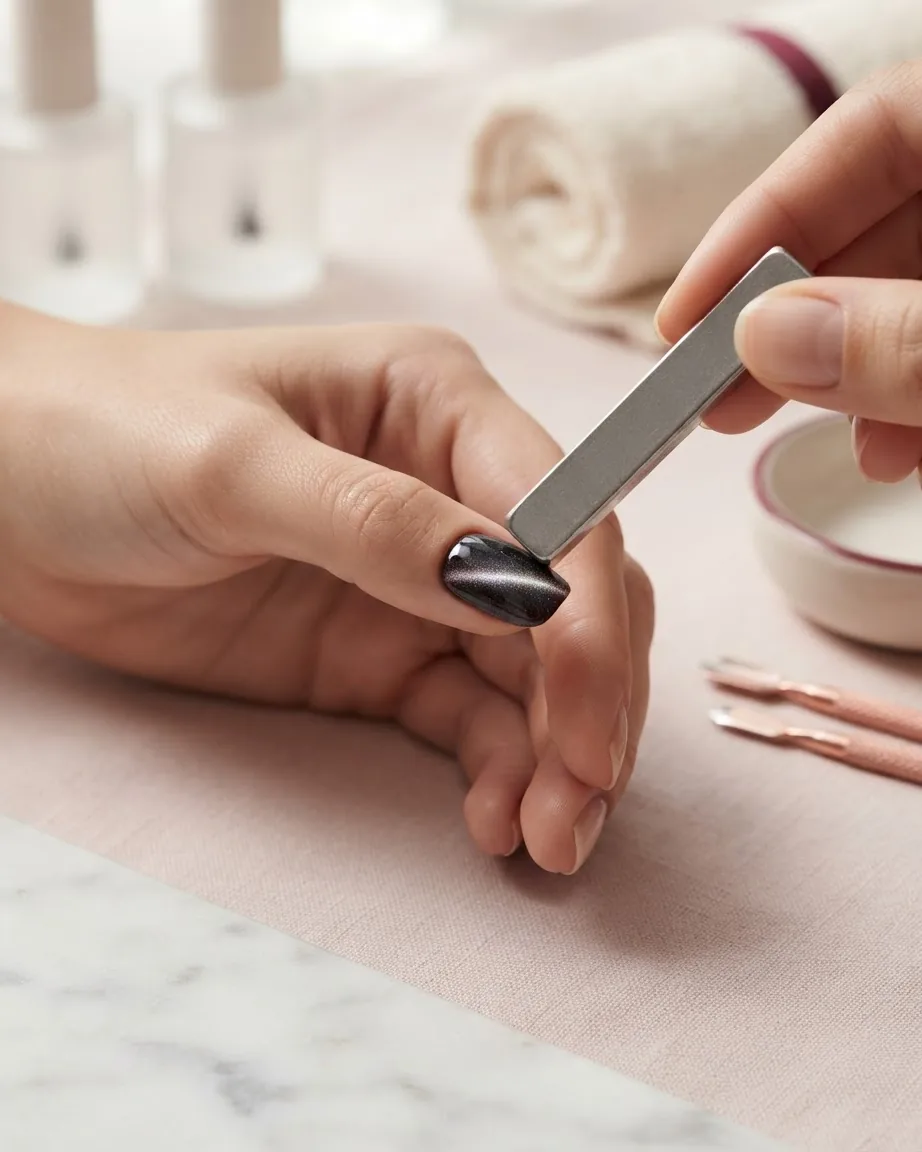
A weak or absent stripe almost always traces to one of a short list of causes. ND Nails Supply names four: the magnet held too far away, the second coat cured before the magnet step, a coat too thick for the particles to move, or a light base instead of a dark one. Beetles Gel adds a fifth from its troubleshooting notes: the polish beginning to self-level before the magnet reaches it, which is why speed matters and why you work one nail at a time.
Matched to a fix:
- Magnet too far: bring it to the distance your bottle specifies and hold for the full time before curing.
- Coat cured too early: apply the second color coat, magnetize, then cure. The magnet works only on uncured polish.
- Coat too thick: the particles cannot align. Wipe back the uncured layer and reapply thinner.
- Light base: switch to a black or dark base to recover visibility.
- Polish self-leveled: work faster, one nail from application to magnet, before it settles.
PN Selfcare warns against the opposite overcorrection: holding the magnet too long or re-magnetizing repeatedly can let the particles sink back and lie flat, which dulls the finish. Set the pattern once, then cure. Overworking it costs you the effect you just built.
Thin Coats and the “Just Re-Magnetize” Trap
Two instructions seem to pull against each other. Beetles Gel advises a slightly thicker coat than standard gel, because the effect needs enough product volume to form a defined pattern. ND Nails Supply insists both color coats stay thin, because a thick layer stops the particles from aligning and the stripe comes out faint no matter how close the magnet is.
The reconciliation is in the word “slightly.” You want enough pigment to carry a visible line, but not so much depth that the iron particles cannot travel to the surface where the magnet draws them. Err thin. And resist the urge to pass the magnet again if the first result underwhelms; repeated magnetizing flattens the particles rather than sharpening them. Wipe back and redo the coat instead.
Routes to the Look: Regular Polish, Gel, or Press-Ons
The cat eye effect reaches the nail by more than one path, and the right one depends on what equipment you own and how much drying you are willing to wait through.
- Regular magnetic polish: magnet required, no lamp. You magnetize over wet lacquer and let it air-dry. No UV investment, but the finish is a conventional polish, so wear tracks a regular manicure.
- Magnetic gel polish: magnet plus a UV or LED lamp. This is the salon-grade route that holds the sharpest line for the longest. LAVIS and LDS cat eye gels cure under LED, with a longer cure under UV for darker shades.
- Press-ons: no magnet, no dry time. The pattern is already set on the tip, so you trade the ability to customize the line for speed and zero equipment.
Byrdie confirms magnetic polish comes in both regular and gel forms, the gel version requiring UV light, and that most kits ship with the magnet tool. If you want the look once for an event, press-ons skip every variable above. If you want it to last, gel is the route. For the press-on path specifically, see our how long press-ons last guide.
Which Magnet You Need for the Pattern You Want
The magnet head shapes the line far more than the bottle does. ND Nails Supply maps shape to result directly: a stick or cat paw magnet pulls one stripe, a multi-head magnet pulls the 3D or 9D parallel lines, and a double-direction magnet pulls two axes on the same nail.
A fuller map of magnet to pattern:
- Bar or stick magnet: one straight band across or along the nail; angle it for a diagonal. This is the everyday cat eye and the first magnet most buyers get.
- Cat paw handle magnet: the same bands with a steadier hold, useful for keeping the same angle across all ten nails.
- Multi-head magnets (3-in-1 up to 6-in-1): several fine parallel lines at once, which is the point of the 9D and galaxy sets.
- Double-end or dual-band magnets: two bands in two directions, built for a layered accent nail.
- Heart tool: a heart-shaped flash in the center, for Valentine’s and novelty requests.
Because the result leans on the magnet shape and the angle more than the shade, two magnets, a bar and a multi-head, can pull most of the patterns a single 12-color set would ever need.
A Centered Stripe or a Diagonal: Two Patterns, Not a Contradiction
Published descriptions of the “classic” cat eye differ, and it is worth knowing why before you fault your technique. InStyle’s design roundup treats a centered, lengthwise line as the signature, while Byrdie defines the look by a line running diagonally across the nail. Both are correct. They are two valid variants set by how you hold the magnet, not a factual disagreement.
PN Selfcare’s pattern chart makes the control explicit: hold the magnet horizontally in the center for a straight line, at a 45 angle for a diagonal, to one side for a side shimmer, or directly over the center for a halo. The hue has nothing to say about which of these you get; the magnet angle decides it.
How Long Cat Eye Nails Last and How to Remove Them Safely
This is the figure the design roundups skip. Cat eye gel wears two to three weeks with a top coat, the same window as any soak-off gel, per ND Nails Supply. The top coat is not optional for the look: without it, the pattern blurs within about a week, while a top gel keeps the line sharp for the life of the manicure. ND also flags capping the free edge as part of keeping the pattern from softening early.
Removal follows the standard gel method. ND Nails Supply directs a 100% acetone foil wrap for about 10 minutes, then pushing the softened gel away rather than peeling it. Acetone-free remover will not break down cured gel. On the solvent point, our nail varnish remover for gel notes and our dip nail removal notes sit alongside this.
Work in a ventilated space when using acetone, and wear gloves for cleaning tasks during the wear period to protect the finish. If you notice pain, lifting that exposes raw skin, or any reaction around the nail, stop and see a licensed professional rather than continuing to soak or file. Nail health concerns belong with a pro, not a removal guide.
Why Your Ten Nails Will Not Match Exactly
A set where every band sits in precisely the same place is not what this technique produces. Each pattern is drawn by hand, nail by nail, so the lines vary across the set by nature, and ND Nails Supply notes that salons present that variation as the character of the service rather than a flaw. A client who genuinely wants ten identical bands is given a multi-head magnet held at the same angle on each nail, which is the closest route to uniformity.
So before you redo a nail because it does not mirror the one beside it, decide whether you are chasing a real defect, a faint or blurry stripe from the causes above, or just the hand-pulled variation that comes with the look. The first is worth fixing. The second is the look working as intended.
The Top-Coat Payoff: How Much Longer the Stripe Survives
The article gives two timelines in different units: a top-coated cat eye holds its sharp pattern for two to three weeks, while skipping the top coat lets the stripe blur within about a week. Converted to a common scale, the top coat is not a small upgrade – it is the difference between a pattern that fades almost immediately and one that lasts the full manicure.
- Two to three weeks with a top coat converts to roughly 14 to 21 sharp days (2 × 7 and 3 × 7).
- A bare pattern that stays crisp only about a week leaves most of the manicure’s visible life on the table once the top coat is skipped.
- At the high end, a top coat makes the cat-eye effect last about 3× as long as skipping it (21 ÷ 7), so the one optional step preserves most of the manicure’s visible payoff.
Figures derive from the wear times stated in the article; actual wear varies with formula, application, and daily hand use.
Frequently Asked Questions
Can I create the cat eye effect with a nail art brush instead of magnetic polish?
Some DIYers approximate it by lightly stroking a thin art brush across the nail, and salon techs can draw the line freehand. That hand-painted version mimics the diagonal flash but lacks the shifting, light-reflective quality the suspended iron particles give. For the true metallic shimmer that moves with the light, magnetic polish and a magnet remain the route.
How should I shake a cat eye bottle before use?
Roll the bottle gently between your palms rather than shaking it hard. Vigorous shaking forces air into the formula and leaves bubbles that mar the finish. Magnetic pigment also settles faster than solid color, so rolling redistributes those heavy particles without the bubble problem, then store the bottle upright and out of sunlight between uses.
What sets and sizes do cat eye gels come in?
LAVIS and LDS cat eye gels at ND Nails Supply ship as 5 oz singles, 12-color sets, and 24-color collections. The 12-color CE sets cost less per bottle than buying the same shades individually, and a single 24-color C-series collection fills a full shade board in one order for anyone building a wide palette.
If my stripe looks wrong, can I fix it before curing?
Yes, as long as you have not cured. PN Selfcare notes you can wipe the uncured cat eye layer off with a cleanser wipe and start that coat over. Once the pattern sits where you want it, cure immediately so the particles cannot drift. After curing, the pattern is locked and the only reset is removing the coat entirely.