A beige that looks right in the bottle can turn a hand sallow the moment it dries, because the shade is fighting the skin’s undertone rather than sitting with it. That single mismatch is why nude nail polish goes wrong more often than any brighter color: the margin for error is narrow, and the correction is not “lighter” or “darker” but a different undertone family. The goal here is to tell you which depth suits your skin, how many coats sheer and cream formulas actually need, and which common rule – matching your skin exactly – quietly ruins the result.
Work through undertone first, then depth, then finish. Those three decisions, in that order, settle almost every near-miss.
Quick answer: A nude nail polish reads best when it shares your undertone family and sits close to your nail-bed color, but stays a shade off your exact skin depth – matching skin precisely produces flat “mannequin hands.” Sheer nudes are forgiving and natural but usually need about three coats; cream (opaque) nudes photograph more evenly and build in two to three thin coats over a base coat, sealed with top coat. Fair skin leans toward soft pinks and pale beige; medium and olive carry warm caramels; deep skin suits rich chocolate and bronze nudes rather than anything pale, which reads chalky.
How to Read Your Undertone Before You Judge Any Nude
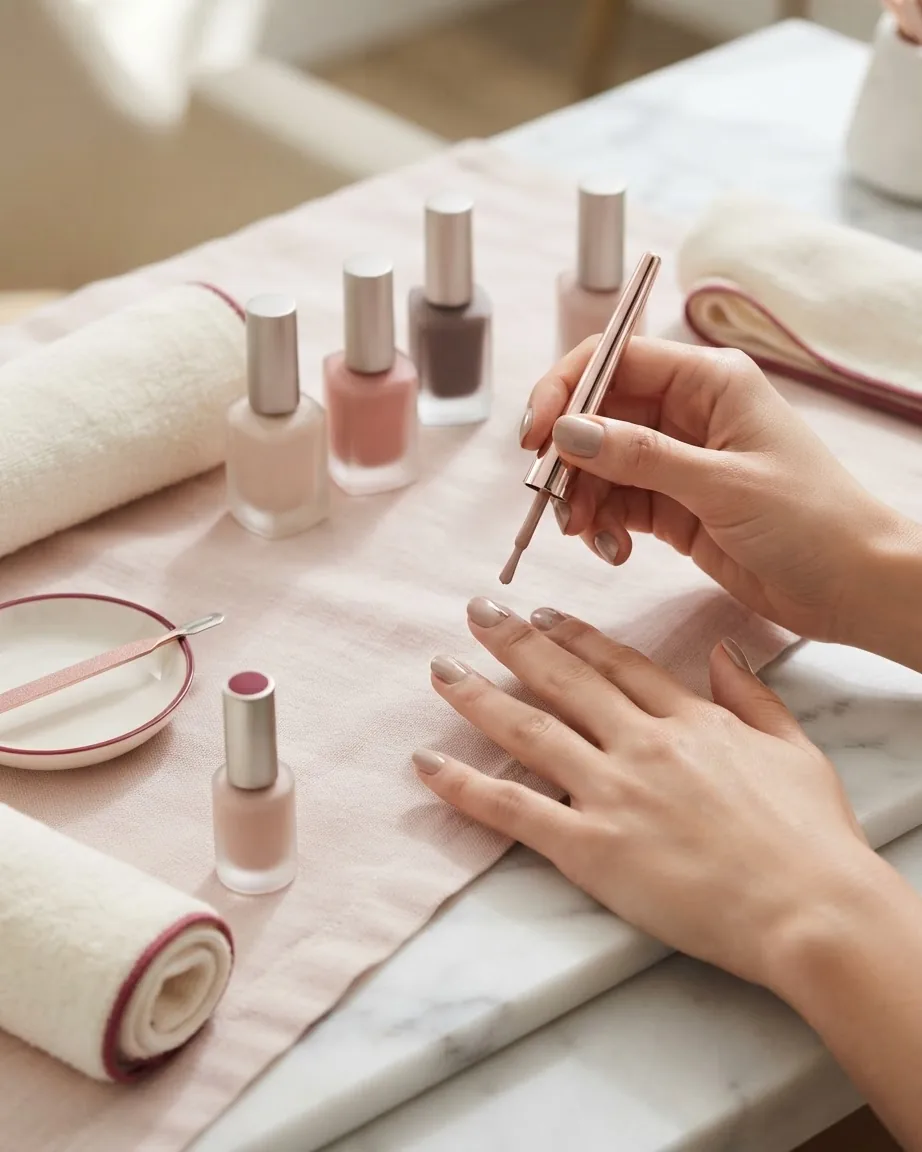
Undertone, not the color you see in the mirror, decides whether a beige warms your hand or greys it out. The vein test is the usual starting point: look at the inside of your wrist in daylight. OPI’s shade-matching guidance in The Perfect Nude for Every Skin Tone maps green or olive-cast veins to warm undertones and blue-green veins toward neutral. EyeCandys, in its undertone-depth-finish guide, draws the line at a slightly different place – greenish veins to warm, a between-green-and-blue cast to neutral.
Those two boundaries are broadly compatible, but the exact cutoff differs, which is the honest reason to treat the vein test as a rough heuristic and never a verdict. If your veins read ambiguously, that ambiguity is itself a signal you likely fall near neutral.
Two cross-checks tighten it. Jewelry preference – whether gold or silver flatters your skin more – is a second read on warm versus cool. How your skin behaves in sun is a third: skin that tans before it burns tends warm, skin that burns first tends cool. No single test is decisive; where two of the three agree, trust that family.
Match the Undertone Family, Not Your Exact Skin
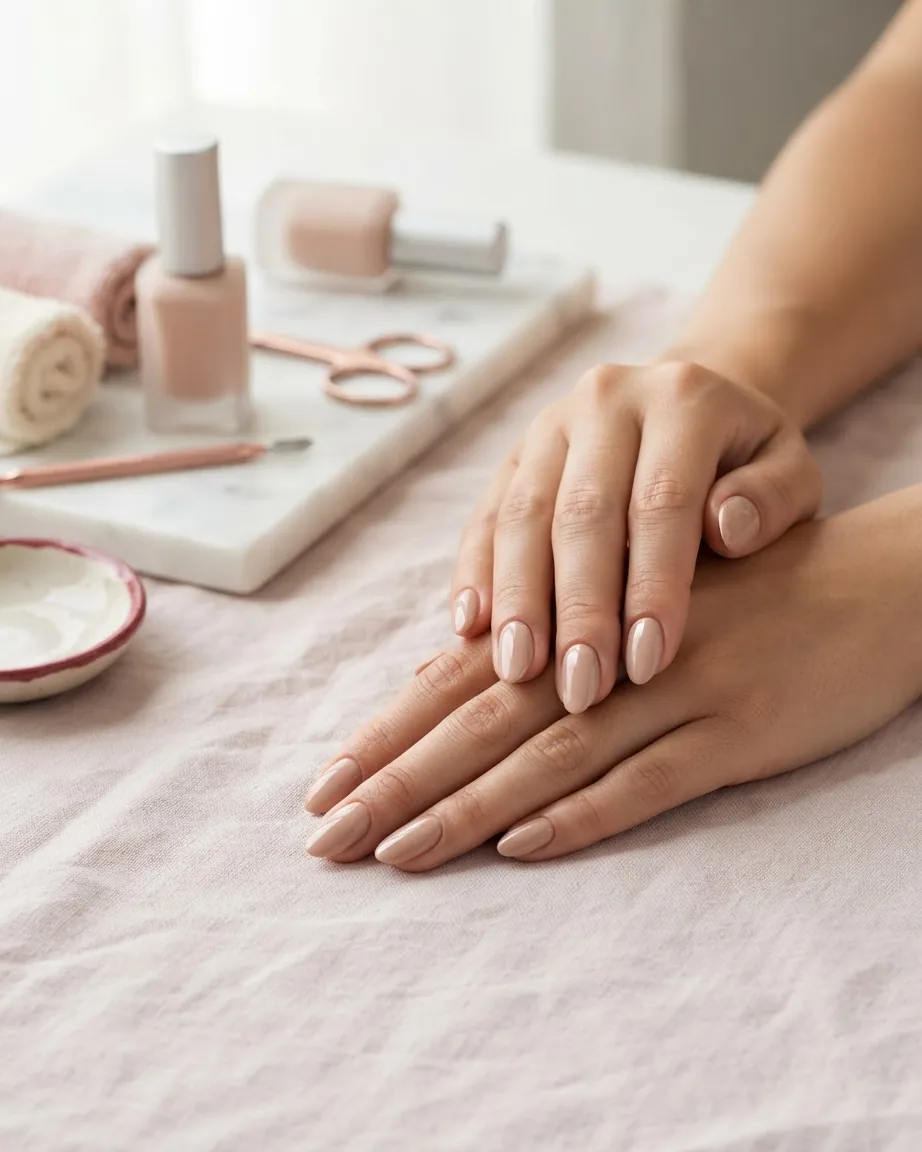
The most expensive misconception about nude nail polish is that “nude” means painting on a copy of your skin. Match your exact depth and the nails disappear into the hand in a flat, lifeless way – The Beauty Look Book describes this trap plainly in its Top 5 Best Nude Nail Polishes write-up, warning against the “mannequin hands” effect that comes from an exact match.
EyeCandys frames the target from the other direction: match your skin and nail-bed color so the shade looks like it belongs to you. These are not in conflict. Resolve it as a condition, not a rule. Match the undertone family and stay in the neighborhood of your nail-bed color for believability – then keep a slight depth contrast, a touch deeper or a touch lighter than your skin, so the nail still registers as a finished nail rather than bare skin. That small gap is what separates a polished hand from a blank one.
What Goes Wrong by Skin Tone – A Pre-Purchase Diagnostic

Most nude failures are predictable from skin tone and the shade’s cast. Run your candidate shade against this list before buying, especially online where you cannot swatch:
- Yellow-based beige on warm or sallow-prone skin: pushes the hand toward a tired, sallow look. Shift toward a pinker or more neutral beige.
- Plain beige on cool skin: greys out, reading dull and ashy against cool undertones. A nude with a rose or peach lean corrects it.
- Pale nude on deep skin: turns chalky and ashy, sitting on top of the skin instead of with it. Deep skin wants rich, warm depth – chocolate, caramel, bronze.
- Dark nude on fair skin: creates heavy contrast that reads more like a statement than a nude. Fair skin holds soft pinks and pale beige better.
The pattern underneath all four: too far in the wrong undertone, or too far from your own depth in either direction. Depth is the second dial after undertone – fair skin toward the pale end, medium and olive into warm caramels and soft browns, deep skin into the richest nudes on the rack.
Sheer vs. Cream Nude Nail Polish: Coat Count and What You’re Trading

The sheer-versus-cream choice is a tradeoff between forgiveness and uniformity, and it changes how many coats you apply. A sheer nude is the natural, barely-there option – it lets the nail line show through and hides application mistakes, but it rarely reaches its intended look in one or two passes. Into The Gloss, which tested 45 nude polishes for coverage and finish, notes in The Best Barely-There Nail Polishes that a beige is “best with three coats, making your nails all but disappear.” Plan on roughly three coats for sheer formulas.
Cream (opaque) nudes trade that soft, see-through quality for even, photograph-ready color. Miss Dolla’s application guidance at DollaNailsPro recommends two to three thin coats of nude polish over a base coat to build an opaque finish, sealed with a top coat. Thin is the operative word – thick coats pool, dry unevenly, and extend drying time.
Which to pick depends on the job. Want the most natural result and have an uneven nail surface to hide? Sheer, and accept the extra coat. Need uniform color that holds up in photos – a wedding, say? Cream. For brand-level nude ranges split by undertone and opacity, ella+mila’s nude collection sorts shades along those same lines. If you want the mechanics of why pale sheers streak in the first place, see our sheer pink nail polish notes.
Nail Shape, Length, and How They Steer the Shade
Shade depth and nail geometry interact. Shorter nails tend to carry creams and soft pinks cleanly – a lighter, more neutral nude keeps a short nail looking tidy rather than stubby. Longer nails can hold deeper nudes without the color overwhelming the hand, because there is more surface to balance the depth.
This is a steering guide, not a rule about what suits you personally. A short nail in a deep chocolate nude is a legitimate look; it simply reads as more deliberate than a soft pink would. Pair the decision with undertone – a long nail in a deep nude of the wrong undertone fails the same way a short one does, just across more real estate. For a related pale-neutral workhorse, our light pink nail polish guide covers a shade that overlaps the soft-pink end of the nude family.
Buying a Nude Online Without Wasting Money
Buying unseen is where nude budgets bleed, and the r/RedditLaqueristas community has built a practical workflow for it. The core moves, drawn from that crowd-sourced advice, come down to this:
- Ignore the bottle color. Lacquer in glass looks nothing like lacquer on a nail; the bottle tells you very little about the on-hand result.
- Judge swatches in daylight against a nail bed. Artificial light shifts undertone. A shade that reads warm under a lamp can grey out in sun.
- Find a swatcher with your skin tone. A swatch on someone whose skin matches yours is worth more than any product photo. Same-undertone, same-depth is the match that predicts your result.
- Salvage near-misses by mixing. A shade that is close but slightly off can sometimes be corrected with a drop of another color – a rescue that beats binning the bottle.
The thread where this gets hashed out – how to find your perfect nude without wasting money on the wrong shades – is worth reading for the range of same-skin-tone recommendations, which do the swatcher-matching work for you.
Where Nude Nails Earn Their Keep: Wear and Low Tip-Wear
Beyond looks, a nude has a maintenance advantage that a bright color cannot match: tip wear barely shows. When a dark or saturated polish chips or recedes at the free edge, the bare nail underneath contrasts sharply and the chip announces itself within a day or two of appearing. A nude sits so close to the nail’s own color that the same wear reads as nearly invisible, which stretches the usable life of a manicure between appointments.
That low-visibility wear is a real reason to choose nude for a stretch when you cannot repaint often – travel, a busy week, a job that beats up your hands. The color is working for you even as it wears, because what wears away looks like more of the same. Pair it with a quality top coat to actually slow the chipping, and the gap between “still looks fresh” and “needs redoing” widens.
Finish, Application Effort, and the Nude That Survives a Workday
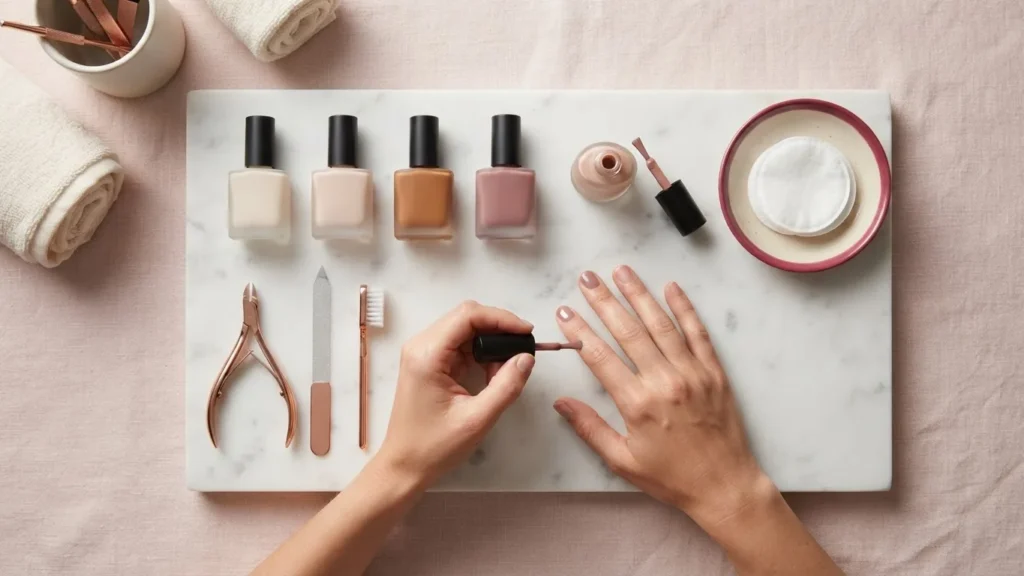
Finish choice ties directly to how much application effort you want to spend and where the nails have to perform. A cream nude’s even build makes it the lower-risk choice for work and formal settings – it photographs cleanly and hides streaks that a glossy sheer can amplify. Building it is the standard sequence: base coat, two to three thin coats of color, top coat, each layer thin enough to dry before the next.
A sheer finish asks for patience instead of precision. The roughly three coats it takes to reach a believable barely-there look mean more drying windows, but the payoff is a result that forgives a slightly uneven surface. Neither is more “correct” – match the finish to the occasion and to how steady your application is on a given day.
A note on nail health rather than nail color: if the nail plate itself is ridged, peeling, discolored, or painful, that is a question for a licensed professional, not something a shade of polish fixes or should hide.
Layers Per Manicure: Sheer vs. Cream Nude, End to End
The coat counts in this guide only tell half the story until you add the base and top coat the cream routine calls for. Counting every layer that actually lands on the nail shows how much longer a cream manicure really runs – and why “thin coats” matters so much when the stack gets deep.
- Sheer nude: about 3 color coats to make the nail “all but disappear” – 3 layers in total as described.
- Cream nude, lower bound: 1 base coat + 2 color coats + 1 top coat = 4 layers.
- Cream nude, upper bound: 1 base coat + 3 color coats + 1 top coat = 5 layers.
- The trade: at the top end, the full cream routine stacks 2 more layers than a 3-coat sheer (5 − 3) – each one adding drying time, which is exactly why thick coats that pool are the thing to avoid.
Frequently Asked Questions
Can I fix a nude that’s slightly too dark or too warm after I’ve bought it?
Sometimes. A near-miss can be nudged by blending in a drop of a lighter or cooler shade on a palette before application. This rescues a bottle that is close but off; it will not convert a wrong-undertone pick into a right one. If the cast is badly off your skin family, treat it as a loss rather than a fixable blend.
Does the vein test alone tell me my undertone?
No. It is a starting read, and even the authorities place the warm-neutral boundary at slightly different points, so a single glance at your wrist is not conclusive. Confirm it against gold-versus-silver jewelry and how your skin reacts to sun. Where two of those three signals agree, trust that result over any one test on its own.
Which lasts longer before it needs redoing, sheer or cream nude?
Both wear similarly, but a nude of either type beats a bright color for how long it looks acceptable, since chips at the tip barely register against a near-skin shade. A cream’s even surface can mask minor wear slightly better up close. Sealing with a good top coat does more for longevity than the sheer-versus-cream choice does.
Is a nude appropriate for a wedding or a formal job?
Yes, and a cream finish is the safer pick for those settings because it reads uniform in photographs and under close inspection. A sheer can look softer in person but may show the nail line or any surface unevenness when a camera gets close. For an all-day professional stretch, the even build of a cream holds up with less fuss.