Drafted with AI language models. How this page was made
How long for nail polish to dry depends on which “dry” you mean. The surface sets fast; the film underneath does not. OPI states ordinary lacquer feels dry to the touch within 30 to 60 minutes but needs a full 24 hours to harden all the way through, and it advises skipping tight gloves or workouts for that first day. That gap between a nail that feels ready and one that is ready is where most smudges happen.
Quick answer: A fresh coat of regular polish loses its wet shine in about 5 to 10 minutes per layer. It reaches a functional “hard set” that survives light activity at roughly 30 to 60 minutes. Full cure, when every solvent has left the film and the polish is chip-resistant, runs 12 to 24 hours. Before bed, aim for a full two hours of setting even if your nails feel done. Gel is a different system entirely, cured by lamp in seconds, not air-dried.
What “Dry” Means in Minutes, Hours, and the Bed-Sheet Test

Three separate end-states hide under the word “dry,” and each lines up with a real action you can or cannot do yet. LP Luxury Nail breaks the regular manicure drying timeline into those stages, and the practical lesson is that “feels dry” is the earliest and least reliable one.
- Touch-dry (surface set): about 5 to 10 minutes per coat. The shine dulls and a light tap leaves no mark.
- Hard set (functional): roughly 30 to 60 minutes. The film withstands most normal activity, but deep pressure still dents it.
- Fully cured: 12 to 24 hours. Solvents have fully evaporated and the polish is chip-resistant.
The sheet-mark problem belongs to that middle window. Nails that pass the touch test at 60 minutes can still press woven creases into a film that will not truly harden for a day. That is why going to bed early on a fresh manicure ruins it.
One Table for Every Dry-Time Number Worth Trusting
This is a cross-source comparison built from the figures each manufacturer and guide states for its own product or method. It exists because no single bottle label tells you how its number compares to a rival’s. Read each row against its condition, not as a single average.
| Product or step | Stated time | Source |
|---|---|---|
| Regular polish, touch-dry per coat | 5-10 minutes | LP Luxury Nail |
| Regular polish, hard set | 30-60 minutes | OPI / Londontown |
| Regular polish, full cure | 12-24 hours | LP Luxury Nail / OPI |
| Essie base coat | 1-2 minutes | Essie |
| Essie total range | 5 minutes to 5 hours | Essie |
| OPI RapiDry quick-dry | 60 seconds | OPI |
| Sally Hansen Insta-Dri | 60 seconds | Sally Hansen |
| Gel color coat, LED lamp | 60-90 seconds | ReformA |
| CND Shellac color coat | 1 minute | CND |
How Long for Nail Polish to Dry With a Fan
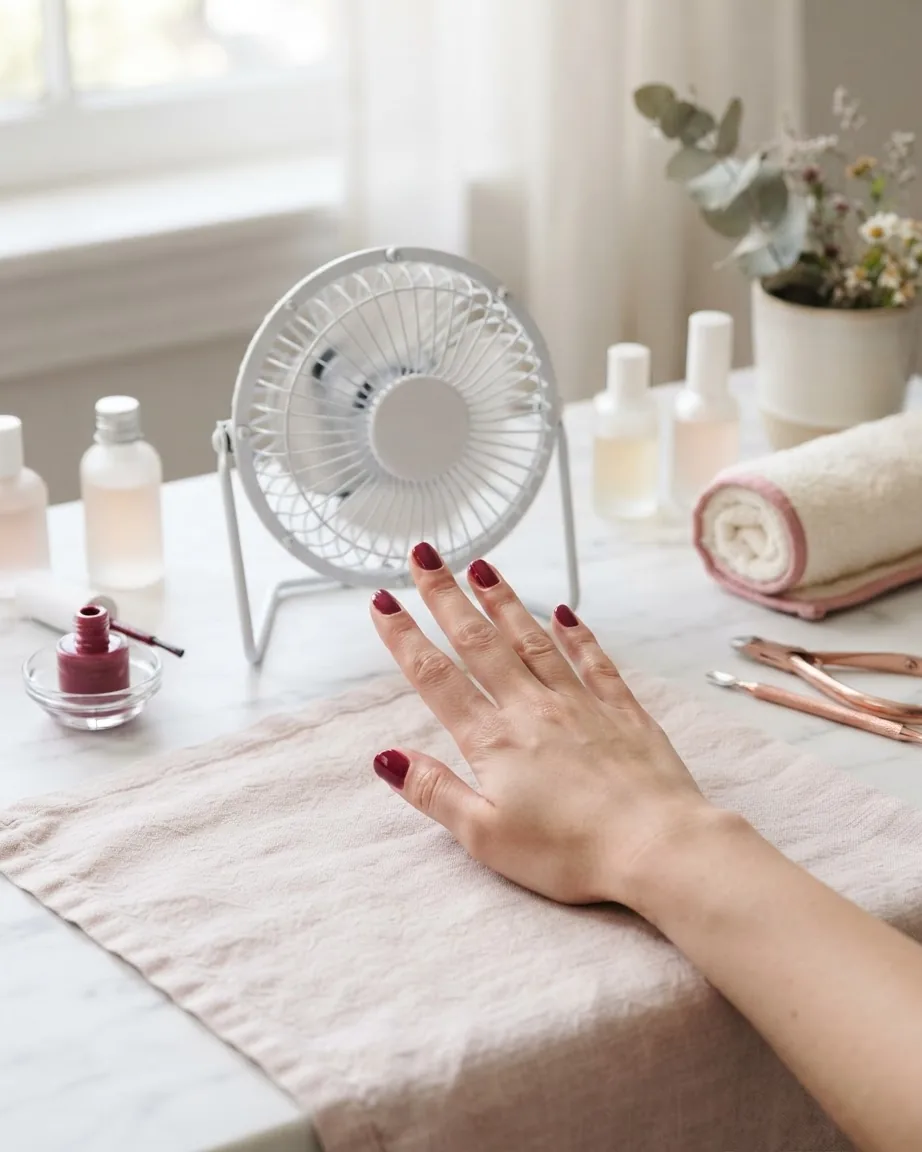
A fan narrows the wait at the bottom end of the range. Londontown states that without help, polish can take anywhere from 30 minutes to an hour to dry completely, and that with a fan this drops to roughly 10 to 20 minutes, depending on the formula and fan speed. The fan speeds solvent evaporation by moving saturated air away from the nail surface. It does not change the 24-hour full-cure clock underneath.
Why Cool Air Dries and Warm Air Does Not
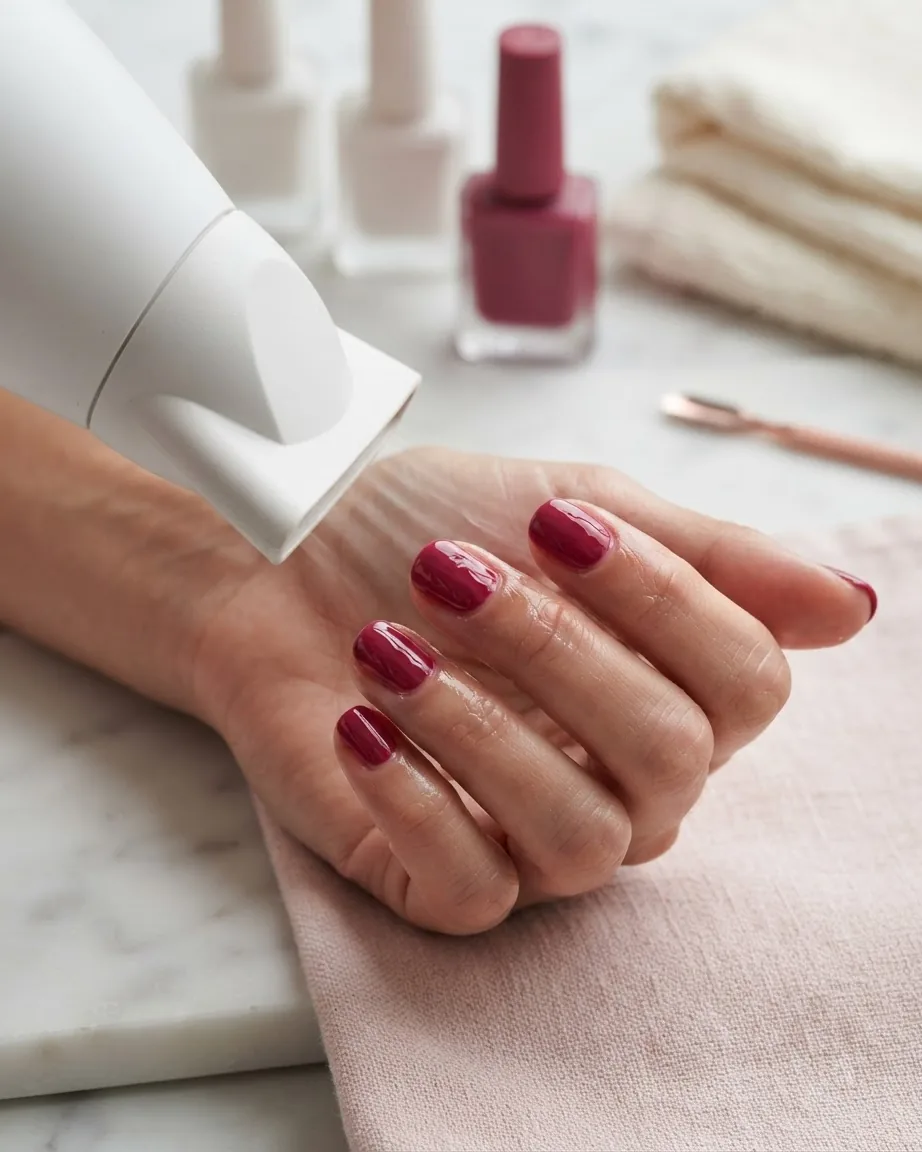
Moving air is the active ingredient, not warmth. OPI’s hairdryer method works only on the cool setting, and even then it warns to wait 30 seconds after painting before the first pass, “or you’ll smudge everything and have to start over,” per OPI’s drying guide. Heat tends to keep the solvent-rich film soft and movable rather than setting it, which is why a hot dryer can leave nails tacky while a cool stream sets them. A cheap desk fan on low does the same job as a hairdryer’s cold button.
How to Tell a Nail Is Set Without Wrecking It
Do not poke the painted surface. Press one nail gently against another, or against a smooth non-fabric edge; a set film leaves no dent or drag. A faint drag or any tackiness means you are still inside the 30 to 60 minute hard-set window and should wait.
Ways to Actually Shorten the Wait
The methods that work attack evaporation; the ones that fail only skin over the top. Byrdie’s Sarah Gibson Tuttle states that waiting five to 10 minutes between coats “makes a world of difference” for drying, per Byrdie’s drying feature, because stacked wet layers trap solvent under the surface.
- Thin coats, more of them. ORLY’s Kelly Bannon, cited by Martha Stewart, recommends three thin coats over two thick ones because thinner layers dry faster.
- Quick-dry drops. Byrdie’s Amy Oung describes drops that absorb solvents in the lacquer; apply about one minute after the color.
- Cool air. A fan brings the wait down to 10 to 20 minutes.
- A quick-dry formula. OPI RapiDry and Sally Hansen Insta-Dri are both built to dry in 60 seconds; Essie’s expressie dries in about a minute.
What does not work the way people hope: hairspray. Byrdie notes a spritz hardens only the top layer while the base layers below stay soft, so nails still need care for at least 30 minutes. That is the same failure as a too-thick coat, which skins over and traps wet polish underneath. For example, if you flood two heavy coats and spray them, the shell can feel firm at 10 minutes and still crater when you grab your keys.
Essie frames the realistic spread honestly: depending on coat thickness, humidity, and formula, you could face a five-minute or five-hour dry time. Plan for the long end.
Getting the Most From a Fan
Point the airflow across the nails, not straight down onto wet polish at full blast, which can ripple a fresh top coat. Keep the fan on the low or cool setting, and let it run through the touch-dry stage rather than switching off at the first firm tap. Even a solid 10 to 20 minute fan session only gets you to functional dryness; the film still needs its longer cure before anything nail-bending. See also: our nail dryer for regular polish guide for how airflow devices differ from UV lamps.
The Ice-Water Trick Is Genuinely Contested
Here is a case where reputable sources openly disagree, so the honest move is to show both sides rather than pick one and hide the other.
- In favor: OPI’s method is to let nails sit a minute, then dunk in ice water for about two minutes. Essie’s version is to submerge freshly painted nails for 3 to 5 minutes. Byrdie’s experts also back a cold-water pass.
- Against: Martha Stewart’s expert advises not to run nails under water, “because then you have to move and you run the risk of dinging or smudging your polish.”
The gap is about movement, not chemistry. A still dip in a shallow bowl is lower-risk than running water, where your hands shift. If you try it, use a still bath and keep the time short.
Skip the Running-Water Version
If you only remember one thing from the debate: the smudge risk lives in the motion, not the cold. Still-bowl dips run 2 minutes (OPI) to 3 to 5 minutes (Essie). Running tap water forces movement, and that is what dings a film still inside its 30 to 60 minute hard-set stage.
How Long for Nail Polish to Completely Dry
Complete drying and surface drying are different clocks. The surface is done in 5 to 10 minutes a coat, but “completely” in the chip-resistant sense means a full cure of 12 to 24 hours per LP Luxury Nail, and OPI puts full hardening at 24 hours. Martha Stewart’s shorter 1-to-2-hour framing and Londontown’s 30-minutes-to-an-hour both describe the point where hands are usable, not the fully hardened film. Treat anything under two hours as “safe to use,” not “finished.”
How Long for Nail Polish to Fully Dry
Fully dry is the 12-to-24-hour cure, and the reason it matters is practical: the film stays dentable long after it feels solid. OPI advises avoiding tight gloves, intense workouts, or anything nail-bending for that first day precisely because full hardening takes 24 hours. For example, pulling on winter gloves two hours after painting can leave fabric imprints the cure has not yet locked out.
How Long to Let Nail Polish Dry
For everyday use, let hands rest about 20 minutes before light tasks, following ORLY’s guidance that the top layer needs that time to start drying. Before bed, extend it: aim for a full two hours of setting even if nails feel dry after one, because sheets press marks into a film still curing. Between coats, wait 5 to 10 minutes; OPI puts each layer at 1 to 2 minutes minimum before the next.
Why Gel Cures in Seconds When Lacquer Takes Hours
Gel does not air-dry at all. It cures by light-triggered polymerization, so a lamp hardens each layer rather than waiting for solvents to evaporate. ReformA states a gel base cures in 30 to 60 seconds under LED and 60 to 90 seconds under UV, each color coat takes 60 to 90 seconds under LED or up to 2 minutes under UV, and a full gel manicure runs about 10 to 15 minutes of curing time. CND cures its Shellac base for 10 seconds and each color layer for one minute in its LED lamp. Thicker builder gels and polygels may need up to 3 minutes to cure through.
One normal surprise: cured gel often feels tacky. That sticky top is the inhibition layer, wiped off with isopropyl alcohol, not a sign of under-curing. For the color side of gel choices, see our purple nail polish guide.
The Numbers Behind ‘Feels Dry’ vs ‘Is Dry’
Put the three stage times on one scale and the smudge trap becomes obvious: a nail reaches a usable state long before the film underneath is actually set. The math below uses only the stated stage times, with hours converted to minutes (24 hours = 1,440; 2 hours = 120).
- Three thin coats take 15 to 30 minutes just to touch-dry. At 5 to 10 minutes per coat, three stacked layers (the ratio ORLY recommends over two thick ones) need 5 x 3 = 15 minutes at best and 10 x 3 = 30 minutes at worst before the surface stops marking, and that is before the hard-set clock even starts.
- A full cure takes about 24x longer than the hard-set point. Divide the 24-hour cure (1,440 minutes) by the 60-minute hard set: 1,440 ÷ 60 = 24. The nail that survives “most normal activity” at one hour is still only 1/24th of the way to chip-resistant.
- Against a single touch-dry coat, the gap is 144x. 1,440 ÷ 10 = 144. A coat that looks matte and done in ten minutes is a rounding error against the full hardening time.
- The two-hour bedtime rule is 2x the hard-set time for a reason. 120 ÷ 60 = 2. Waiting until nails merely feel firm leaves you at the halfway mark of the recommended pre-sleep buffer: which is why early nights wreck fresh manicures.
The practical takeaway: treat anything under two hours as “safe to use,” never “finished,” and save anything nail-bending for the next day.
Frequently Asked Questions
How long does regular nail polish take to dry?
Surface set lands at 5 to 10 minutes a coat, and a usable hard set at roughly 30 to 60 minutes. OPI gives the same 30-to-60-minute touch-dry window. The chip-proof cure, though, stretches to 24 hours, which is the number that decides when gloves and workouts are safe.
How long does gel polish take to dry?
It cures under a lamp rather than drying by air. A gel base takes 30 to 60 seconds under LED, each color coat 60 to 90 seconds, and a full set about 10 to 15 minutes of lamp time. Thick builder gels and polygels can need up to 3 minutes per layer.
How long between coats of nail polish?
Essie puts a base coat at 1 to 2 minutes and each color layer at a few minutes before the next. OPI gives each layer 1 to 2 minutes minimum. Byrdie’s tip of pausing 5 to 10 minutes between coats also cuts bubbling in the finished film.
How long for toe nail polish to dry?
Toes follow the same air-dry stages as fingers: surface in 5 to 10 minutes, hard set near 30 to 60 minutes. The practical difference is footwear. Closed shoes press like bed sheets, so hold off through the full cure window and favor sandals until the film is well past its functional-dry mark.