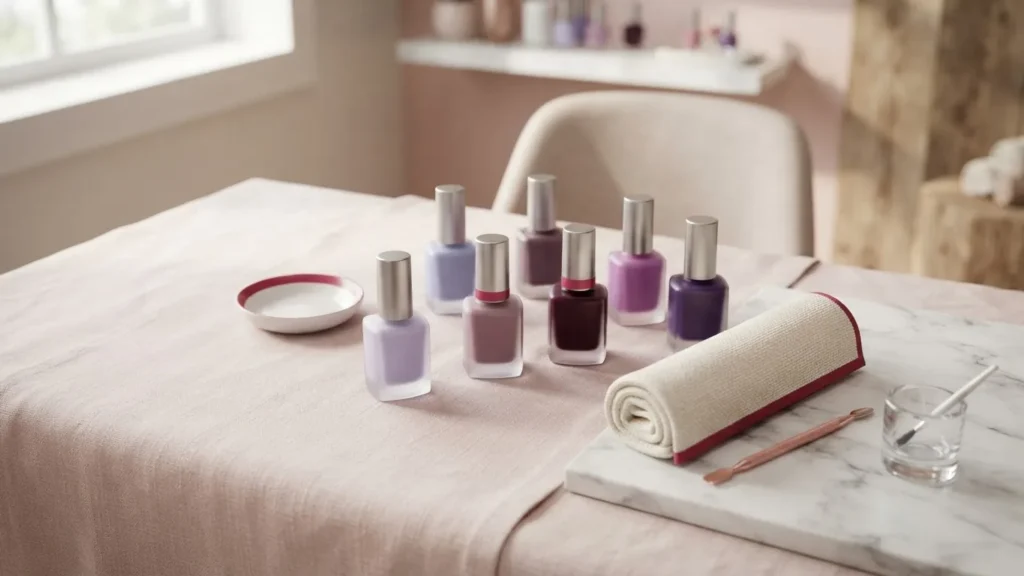
Two bottles can carry the same word – purple – and pull in opposite directions on the same hand. A pale lavender and a deep aubergine both file under purple nail polish, yet one leans cool and blue while the other leans warm and brown-red, and they suit different skin undertones. That split, not the word on the cap, decides whether a shade settles against the skin or clashes with it. What matters after that comes down to shade family, undertone, and, if you go the gel route, how the color is cured and how much UV that costs.
Purple nail polish divides into cool shades (lavender, lilac, periwinkle) and warm ones (mauve, plum, aubergine, blackberry). Cool undertones generally suit the blue-leaning purples; warm undertones suit the berry and brown-violet range. Lavender reads blue-soft, while lilac carries a touch of pink. On format: regular lacquer air-dries and needs no lamp, so there is no UV exposure at all, but it holds for fewer days. Gel buys longer wear and even color, at the cost of UV each session and a cure step that has to be done correctly. Want length without a lamp, pick lacquer; want weeks of wear, pick gel done properly.
Lavender, Lilac, Mauve, Plum: Reading the Purple Shade Map
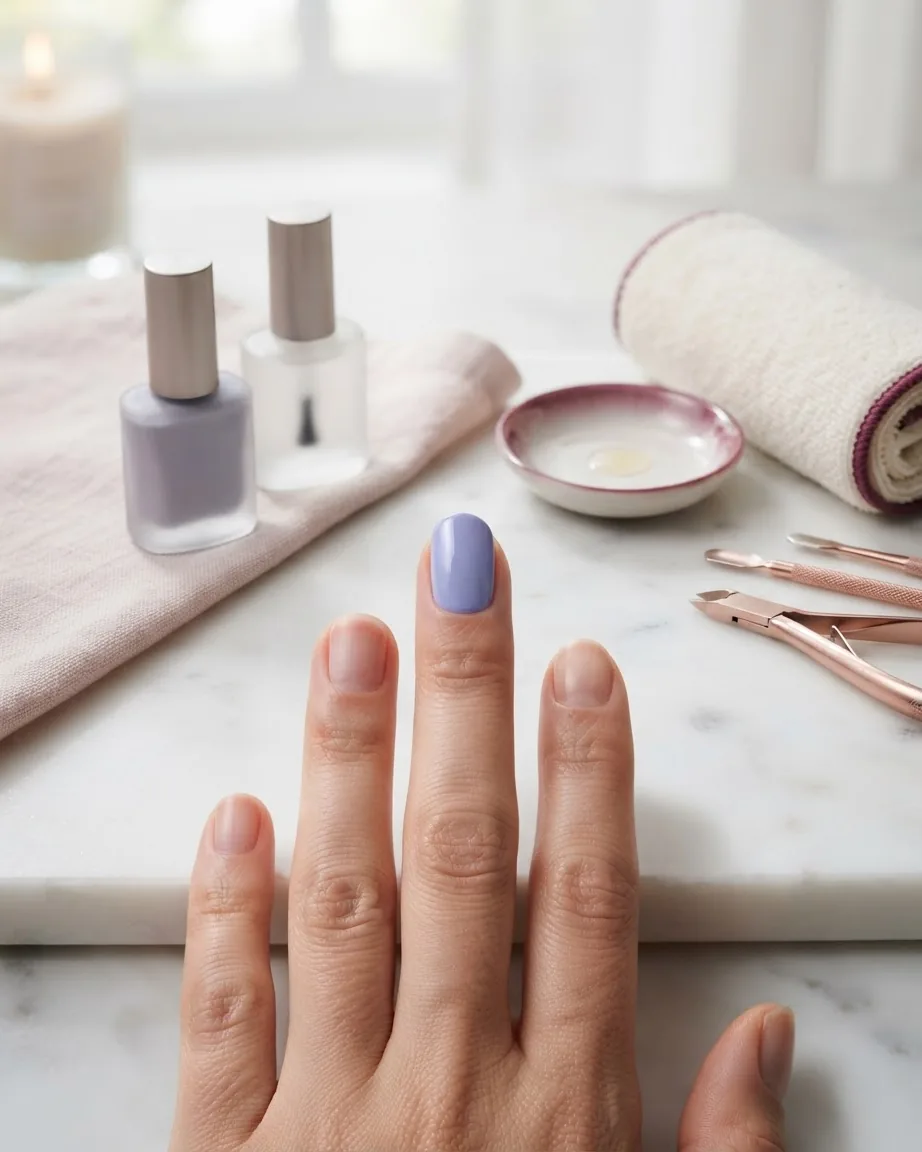
The family is wide, and the names are not interchangeable. Lavender sits at the cool, washed-out end, carrying a visible blue cast. Lilac is close but warmer, with a pink lift that reads softer on the nail. Push toward gray and you land in mauve; push toward red-brown and you get plum, then the darker aubergine and blackberry. Periwinkle borders on blue, amethyst sits mid-saturation, and violet is the fully pigmented center of the range.
Brands that build a dedicated purple range, such as Bluesky Cosmetics and Dear Sundays, split their shades along these lines rather than selling one flat “purple.” That matters when you buy online: the swatch name is doing real work, and a bottle sold as lilac will not behave like one sold as aubergine once it’s on the nail. See also: our lavender nail polish guide.
Matching Purple to Your Undertone (and the Depth Rule That Isn’t Sourced)
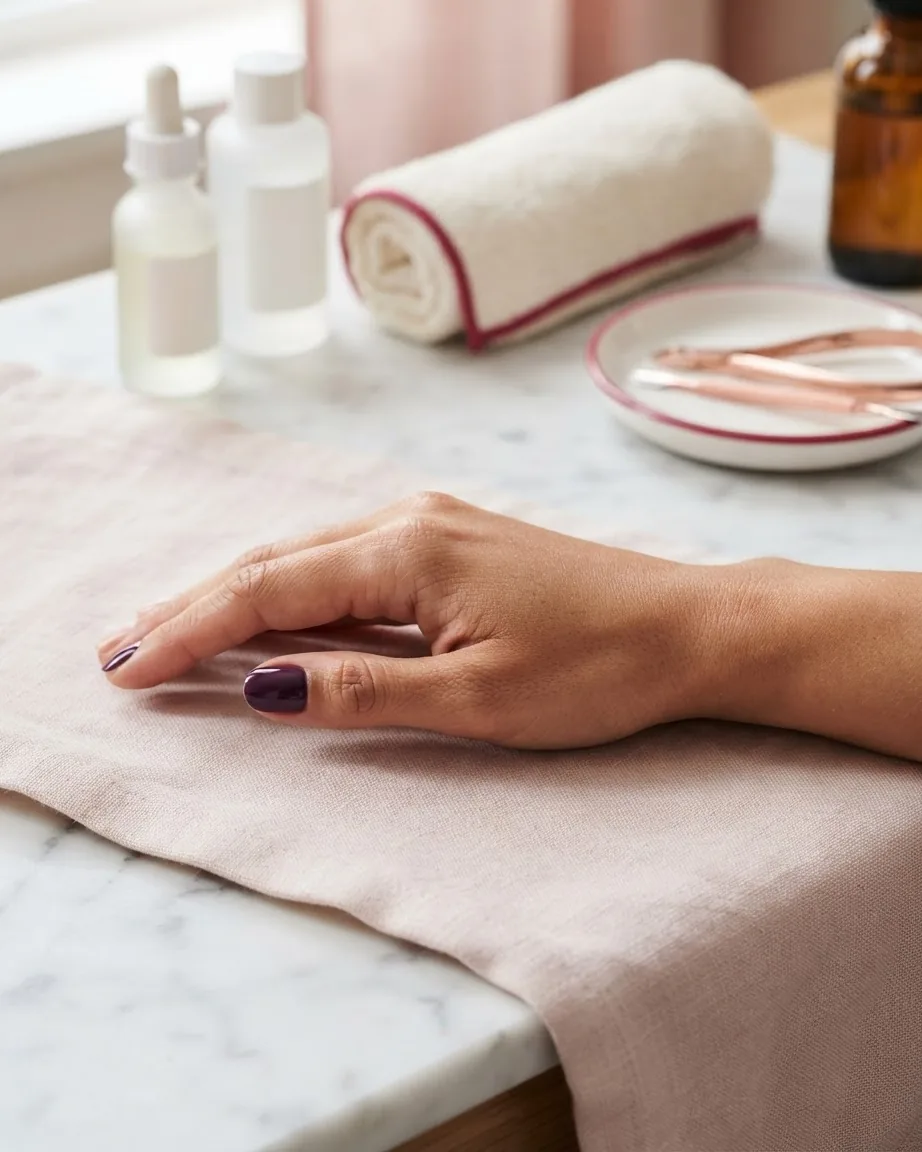
There are two competing ways to pick a purple, and they don’t measure the same thing. One approach sorts shades by depth: lighter violets for fair-to-medium skin, deeper violets for medium-to-deep skin. The other sorts by undertone temperature: cool undertones toward lavender and lilac, warm undertones toward plum and berry.
The depth-based version circulates widely but carries no clear source behind it. The undertone-temperature version is the one a retailer with an actual purple range, like Bluesky Cosmetics, uses to steer buyers. When the two disagree, go by undertone. Depth affects contrast and personal taste, but temperature is what makes a shade sit with your skin or against it, and it’s the axis a seller with swatches to match is working from. For a warmer counterpart in a different family, there’s our red nail polish guide.
How Long Purple Nail Polish Lasts, and the Gel-vs-Lacquer Call
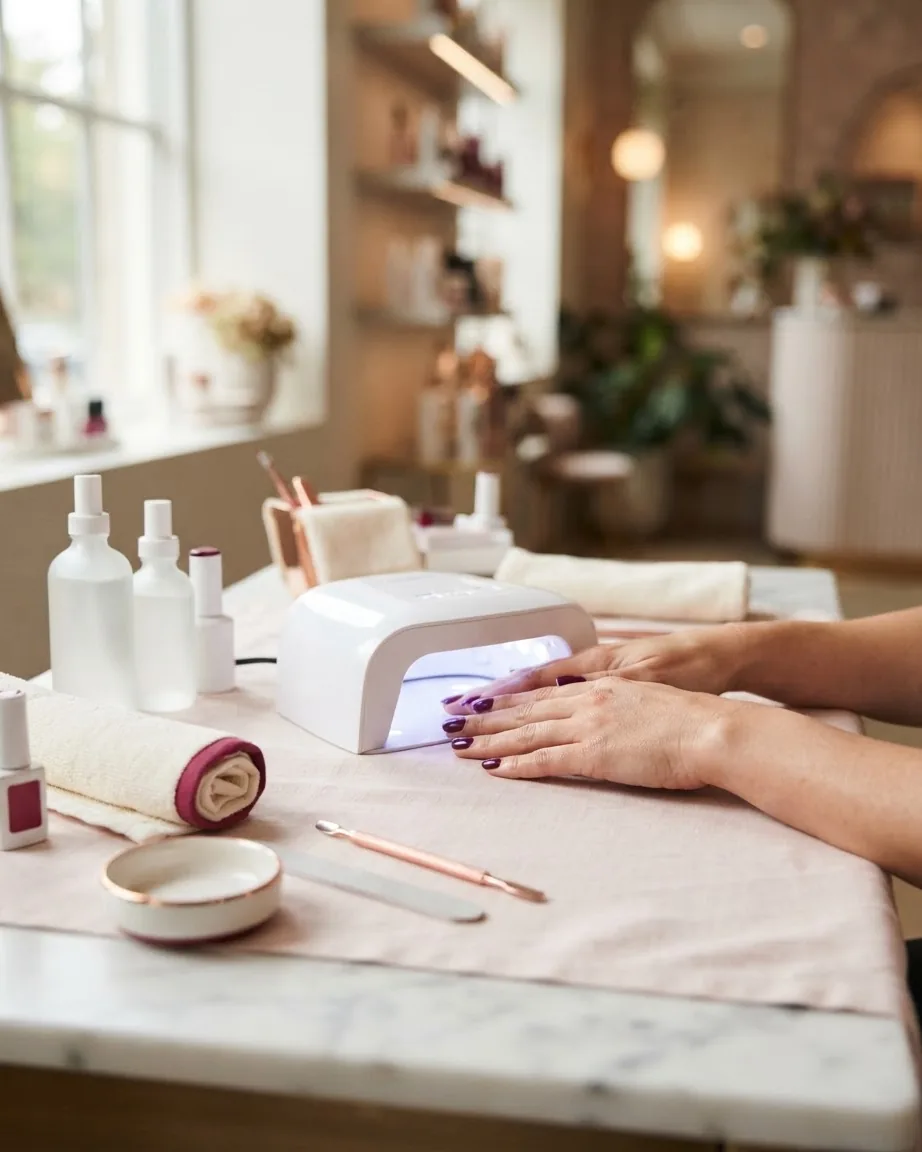
A high-pigment purple can reach full opacity fast. Bluesky Cosmetics reports that its stronger formulas give full coverage in 1 to 2 thin coats and last 21 or more days with proper prep. Prep is carrying weight in that sentence: the 21-plus-day figure assumes a clean, dehydrated nail and a correct base-and-top structure, not polish over a greasy plate.
That number applies to gel. Regular lacquer in the same color can match the coverage in a thin coat or two, but it won’t hold for the same stretch of days, because it air-dries instead of curing hard under a lamp. So the real decision is a trade: lacquer gives you color with no lamp, no cure step, and no UV, but shorter wear; gel gives you the longer wear at the cost of the lamp, the cure, and a small dose of UV each session. Neither is wrong. The right pick depends on whether a lamp is acceptable to you. When it’s time to take the color off, see our remove nail polish guide.
The Cure Step That Decides Whether a Purple Gel Is Safe
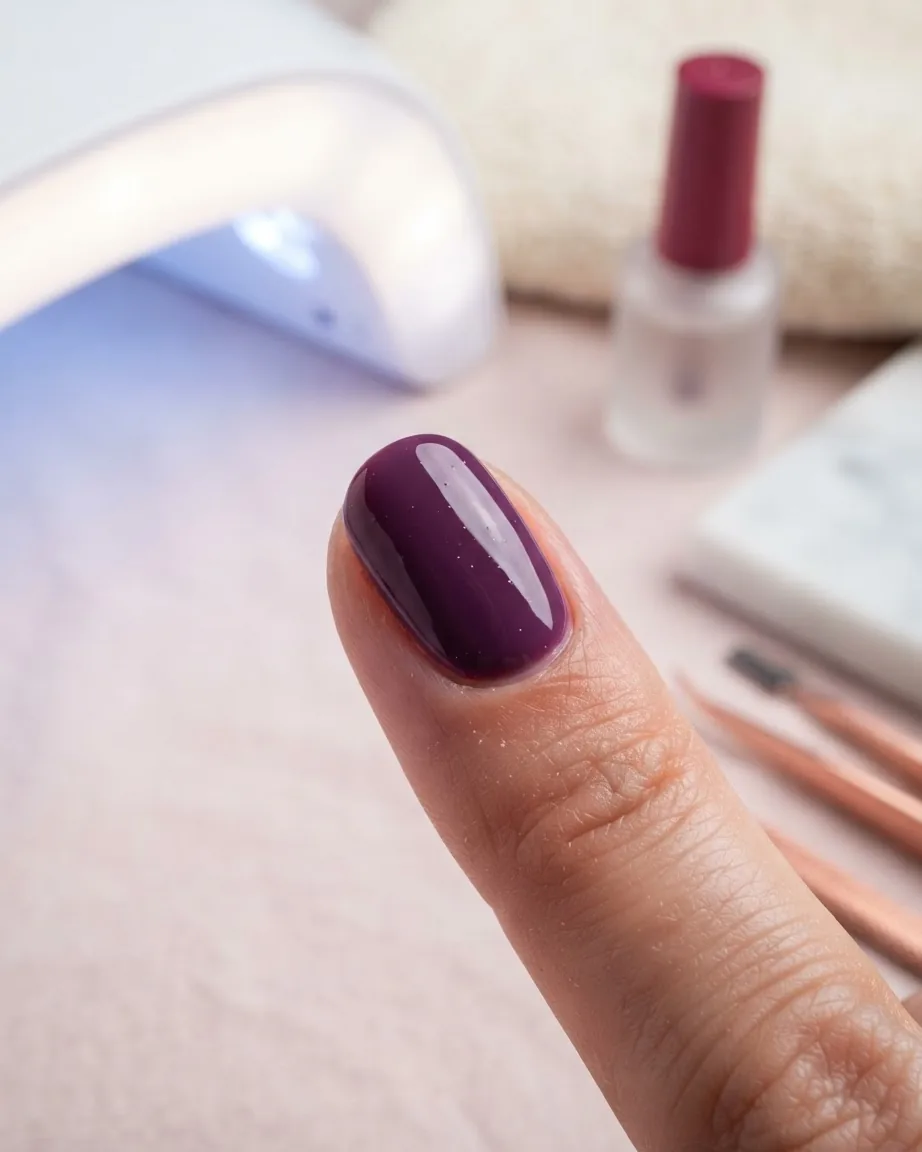
Gel polish only works because it hardens under light for a set time. Reporting by law firm Leigh Day, drawing on the British Association of Dermatologists, notes that polishes are cured for a specified length, such as 60 or 90 seconds. Short of that time, or with gel that reaches the skin before it sets, the risk is not the purple pigment. It’s uncured acrylate touching skin.
The failure mode is specific: liquid, under-cured gel flooding onto the cuticle or the skin around the nail. That contact is what can sensitize a person to acrylates over time, and the dermatology reporting ties repeated skin exposure to allergies that can be life-changing, including reactions that interfere with later medical and dental work. Any sign of redness, itching, or a rash around the nail is a reason to stop and see a professional, not something to manage at home.
One common assumption deserves correcting: “HEMA-free” is not an automatic safety stamp. A product without HEMA can still contain other powerful acrylates that sensitize skin the same way. The phrase narrows one ingredient; it doesn’t remove the category. The UK’s Chartered Trading Standards Institute is the consumer-safety body that has flagged this ground. Keep the product off the surrounding skin and cure for the full time printed on the bottle, whatever the label claims.
How Much UV a Purple Gel Manicure Actually Puts on Your Skin
The lamp is the part people worry about, and the chemistry writer behind Lab Muffin Beauty Science has put real numbers on it. Per visit, nail-lamp UVA exposure is less than 10 minutes every few weeks, which the analysis frames as roughly the energy of a maximum 20 minutes of midday summer sun in Barcelona at UV index 9.
Even the harsher lamps don’t change that much. The worst are about double the intensity of a typical one, which works out to around 20 minutes of midday summer sun every 3 weeks. For scale, the manufacturer-recommended 60 second cures translate to about 5 minutes per hand; reaching a genuinely high sun-equivalent dose in one sitting would mean something like another 20 minutes on the same day, the equivalent of eight manicures packed into a single day. A normal purple gel appointment sits well under that. The UV question, in other words, is a smaller factor than the acrylate-on-skin one.
Where Purple Came From: Tyrian Dye to Royalty
Purple’s status on skin and fabric predates any polish bottle. The color was expensive because the original dye, Tyrian purple, came from murex sea snails in staggering quantity. Figures recorded for the yield disagree – accounts range from roughly 250,000 snails per ounce to about 8,500 per gram – and those numbers aren’t reconciled, but the scale explains the price.
The making was slow, too. As Wikipedia’s account of purple describes, the extracted mixture was cooled, treated with ammonia, and kept damp for 3 to 4 weeks. That cost tied the color to power. The same source records that the Emperor Charlemagne was crowned in 800 in a mantle of Tyrian purple and buried in 814 in a shroud of the same color that still exists. Much later, in a different register, the Purple Rain Protest against apartheid took place in Cape Town on 2 September 1989, when a police water cannon loaded with purple dye sprayed thousands of demonstrators. The hue carried meaning long before it carried a cure time.
Common Questions About Purple Polish
Are the gel-polish safety warnings here based on US rules?
Allergen warning
No. The cautions above come from UK bodies – dermatology reporting and consumer-safety regulators. Read them as the mechanism of how acrylate allergy develops, not as a statement of US law. The science travels regardless of jurisdiction. Any reaction near the nail or skin, such as persistent itching or lifting that won’t settle, belongs with a qualified professional wherever you live.
Will any UV lamp cure any purple gel?
Not reliably. A gel sets only when the lamp’s output matches the polish’s photoinitiator, which is why makers such as Pink Gellac pair a lamp with their own range. A mismatched or underpowered lamp can leave the layer under-set even when the top looks dry, and that under-set gel is the part that can reach skin. Follow the cure time for the exact bottle you’re using.
Combien de soleil une pose de gel violet représente vraiment
Lab Muffin pose le repère : pour atteindre en une journée une dose UVA que l’analyse juge élevée, il faudrait l’équivalent de 20 minutes de soleil de midi (Barcelone, UV 9), soit huit manucures d’affilée. On en tire des chiffres concrets que les pages concurrentes ne donnent pas.
- Une seule pose = 2,5 minutes de soleil de midi. 20 min ÷ 8 manucures = 2,5 min par pose. Un rendez-vous de gel violet t’expose à autant d’UVA que deux minutes et demie dehors à midi en plein été.
- Un rendez-vous = 12,5 % de la dose « élevée ». 1 ÷ 8 = 12,5 %. Pour approcher le niveau qui inquiète, il faudrait enchaîner huit poses dans la même journée.
- Pire lampe sur un an : ≈ 5,8 h de soleil de midi. La lampe la plus intense (double intensité) revient à 20 min de soleil toutes les 3 semaines, soit (52 ÷ 3) × 20 ≈ 347 min sur l’année d’usage continu.
Côté UV, le gel violet est donc un petit facteur. Le vrai risque reste l’acrylate non durci qui touche la peau, pas la lampe.