Denatonium benzoate, the active in most of these formulas, is detectable at 0.05 ppm and intolerably bitter to most people at 10 ppm – meaning the deterrent works at trace amounts that have nothing to do with how much coating sits on the nail. That single fact separates what a bitter tasting nail polish for nail biting is actually doing (triggering a reflex) from what buyers assume it does (poisoning the habit out). It also explains why the taste can transfer, linger, and reappear long after the biting episode it was meant to stop.
This guide separates the consumer-review picture from the peer-reviewed one, splits the safety question into parts that are usually blurred together, and places the polish inside a realistic plan rather than selling it as a cure.
Quick answer: does a bitter polish stop nail biting?
A bitter tasting nail polish for nail biting coats the nail with denatonium benzoate, which reaches the tongue the instant you bite and produces an unpleasant taste that interrupts the motion. Hands-on consumer testing reports it halting the habit after about 24 hours of continuous wear. Peer-reviewed evidence is more conditional: a controlled trial found a competing-response technique outperformed the bitter-substance approach. It is best used as one layer of a plan, not the whole plan.
Why denatonium benzoate tastes bitter at trace amounts
The bitterness is not a matter of dose piled on the nail. Denatonium benzoate is one of the most bitter compounds known, and the numbers from chemical-supplier data make that concrete. According to Wincom Inc., the taste threshold sits at 0.05 ppm, and solutions of 10 ppm are intolerably bitter to most people. ScienceDirect Topics puts the same 0.05 ppm threshold in physical terms: roughly 1 g of the compound dissolved in 500 gallons of water.
That matters for one practical reason. The coating is not meant to be eaten; it is meant to be tasted. A reflex fires the moment the nail touches the tongue, before any real quantity reaches the mouth. So “how much is on there” is the wrong question. A thin, intact film does the job as well as a thick one, which is why reapplication cadence – keeping the film present – tends to decide results more than coat thickness.
24 hours vs. a controlled trial: the effectiveness gap
Here is where source type changes the answer, and both answers are worth holding at once.
Consumer testing is encouraging. A hands-on comparison from Allure reports the polishes “halted my habit entirely after wearing each for at least 24 hours.” The TLC Foundation for Body-Focused Repetitive Behaviors, a nonprofit specializing in these behaviors, notes that deterrents can register even during automatic or unconscious biting – the kind you don’t notice starting.
Peer-reviewed work is more guarded. A 1992 controlled trial published in Behaviour Research and Therapy compared a bitter substance (mild aversion) against a competing-response method. Both produced significant gains in nail length, but the competing-response method showed the most beneficial effect on nail length, skin damage, and self-rated control. The academic effectiveness evidence here rests largely on that single 1992 trial, which is worth knowing before treating any longevity or success figure as settled.
These findings don’t cancel each other out. One measures whether the taste interrupts a motion over a day; the other measures which technique rebuilds nails and reduces damage over a study period. The honest read: the polish can stop the act in the moment, but the strongest documented behavior change came from training a replacement action, not from aversion alone.
The safety question has three separate answers
Lumping “is it safe” into one yes/no hides the real picture. Split it into three.
The bitterant itself. Denatonium benzoate is generally regarded as safe and is not known to pose long-term health risks – which is why it’s used as a deterrent in countless non-cosmetic products. Its job is unpleasantness, not harm.
The rest of the formula. Safety claims about the bitterant do not automatically extend to every other ingredient in a given bottle. Some formulas can dry or irritate with overuse, can irritate the eyes or mouth, and some contain benzophenone-3 (oxybenzone). Those caveats attach to specific ingredients, not to the bitter agent – a distinction most product pages skip.
The age floor. For children, guidance is brand-specific rather than universal. In a long-term review, NBC Select reports that the ingredients in the Mavala formula are considered safe for adults and kids 3 years or older, per the brand and the experts consulted. The same review notes Mavala does not recommend the polish for younger children because their taste buds aren’t yet fully developed – the deterrent may simply not land.
Where a child, skin damage, or a possible reaction is involved, that’s a line for a professional, not a product page. Nail health concerns belong with a clinician – full stop. If contact with the eyes or mouth causes irritation, wash it off and stop use; a suspected reaction warrants stopping and seeking care.
What the taste does to your day: food, lingering, wash-off
This is the part buyers underestimate, and consolidating it in one place is more useful than the scattered mentions elsewhere. The same chemistry that makes the polish effective makes it intrusive.
- It transfers. Allure’s testing describes the taste spreading “onto everything my hands touched.” Finger foods, utensils, lip balm – anything that reaches your mouth can carry it.
- It lingers. NBC Select reports the taste persisting at least 15 minutes after fingers drifted near the mouth. In a separate product and context, Allure describes one formula’s taste lasting two days before dissipating. These are different products and situations, not a single wear figure – don’t treat either as a universal number.
- It washes off. Hand-washing, dishwashing, and ordinary wear erode the film. Allure’s test notes a formula wearing off so that reapplication was needed a few hours after the initial coat.
The practical takeaway: plan meals around it. If you eat with your hands or bite your nails most at night, time your coats so the film is freshest when the urge is strongest, and accept that lunch may taste like regret for a quarter of an hour.
How often to reapply a bitter tasting nail polish for nail biting
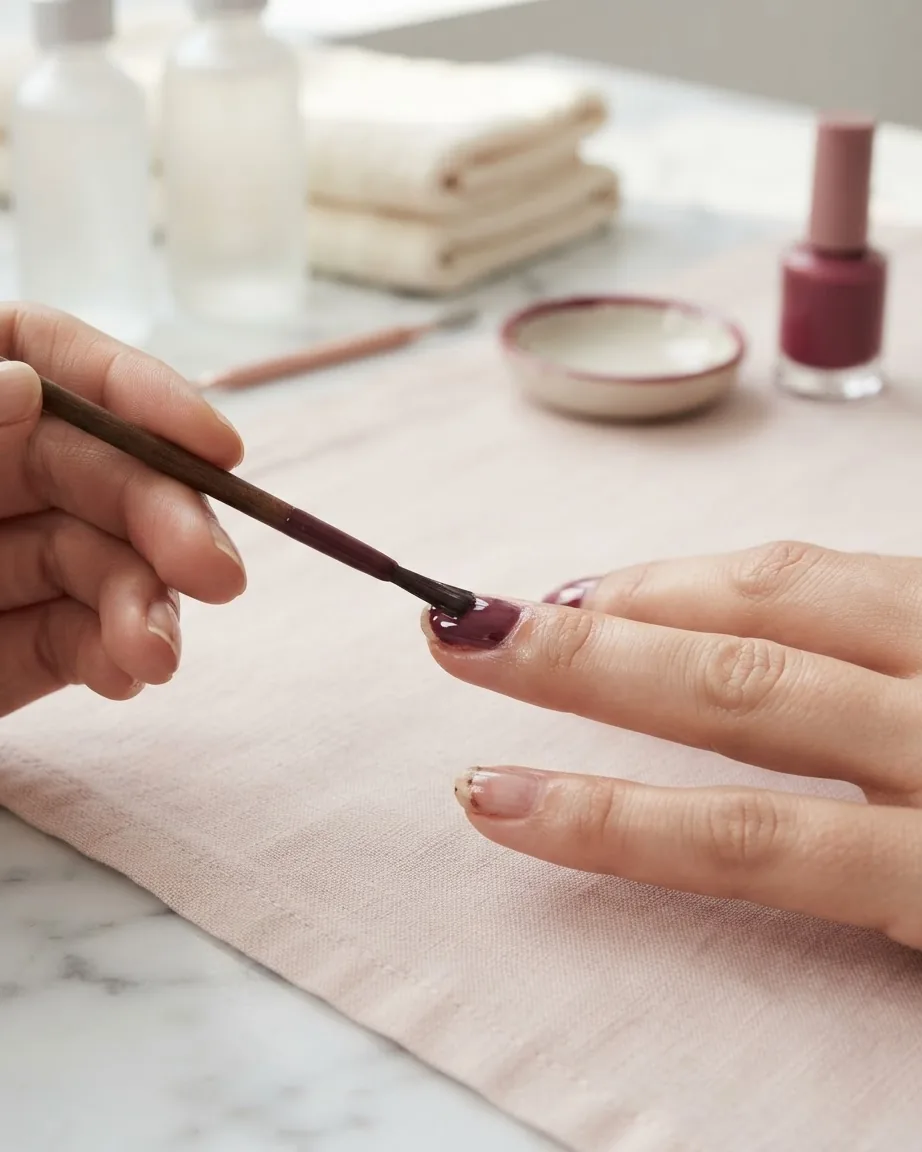
Because the film is what matters, cadence beats volume. For the Mavala formula, the brand recommends reapplying every 2 days, per the NBC Select review. But hand activity rewrites that schedule. Allure’s hands-on test saw a formula wear off within a few hours, requiring same-day reapplication.
Read the gap between those two figures as a range set by your hands, not a contradiction: a desk worker who washes up twice a day sits near the 2-day end; someone cooking, cleaning, or washing frequently will land closer to several applications a day. Check the film the way you’d check a topcoat – if biting stops producing a taste, the coating is gone and it’s time to recoat. For the general mechanics of keeping a color layer intact and off your skin, see our metallic nail polish notes.
Beyond the bottle: a stepped, non-shaming plan
Chronic nail biting (onychophagia) is classified as a body-focused repetitive behavior, part of the OCD-type spectrum – not a willpower failure. That framing changes what “treatment” should look like, and it carries one direct caution.
The “Art of Prevention” review estimates nail biting affects 20% to 30% of the general population – this is common, not fringe. The same review warns that aversive coatings “should be avoided for patients suffering from an underlying compulsive disorder.” That is the one hard line: if the biting is driven by a compulsive disorder, a bitter polish may be the wrong tool, and a clinician should steer the plan.
A reasonable ladder, with the polish as one rung:
- Keep nails short. Less free edge means less to grip with the teeth. The 1992 trial’s whole metric was nail length for a reason.
- Train a competing response. This is the technique that outperformed the bitter substance in the controlled trial – a deliberate, incompatible action when the urge hits.
- Consider NAC under guidance. The PMC review cites a randomized trial (Ghanizadeh and colleagues, 2013) reporting reduced nail biting after 800 mg of N-acetylcysteine per day over a 1-month period in a cohort of children versus placebo. This is a supplement with a medical context; it’s a conversation for a clinician, not a self-prescription.
- Add bitter polish as a reminder layer. Useful for interrupting automatic biting while the behavioral work takes hold.
- Seek care for damage. Broken skin, bleeding, or signs of infection around the nail go to a professional, not a bottle.
Cleveland Clinic frames nail biting within this behavioral and body-focused repetitive behavior context as well, reinforcing that the durable fix is behavioral rather than chemical. The polish buys interruptions; the plan buys change.
Removing the coating and avoiding a stained nail
A bitter polish is still polish, and it comes off like one. When you’re switching formulas or giving nails a rest, standard removal applies; if you’re caught without remover, our walkthrough on removing nail polish covers the solvent logic. One housekeeping note worth keeping in mind: tinted or pigmented deterrent formulas can leave a cast on a bare, already-stressed nail plate, so a base layer under any colored version is sensible for nails that bitten edges have already roughened.
Which bitter polish picture to trust for your situation
The decision isn’t “does it work” – it’s which answer applies to you. If your biting is an idle, automatic habit, the consumer-review picture is the relevant one: expect interruption within about 24 hours of consistent wear, plan for reapplication as often as your hands demand, and accept the taste intrusion at meals. If your biting is tied to a diagnosed compulsive disorder, the peer-reviewed caution is the relevant one, and the review’s warning to avoid aversive coatings in that case should route you to a professional first. If you want the strongest documented result on nail regrowth and skin damage, the controlled trial points at a competing-response technique, with the bitter coating as support rather than the lead.
Is bitter nail polish toxic if I accidentally swallow a little?
The bitter agent, denatonium benzoate, is designed to be unbearable at trace levels precisely so you reject it before meaningful quantities enter the mouth. It’s regarded as safe and isn’t linked to long-term health risks at these amounts. Still, other ingredients in a specific bottle carry their own caveats, so any ingested product that causes a reaction should prompt stopping use and seeking care.
Can toddlers or very young children use it?
Guidance is tied to the brand, not a blanket rule. The Mavala formula carries a floor of 3 years and older, with the maker declining to recommend it for younger children on the grounds that immature taste buds may not register the deterrent strongly enough. For any child, loop in a pediatric professional rather than relying on a label age alone.
Why does the taste come back hours after I applied it?
The film erodes with hand-washing and ordinary contact rather than vanishing all at once, so a faded coat can still release bitterness unevenly. Separately, residue can cling after transfer to the mouth; one review clocked that aftertaste at 15 minutes following incidental contact. A fresh, intact coat gives a cleaner, more predictable deterrent than a half-worn one.
How many people actually bite their nails?
Prevalence lands between 20% and 30% of the general population, which places it firmly in common-habit territory rather than rare behavior. That scale is part of why both drugstore deterrents and clinical techniques exist side by side – and why framing the habit as a shameful personal flaw misreads what is, for many, a body-focused repetitive behavior.
Do the math: how little polish – and how often you’ll actually recoat
Two numbers already in this guide, run through simple arithmetic, settle the two questions buyers get wrong – “how much do I need on there?” and “how often will I really reapply?”
- It’s a trace, not a dose. ScienceDirect puts the 0.05 ppm detection threshold at roughly 1 g of denatonium in 500 gallons of water. A US gallon is 128 fluid ounces, so that’s 500 × 128 = 64,000 fluid ounces of water sharing a single gram. The reflex fires on a vanishingly thin film – which is why a thin, intact coat works as well as a thick one, and why keeping the film present beats piling it on.
- The brand cadence sets a baseline, not a ceiling. Reapplying every 2 days works out to 0.5 applications a day. But Allure’s test saw a formula wear off in a few hours; recoating roughly every 3 hours across a waking day is 24 ÷ 3 = 8 applications a day.
- Heavy hands can mean ~16× the label cadence. Compare the two: 8 ÷ 0.5 = 16 times more frequent recoating for someone cooking, cleaning, or washing up constantly than the 2-day brand figure implies. Budget your bottle – and your time – for your hands, not for the label.