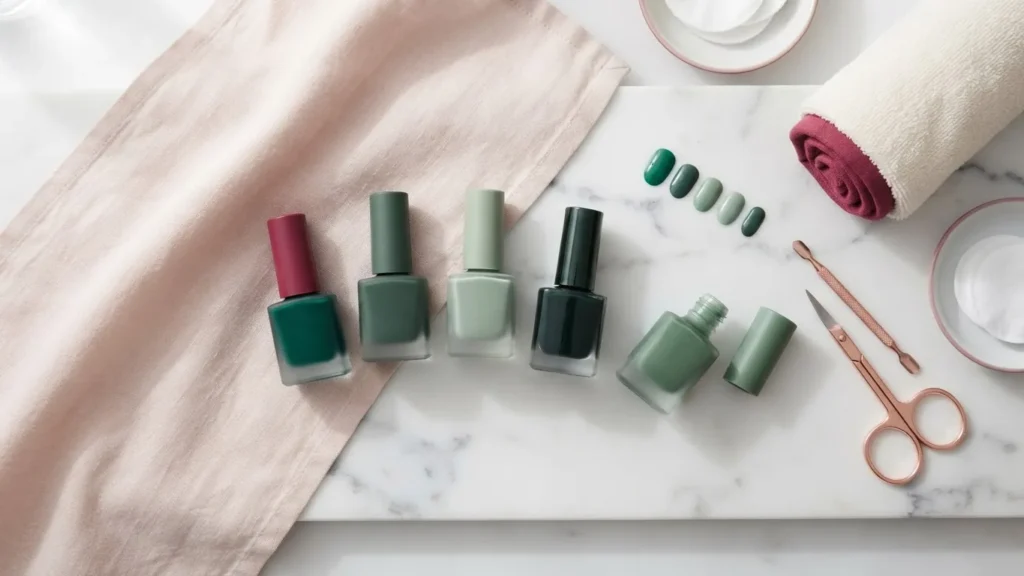
A deep emerald that looks like a jewel in the bottle can turn almost black under office lighting, while the exact same color stays readably green outdoors or under a glossy topcoat. That gap between bottle and hand is the problem most people run into with green nail polish, and it is fixable with finish choice rather than a different shade. The harder question is the other green on the internet: a green tint on the nail that is bacterial, not cosmetic. This guide separates the two, matches shades to undertone, and names the escalation point where a nail stops being a styling question.
Quick answer: Match green to undertone first. Cool or fair skin leans toward mint, seafoam, and soft pastel greens; warm or olive skin leans toward olive, sage, and deeper forest tones. Sage is the safest universal pick because it sits mid-spectrum. For a dark emerald that disappears indoors, use a glossy or chrome finish, never matte. A green tint that washes out is cosmetic staining; a green, blue-green, or blackish discoloration that will not clear, paired with lifting, can be green nail syndrome, which accounts for roughly 1% to 4% of all nail infections and belongs to a clinician.
Reading Your Undertone Before You Pick a Green
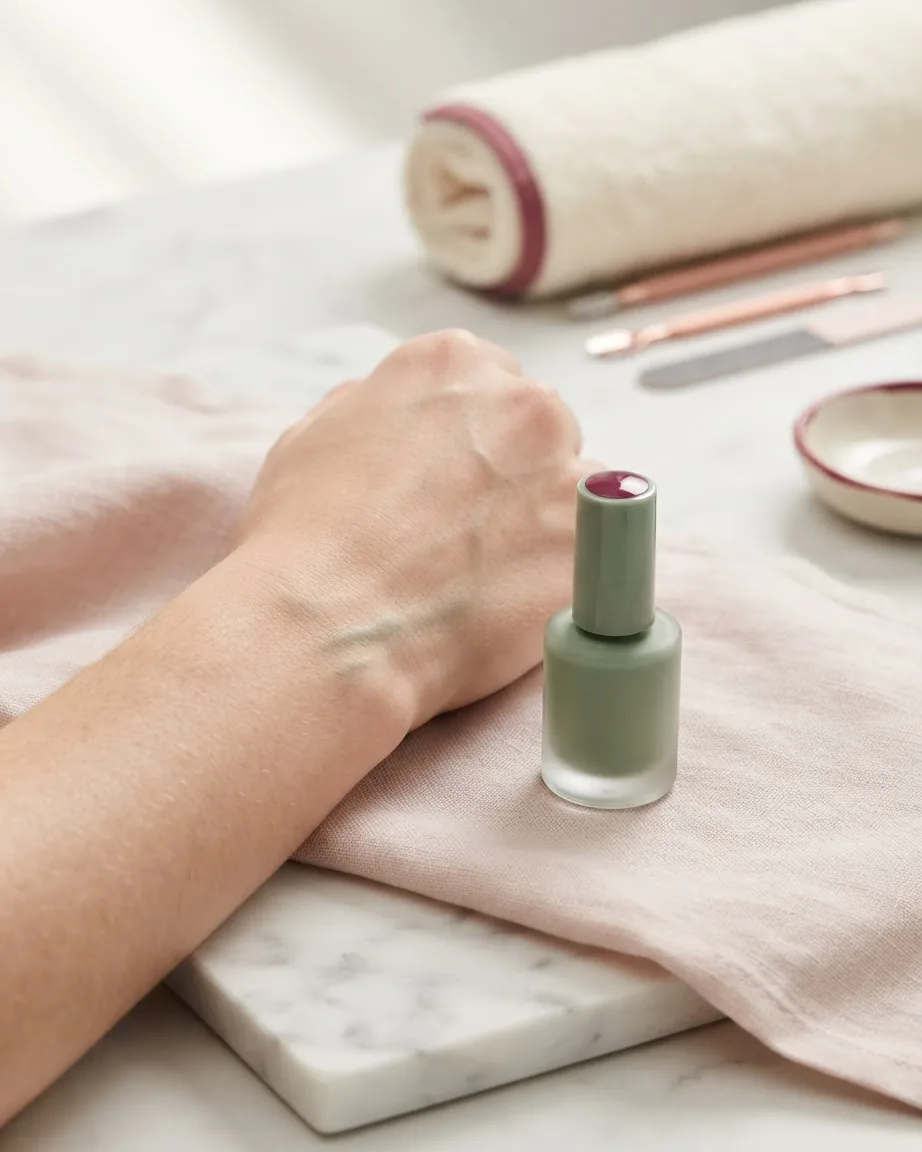
Green spans a wider undertone range than most polish families, which is why one green flatters a hand and the next makes it look sallow. The split is cool versus warm: blue-leaning greens against cool skin, yellow-leaning greens against warm skin. Joyee Nails frames the green-by-undertone decision as blue-toned skin pairing best with greens that lean blue – mint, seafoam, emerald, and teal – while yellow-toned skin pairs best with olive, pistachio, sage, and lime.
If you are not sure which camp you fall in, the vein test gives a fast read. Blue or purple veins on the inner wrist suggest cool undertones; green-looking veins suggest warm. It is a guide, not a lab result, so treat a borderline reading as neutral and lean on sage.
Why sage specifically? It is cited as the single green that flatters across all undertones because it sits in the middle of the cool-warm spectrum rather than committing to either end. If you own one green and want it to work on most hands and most occasions, that is the bottle.
Brand shade buckets line up with this. OPI sorts its green shades by skin tone: mint, seafoam, or soft pastel greens for cool or fair skin; olive, forest, and emerald for medium or olive skin; and bold greens or almost-black shades for deep or warm skin. One shade crosses a line between the sources, though – see the next section before you buy an emerald on the strength of your undertone alone.
Where Emerald Belongs: A Disagreement Worth Knowing

Emerald is the one green the sources do not fully agree on, and the split is worth naming because it changes what you buy. Joyee Nails groups emerald with the blue-leaning greens best for cool and neutral skin. OPI places emerald in the medium-and-olive bucket alongside forest. Neither is wrong; they are describing the same saturated jewel tone from two angles – its blue depth versus its richness on warmer skin.
The practical resolution: emerald is a neutral-to-flexible green rather than a strictly cool or strictly warm one. If your undertone reads clearly cool, you will likely love it. If it reads warm or olive, it still works, but you may prefer it one step deeper toward forest. When a shade sits on a fence like this, buy the finish that keeps it alive on the hand, which matters more for emerald than placement does.
Defining Mint, Sage, Emerald, Olive, and Forest
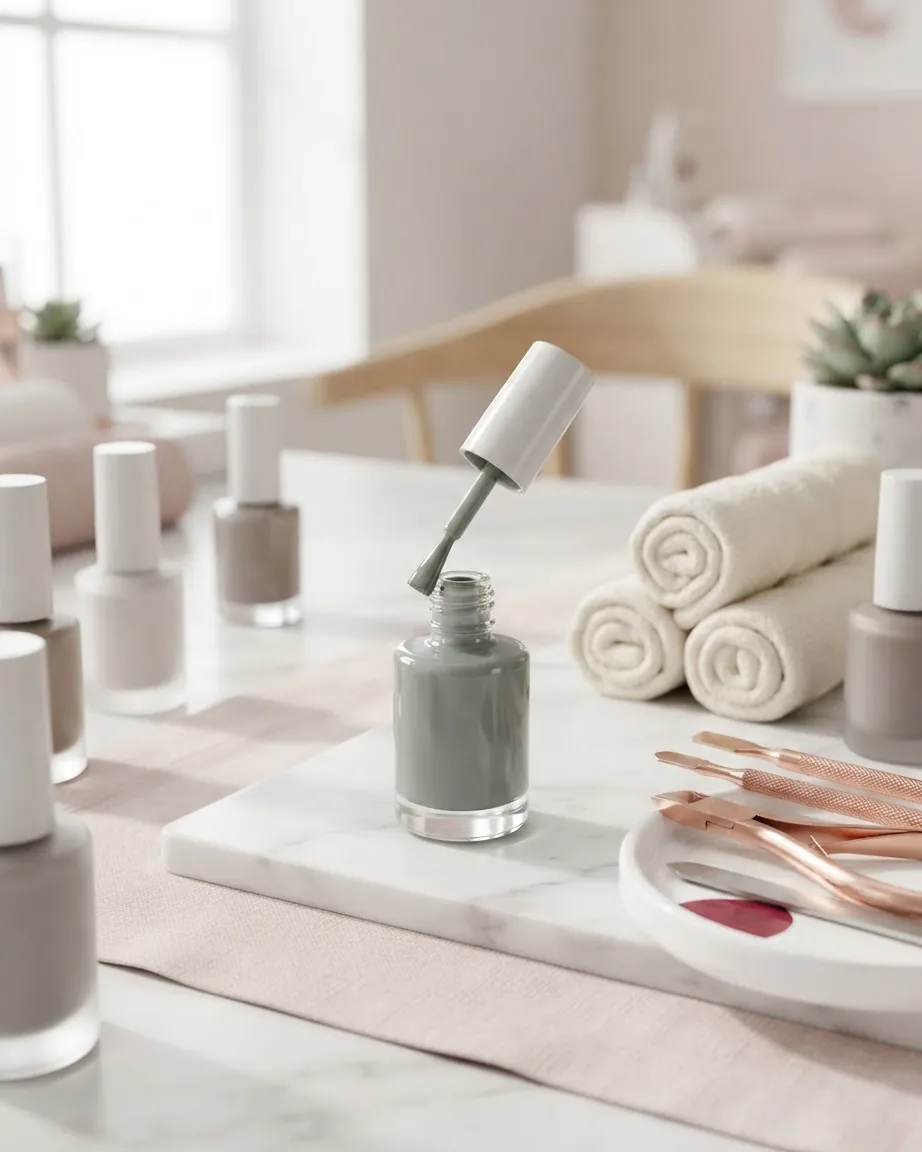
These names get used loosely, so here is what separates them. Ella+mila’s shade education distinguishes mint as a light, fresh pastel green; sage as muted and grey-leaning for an understated look; and emerald as a deep, saturated jewel tone. Those three mark the range from palest to deepest within the blue-and-neutral side.
Olive and forest round out the warm and dark ends. Olive is the warmest green, carrying yellow and brown undertones, which makes it the standout for warm-toned skin – it works with golden undertones instead of fighting them, and it can look muddy on cool skin for the same reason. Forest is a deep, saturated green that reads as a sophisticated near-neutral. Seafoam sits between mint and sage: light, slightly blue, cool-leaning.
- Mint: light pastel green, cool-leaning, best on fair or cool skin.
- Seafoam: soft blue-green pastel, cool-leaning.
- Sage: muted grey-green, mid-spectrum, the universal default.
- Emerald: deep saturated jewel tone, neutral-to-flexible.
- Olive: warmest green with yellow-brown base, best on warm skin.
- Forest: deep saturated green that wears like a neutral.
The Emerald-Reads-Black-Indoors Problem
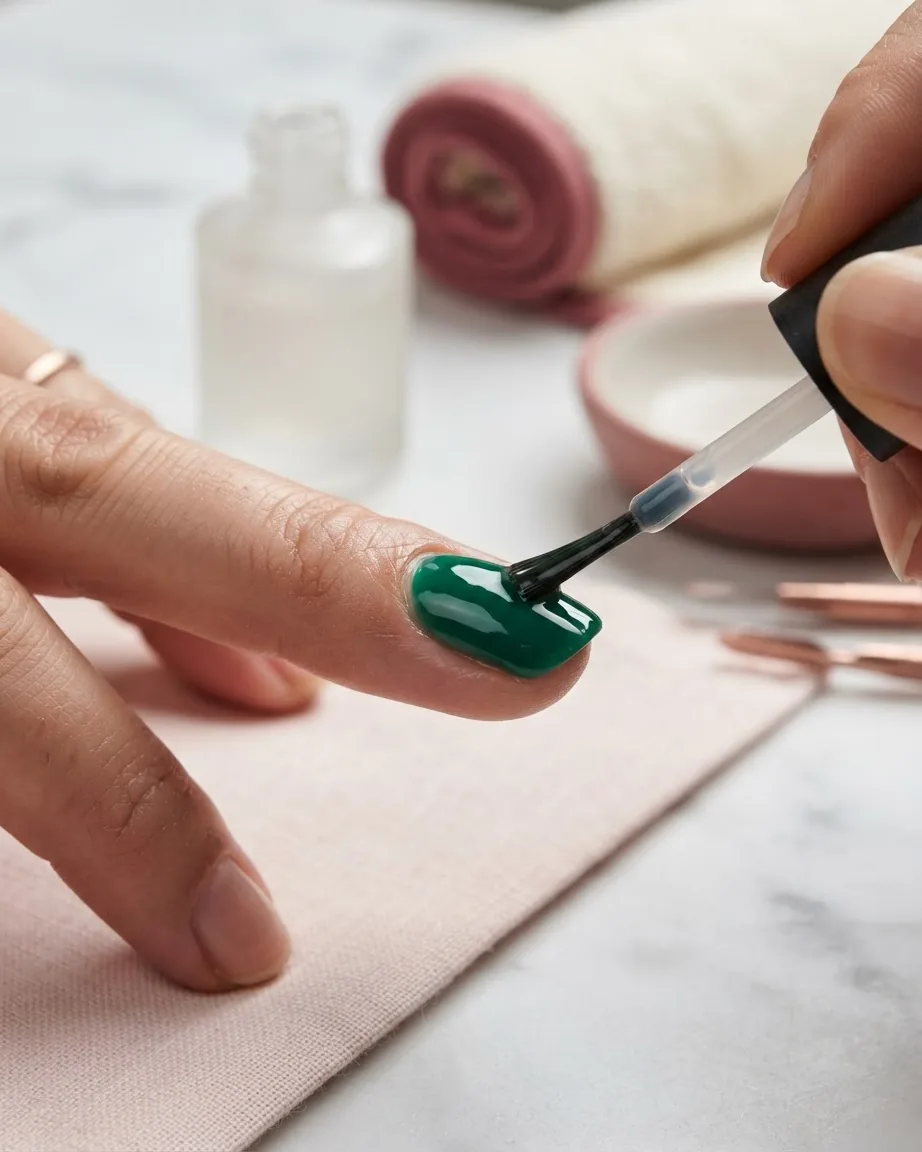
This is the failure mode behind most disappointed green manicures. A deep emerald can appear almost black under artificial lighting – the pigment is dark enough that without reflected light, the eye registers it as black rather than green. The fix is not a lighter shade; it is finish.
A glossy or chrome emerald reflects enough light to stay visibly green even indoors. Matte emerald photographs well but reads as dark and flat in low-light rooms, which is exactly where you spend most of your day. So the rule for any deep green you want recognizable at a desk or a dinner table: glossy or chrome, not matte. Chrome pushes it furthest toward a lit, metallic green; a standard glossy topcoat is enough for most people.
Save matte for lighter and mid-tone greens – sage, olive, mint – where there is no darkness for the finish to collapse into. If you like the drama of near-black and the room is well lit, matte emerald can hold; in dim light it will not. For a related look where the finish does the heavy lifting, see our cat eye nail colors guide.
Office Greens Versus Off-Duty Greens
Not every green reads the same in a meeting. Ella+mila’s wearability guidance is direct: muted sages and deep forest greens wear like sophisticated neutrals and sit comfortably in professional settings, while brighter limes and neons are better saved for off-duty days. The dividing line is saturation. The more a green shouts, the more it belongs to the weekend.
Seasonally, the same logic flexes. Mint and seafoam feel right in spring and summer; sage and olive carry across fall; forest and deep emerald anchor winter. None of this is a rule you must follow, but if you want one bottle to disappear into daily wear, a muted sage or a forest covers more of the calendar than a lime does.
Will a Dark Green Stain My Nails?
Deep and jewel greens carry real staining risk, and the reason is pigment load. Kester Black’s guidance on preventing stained nails notes that darker shades – deep reds, blues, and purples – are more prone to staining because they hold higher concentrations of pigment. A saturated forest or emerald behaves the same way.
The preventive step is a base coat. A nourishing base coat puts a protective layer between the nail plate and the polish, so the pigment grips the base coat rather than the keratin underneath. Apply it under every dark green, not just occasionally. The same principle shows up in our red nail polish guide, since red is the worst offender of all for leaving tint behind.
If a stain does land, there are two at-home approaches drawn from these brand guides. Brushing the nails with any whitening toothpaste or baking soda for 5 to 10 minutes can lift discoloration, per DipWell. For a yellow cast, Kester Black describes soaking a cotton pad in lemon juice and holding it against the nails for 10 to 15 minutes. One caution attaches to that yellow: if your nails are yellow and you have not worn a dark polish, that can signal infection or fungus, and Kester Black’s own advice is to have a GP look at it rather than scrub.
Cosmetic Green Stain Versus Green Nail Syndrome
Here is the distinction that matters most, because the two things share a color and nothing else. A green tint after a green manicure is often just cosmetic staining. DipWell makes the point plainly in its guide to Pseudomonas nail infections: do not automatically assume the worst if you just wore a green dip powder, because the pigment can leave a harmless tint that washes out.
Green nail syndrome, also called chloronychia, is a different animal entirely. According to Dermatology Advisor’s clinical reference on green nail syndrome, it is a gram-negative bacterial infection caused by Pseudomonas aeruginosa – not a fungus. The green, blue-green, or blackish color comes from two pigments the bacteria produce, pyocyanin and pyoverdine. In patients with darker skin tones, that discoloration may read more yellowish or brownish rather than green.
The self-triage test is simple. Cosmetic stain lives on the surface and lifts with a toothpaste or baking soda scrub over 5 to 10 minutes. A true infection often tracks with a lifted or separated nail. If it will not wash out and the nail is lifting, stop treating it as a styling problem.
Does Green Polish or Gel Actually Cause the Infection?
This is the fear that keeps people away from green, and it is mostly backwards. Dermatology Advisor does list applying nail polish and wearing artificial nails such as acrylics and gels among the behavioral risk factors for green nail syndrome – but the mechanism is moisture, not the color. Pseudomonas thrives in warm, damp, nearly oxygen-free conditions, and an enhancement that lifts or traps water gives it exactly that pocket.
The key qualifier: P aeruginosa rarely infects an intact, uncompromised nail. Patients often have a recent history of trauma or a fungal infection first. So green polish on a healthy, well-sealed nail is not the hazard; moisture trapped over a nail that is already lifting or damaged is. The most common risk factors are onycholysis – the nail separating from its bed – and a damp environment, especially prolonged exposure of more than 2 to 3 weeks, which gives the bacteria time to colonize.
The practical takeaway: wear green freely on sound nails, keep enhancements dry and well-sealed, and do not leave lifting polish or a lifting tip in place for weeks.
When a Green Nail Belongs to a Doctor
Escalate when the green does not behave like a stain. The triggers: color that will not wash off, a nail that is lifting or separating from the bed, pain, swelling, or a yellow discoloration with no dark polish to explain it. Highest prevalence of green nail syndrome falls in patients 40 to 60 years old, and it makes up roughly 1% to 4% of all nail infections – uncommon, but not rare enough to ignore when the signs line up.
Treatment is a clinician’s call, not a home project. Dermatology Advisor lists the first-line topical antiseptic as 1% acetic acid, with oral antibiotics or nail avulsion reserved for severe, refractory cases. Patients may also be advised to avoid or limit nail polish during treatment so the nail can be monitored as it clears. This guide is cosmetic only; if you suspect an infection, a dermatologist or GP settles it. For safe enhancement removal while you wait, see our acrylic nails off guide.
The “Green Nail Theory” Trend, Briefly
You may have arrived here because of the other green on your feed. The “green nail theory” is a manifestation trend claiming green nails attract peace, abundance, and growth, following earlier red and blue nail theories. The New York Post describes it as a new-age spin on manifestation, with social media users painting their way to a mood boost. There is no scientific evidence behind it. If a green manicure lifts your mood, that is a fine reason to wear one – it just has nothing to do with the clinical green nail covered above, and the two should never be confused.
Picking Your First Green With Confidence
Put the decisions in order and the bottle chooses itself. Read your undertone with the vein test; cool picks blue-leaning greens, warm picks yellow-leaning greens, and anything ambiguous points to sage. Choose finish by shade depth: glossy or chrome for any deep emerald or forest so it stays green indoors, matte only for lighter and mid-tone greens. Lay a base coat under every dark green to blunt staining. And keep the two greens straight – a tint that scrubs off in 5 to 10 minutes is cosmetic, while color that stays put over a lifting nail is a reason to call a professional. For a softer palette to pair with, our soft pastel nail polish guide covers the lighter end.
Is sage green really the safest choice for every skin tone?
It is the closest thing to a universal green because it sits mid-spectrum, neither strongly blue nor strongly yellow, so it does not clash with either undertone. That said, a committed cool or warm hand will still look sharper in a shade built for it. Sage is the low-risk default when you are buying one bottle or unsure of your undertone.
How do I tell a harmless green stain from an infection at home?
Scrub the nail with whitening toothpaste or baking soda for several minutes. Cosmetic pigment sits on the surface and lifts; a Pseudomonas discoloration sits beneath the plate and stays. An infection also tends to accompany a nail that is separating from its bed, sometimes with soreness. Surface tint that clears is styling; embedded color with lifting warrants a clinician.
Can I wear green gel or acrylic without risking chloronychia?
Yes, on a healthy nail. The bacteria behind green nail syndrome rarely take hold on an intact, undamaged nail – they need trapped moisture over a compromised surface, typically after lifting or an earlier injury. Keep enhancements dry and well-sealed, and replace any tip that starts lifting instead of leaving it for weeks. The green color itself poses no risk.
Why does my emerald look great in photos but dull in person?
Phone cameras add light and flash that a dim room does not. A dark emerald needs reflected light to register as green rather than black, so it photographs rich and then flattens under house lighting. Switch from matte to a glossy or chrome topcoat, which bounces enough light to hold the color indoors where you actually wear it.
How long should I leave an at-home stain remedy on?
For general discoloration, a whitening toothpaste or baking soda scrub runs 5 to 10 minutes. For a yellow cast specifically, a lemon-juice-soaked cotton pad held against the nails works over 10 to 15 minutes. If yellow appears without any dark polish behind it, skip the remedy and have a GP rule out infection or fungus first.
Combien de temps pour chaque méthode de détachage maison
Les deux détachages maison ne demandent pas le même temps de pose. Le dentifrice blanchissant ou le bicarbonate agit en 5 à 10 minutes ; le citron, lui, se pose 10 à 15 minutes. Si tu es pressé, pars sur le dentifrice/bicarbonate.
- Dentifrice blanchissant / bicarbonate : 5 à 10 min (vise la décoloration verte).
- Citron : 10 à 15 min (vise plutôt le jaune).
Rappel : un jaune sans vernis foncé récent n’est pas une tache à frotter, c’est un motif de consultation.