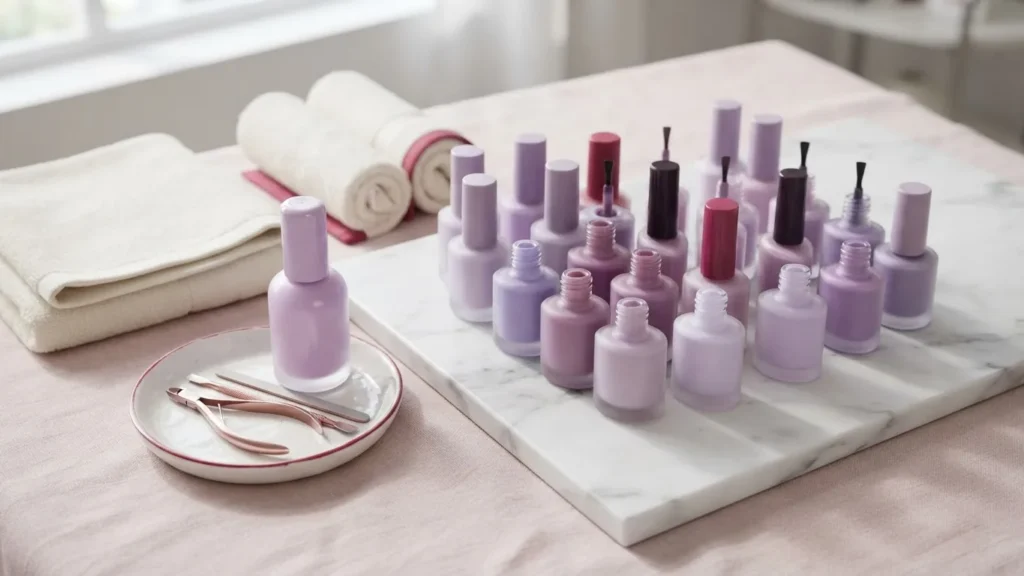
Type the same two words into any polish shop and you get back two unrelated manicures. One is a translucent, milky veil you build up slowly; the other is a flat, opaque gray-violet that covers at two coats. Lavender nail polish is not a single product category, and the coat counts, the coverage, and the way the color sits on your hand all swing depending on which of the two you picked up. Before any of the shade-matching or wear questions matter, you have to know which finish is in the bottle – because a number that is true for one is wrong for the other.
This guide separates the two finishes, names the shades that have a documented routine behind them, and resolves where brand advice and real-wearer reports point in opposite directions.
Lavender nail polish arrives in two finishes that do not share specs: a sheer-to-milky “lavender milk” you build across 1 to 3 coats, and an opaque grayish-lavender creme that reaches full coverage at 2 coats plus top coat. Milky formulas let ridges and yellowing show through; opaque cremes hide them. On cool or very pale hands the color can read gray rather than purple, so a shade that flatters one person washes out on another. Wear is driven by prep and application, not the pigment – Essie rates its original enamel for up to 7-day wear with a proper routine.
Lavender Milk vs. Opaque Creme: Why the Coat Count Changes
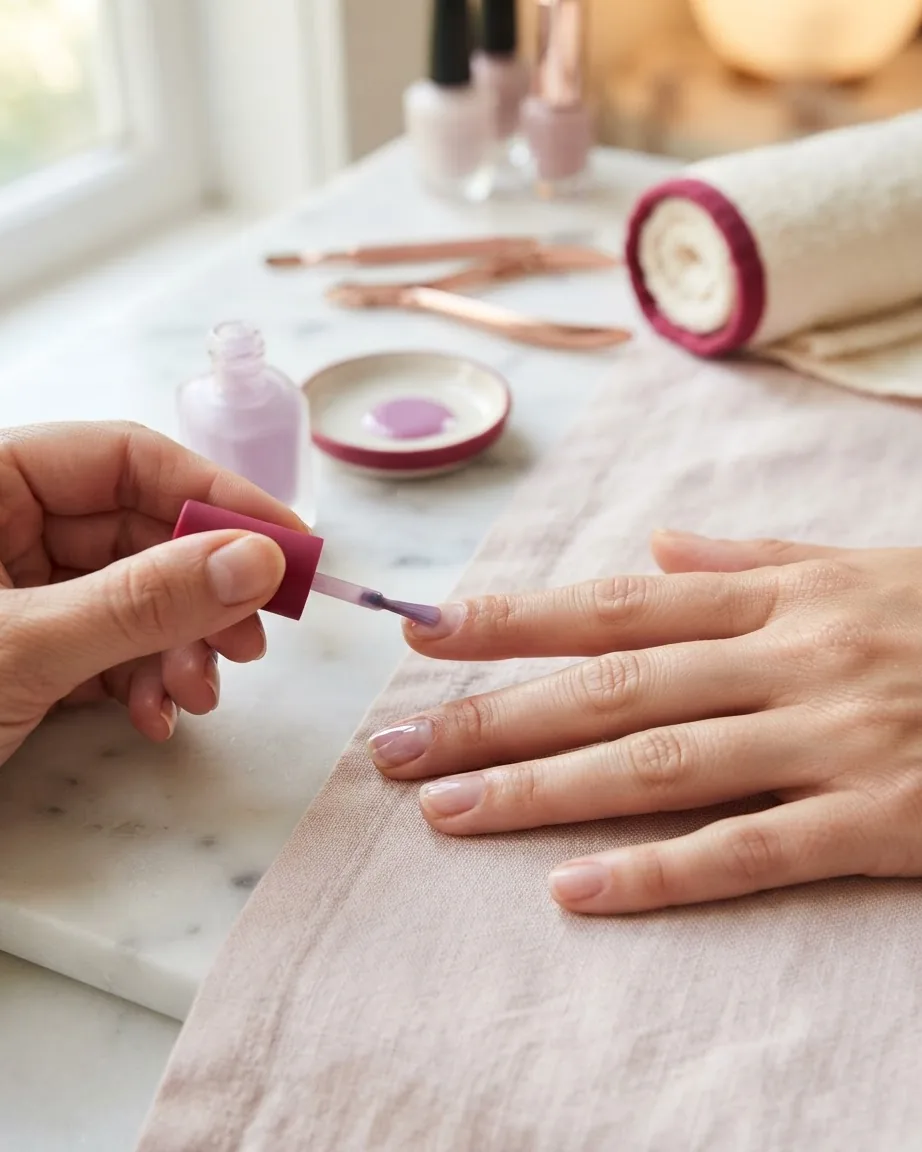
The split matters because a coverage instruction written for one finish misleads you on the other. A sheer “lavender milk” is translucent by design. Cirque Colors builds its Lavender Sky across 1 to 3 coats, moving from a barely-there wash to what the brand calls a milk bath finish – the coat count is a dial you set, not a fixed step. GELCARE’s Lavender Water sits in the same semi-sheer family, a milky veil rather than solid color.
An opaque creme behaves differently. Essie’s In Pursuit of Craftiness is a grayish-lavender lacquer that needs 2 color coats to reach full opacity. You do not build it from sheer; you lay it down to cover. Applying the milk-finish logic to a creme leaves you overworking a formula that was meant to go opaque in two passes, and applying creme coat counts to a jelly buries the translucency you bought it for.
So the first decision is finish, not shade. If you want your nail line or a hint of your natural plate to show through, a buildable jelly like Lavender Sky is the format. If you want even, solid color with no show-through, an opaque creme is. Do not carry a number across that line. For how white loading turns a pure hue into a buildable soft color, see our soft pastel nail polish guide.
Named Lavender Shades With a Documented Routine

Several lavenders come with a manufacturer-stated application method rather than guesswork. Cirque Colors Lavender Sky is the jelly reference point: 1 to 3 coats, translucent to milky. GELCARE Lavender Water is the semi-sheer “lavender milk” lacquer, applied over a base and built in thin color coats. Essie In Pursuit of Craftiness is the opaque grayish-lavender creme, and the brand’s standard enamel routine is 1 base coat, 2 color coats for opacity, and 1 top coat.
Glamour, covering the lavender-milk manicure trend, cites nail artists Tom Bachik and Elle Gerstein on the soft, semi-opaque look that drove the shade’s run. AIMEILI carries lilac and lavender options in both its editorial and its gel lineup. Essie’s Go Ginza also circulates in beauty editorial as a lavender worth naming.
One buy caveat worth holding: some shoppers have reported Lavender Sky bottles arriving lighter or darker than expected from batch to batch. That comes from forum discussion, not a manufacturer statement, so treat it as a reason to check current reviews before ordering rather than a confirmed defect.
Why Lavender Reads Gray or Washed-Out on Some Hands

Lavender carries cool blue-gray undertones. Essie’s own grayish-lavender creme is built around exactly that muted, cool cast – which is also why the color can turn flat or ashen on skin it fights rather than complements. The pigment that makes a lavender look soft and dusty is the same pigment that can make a cool or very pale hand look drained.
Here the guidance splits by source type, and the split is the useful part. AIMEILI’s shade editorial places lavender and pastel violet among the softer purples that suit fair skin. Against that, some cool-toned and pale wearers report the opposite in forum threads – that lavender reads gray, “zombie,” or mannequin-like on them, and that a version leaning “practically blue” flatters where a true lavender does not.
These are different classes of evidence: brand editorial on one side, individual wearer reports on the other, and neither settles the other. The practical read is that lavender is not universally flattering the way the editorial implies. If your hands run cool or very pale and a lavender has gone flat on you before, a bluer-leaning lilac is the adjustment people in that group describe reaching for. Swatch on your own nail, not on the bottle cap, before you commit. If a soft purple keeps fighting your undertone, our nude nail polish matching guide walks the undertone question in a lower-risk color.
Will a Sheer Lavender Show Yellow Nails or Ridges?
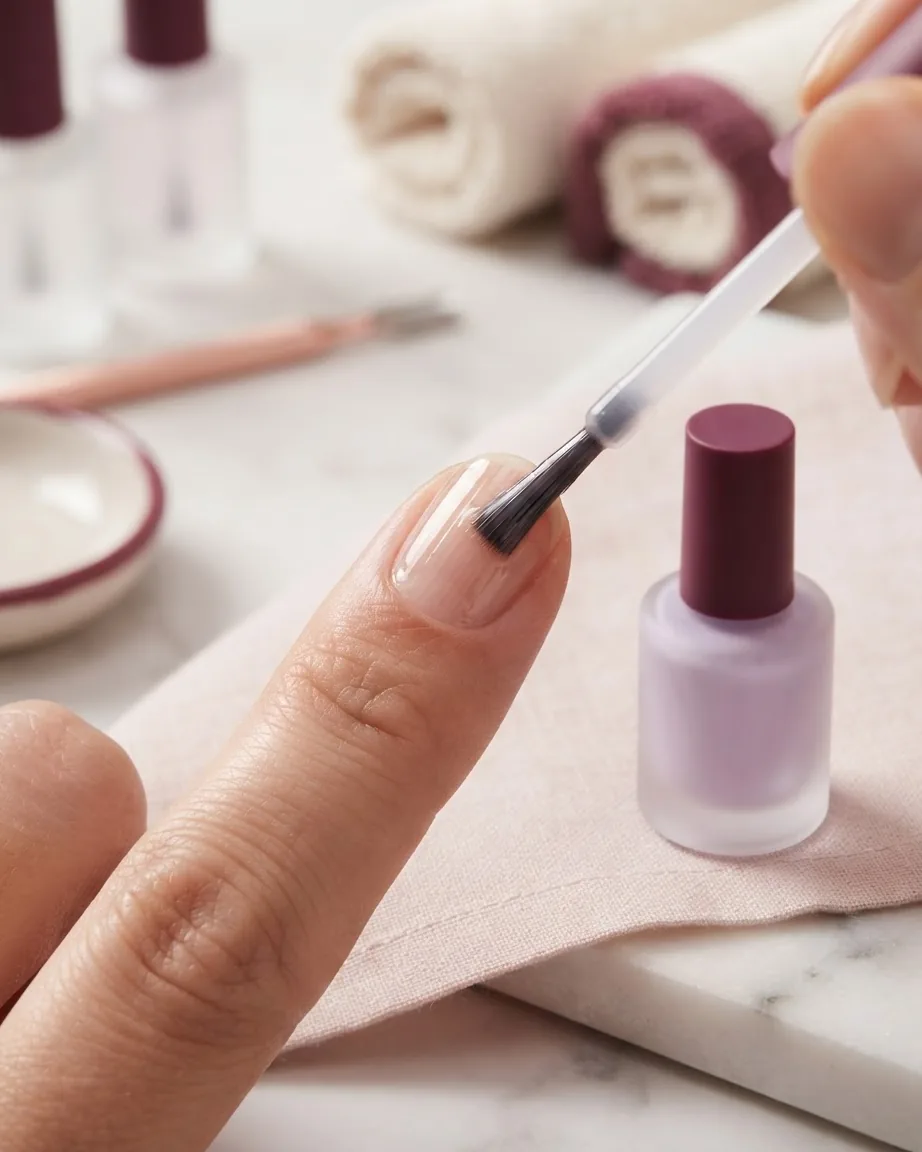
This is where finish choice has a consequence most shade guides skip. A sheer or milky lavender is translucent, so whatever is under it shows through – including yellow staining and ridge shadows. The same translucency that makes Lavender Sky look like a soft wash at one coat also means a bare, yellowed, or ridged nail reads right through it.
Cirque frames its jelly as something that can be used to counteract yellow staining when layered with intent – a sheer jelly over a correcting base shifts the cast. But a plain milky lavender applied straight onto the natural nail does the opposite: it reveals what is there. If your nails run yellow or ridged and you want a sheer lavender, the move is a corrective or ridge-filling base underneath, not more coats of the sheer itself. An opaque creme sidesteps the problem entirely by covering, which is one honest reason to pick the creme over the milk finish for a less-than-perfect nail plate.
Prep That Gets Lavender to 7-Day Wear
Wear time is an application outcome, and the prep steps that protect it are specific. Glamour’s trend coverage flags a common mistake directly: cleaning the nail with acetone before polishing. Acetone leaves debris on the plate that causes polish to chip faster or fail to dry. The fix is a cleanse with 75%+ isopropyl alcohol instead, which clears oils without leaving that residue.
Base-coat timing is the next lever. GELCARE’s method for Lavender Water calls for a thin, even base coat, then allowing it to dry for at least 3-4 minutes before the first color coat goes on. Rushing that window is where lifting and early chipping start.
There is also a base-coat mistake that produces bubbles: doubling it. GELCARE’s guidance is to avoid applying more than one coat of base, because a second one can trap small bubbles under the color. More base is not more protection here – it is a texture problem waiting to surface.
For color, the GELCARE routine is two coats, allowing at least 2 minutes for each coat to dry before the next. For an opaque Essie creme, the standard is 1 base, 2 color coats for full opacity, 1 top coat, and the brand rates that enamel for up to 7-day wear with proper application. Note that these timers belong to their own formulas – a 4-minute base-coat wait from one brand is not a universal law, and summing a brand’s separate dry times into a single “total” figure invents a number none of them states.
Color vs. Application: What Actually Decides Whether It Lasts
Glamour’s coverage carries what looks like a contradiction, and resolving it tells you where to spend effort. In one place the reporting states that color choice does not affect the longevity of a manicure – it is all in the application. In another, the same coverage warns that light, sheer lavender can fade from sun exposure or even the dye rubbing off your jeans, and recommends a UV top coat to prevent it.
Both are true because they describe two different things. Longevity – how long the polish stays on the nail without chipping or lifting – is application-driven, and the pigment color has nothing to say about it. Visible fading is a separate failure mode: a pale lavender can stay fully intact on the nail while the color itself lightens from UV and abrasion. So a sheer lavender can last its full run and still look duller at day five.
The remedy addresses the second problem only. A UV-filtering top coat protects pale pigment from sun fade; it does not change the prep-and-application fundamentals that keep the polish adhered. If your lavender keeps fading rather than chipping, the answer is the UV top coat and less direct sun on the nails – not a different base or more color coats.
Gel Lavender vs. Regular Lacquer, and the Safety Line
The lavender shades covered here span both regular lacquer – the Cirque, GELCARE, and Essie formulas that air-dry – and gel, which cures under a UV or LED lamp. The practical difference at home is removal: air-dry lacquer comes off with ordinary polish remover, while cured gel bonds to the nail plate and needs its own removal process.
AIMEILI’s gel lavender product page instructs a patch test before use, and that instruction is the right default for any gel polish. The general safety form matters more than any single shade: work in a ventilated space, keep liquid product off skin and cuticles, wash off immediately if contact happens, and stop and see a nail professional if you suspect a reaction. Some gel formulas are marketed as HEMA- or TPO-free; if sensitivity is a concern, that is a label worth reading. Nail-health questions beyond cosmetics belong with a professional, not a color guide.
For taking a cured gel lavender back off without wrecking the plate, see our gel nail polish remover guide.
Is “lavender milk” the same as regular lavender polish?
No. “Lavender milk” names a translucent, semi-sheer finish you layer from a faint wash up toward a milky look across several thin passes. Regular opaque lavender is a creme that covers solidly in two color coats and hides the nail underneath. Picking between them decides coverage, how many coats you apply, and whether your natural nail shows through.
How many coats does a sheer lavender need?
A buildable jelly like Cirque Lavender Sky ranges across 1 to 3 coats, from barely-there to a milk-bath density – you stop at the opacity you want rather than following a fixed number. An opaque Essie creme is different: 2 color coats reach full coverage, and adding more does not deepen it, it only risks a thicker, slower-drying layer.
Why does my lavender turn gray after a few days?
Two separate things can cause that. A cool blue-gray undertone in the pigment can read ashy against certain skin from the start. Separately, a pale lavender fades under sun exposure and daily abrasion, lightening even while the polish stays intact on the nail. A UV-filtering top coat addresses the fading version; the undertone version calls for a different, warmer or bluer shade.
Can I use acetone to clean my nails before applying lavender?
Skip it for the pre-polish cleanse. Acetone leaves debris behind that makes polish chip sooner or refuse to dry properly. A wipe with isopropyl alcohol at 75% or higher clears surface oil without that residue, which gives the base coat a cleaner surface to grip. Save acetone for actual removal, not prep.
Count the Coats Before You Buy: 4 Layers Fixed vs. a 2-Coat Dial
The finish you pick decides how many passes you commit to before you ever open the bottle, and the two documented routines land in different places. An opaque Essie creme is a fixed job: 1 base coat, 2 color coats for opacity, and 1 top coat add up to 4 layers every time, with no building required. A sheer Cirque jelly is a dial instead of a fixed step – its 1-to-3-coat range means you can lay on up to 2 extra color passes beyond the single-coat minimum to move from a barely-there wash toward a milk-bath finish.
- Opaque creme = 4 layers, non-negotiable: 1 + 2 + 1. You cannot shortcut the two color coats without losing opacity, so budget time for four passes plus their dry windows.
- Sheer jelly = a buildable range, up to 2 extra coats: 3 − 1 = 2. The same bottle covers “barely-there” at one coat and “milk bath” at three, so your coat count is a look-choice, not a coverage rule.
- Don’t carry the number across: applying the creme’s fixed count to the jelly buries its translucency; applying the jelly’s “build it up” logic to the creme just overworks a formula meant to cover in two passes.